

Your wooden spoon is failing your sourdough. It’s time to stop fighting the stickiness and start respecting the craft. With sourdough-related searches surging by 178% recently, more bakers are realizing that traditional tools just don’t cut it for high-hydration doughs. You’ve likely seen this strange, looped wire tool and wondered, what is a danish dough whisk used for? It isn’t just another kitchen gadget. It’s a precision flow-tool that respects dough integrity where brute force fails.
We know the frustration of dough sticking to every surface and the hand fatigue that comes with mixing heavy rye. It’s exhausting to clean a standard balloon whisk after a session. This article reveals why this tool is the ultimate solution for mixing sticky sourdough without the mess or the muscle strain. We will show you how to achieve faster mixing times and better gluten development without overworking your flour. Since 71% of consumers identify mouthfeel as central to food pleasure, it’s time to use the tool that protects your bread’s texture. Let’s explore how this professional secret transforms your baking process and delivers the results your hard work deserves.
Key Takeaways
- Understand what is a danish dough whisk used for through its specialized concentric loops that mix without trapping sticky dough.
- Stop struggling with snapped wooden spoons and clogged balloon whisks that ruin your sourdough's texture.
- Unlock the versatility of this tool for everything from light pancake batters to heavy, seed-filled rye loaves.
- Learn the professional "cutting and folding" technique to incorporate liquids efficiently and build superior gluten development.
- Respect your craft by pairing high-performance mixing tools with premium storage solutions like the beeswax Bread Bag.
The Anatomy of a Brodpisker: More Than Just a Funny-Looking Wire
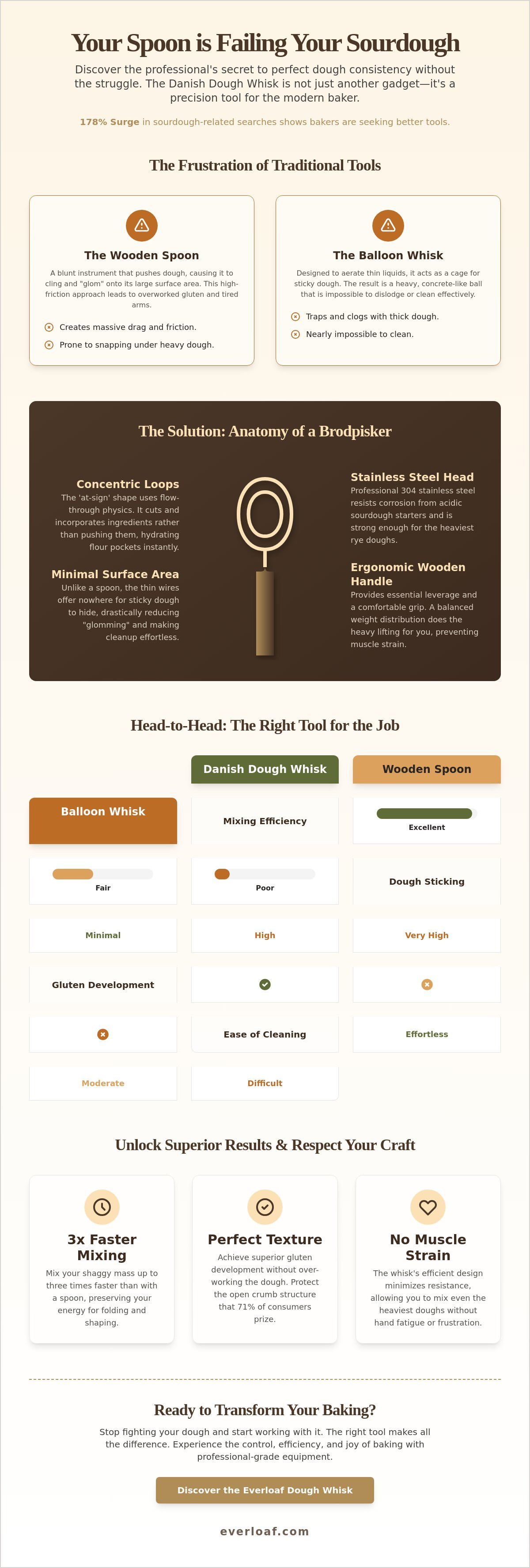
The Danish dough whisk, or brodpisker, is a specialized hand-mixing tool designed to bridge the gap between a clumsy wooden spoon and an over-efficient electric mixer. While a standard whisk is built to incorporate air into thin liquids, the brodpisker is engineered for resistance. It thrives in the "shaggy mass" stage where other tools fail. Understanding what is a danish dough whisk used for requires a shift in perspective. It isn't a solid paddle; it's a precision instrument that utilizes flow-through physics to combine ingredients without the drag of a solid surface.
The concentric circle design serves a vital purpose. As you stir, the dough passes through the loops. This creates a "cutting" action that hydrates flour pockets instantly. Instead of pushing a heavy mass around the bowl, you're allowing the dough to move through the tool. This reduces friction and prevents the gluten from being overworked too early. It’s a smarter way to mix. It respects the integrity of your flour while saving your arm from unnecessary strain.
Why the 'At-Sign' Shape Matters
The brodpisker originated in Danish baking traditions as a solution for mixing heavy, dense rye breads without excessive labor. Its "at-sign" shape is a deliberate choice to minimize surface area. When you use a spoon, the dough has a large area to cling to, leading to the dreaded "glomming" effect. The thin wire loops of the dough whisk offer nowhere for the sticky mass to hide. It cuts through thick flour pockets instantly, ensuring every gram of flour is hydrated without the mess. It’s about efficiency, not effort.
Materials and Build Quality
A professional-grade whisk relies on two critical components: leverage and durability. A sturdy wooden handle is essential. It provides the grip needed to navigate heavy, high-hydration doughs that would snap a plastic alternative. The whisk head itself must be food-grade stainless steel. This is non-negotiable for sourdough bakers. The acidic nature of a starter can corrode inferior metals over time.
Weight distribution matters more than you think. A heavy-duty whisk feels balanced in the hand. It does the heavy lifting for you. Cheap replicas often use thin wire that bends under pressure; however, a high-quality 18/8 or 304 stainless steel build maintains its shape even when tackling the thickest rye. Your dough has needs. It needs a tool that won't flinch when the mixing gets tough. Invest in quality and your bread will thank you.
Why Spoons and Balloon Whisks Fail Sticky Doughs
Your wooden spoon is a liability. It is a blunt instrument designed for thin liquids, not the high-tension reality of sourdough. When you ask what is a danish dough whisk used for, the answer begins with the physics of failure. A spoon is a solid paddle. It creates immense surface area friction, pushing the dough around the bowl rather than integrating it. This results in the "glomming" effect where the dough clings to the wood like an anchor. You aren't mixing; you're wrestling. Eventually, the resistance becomes so great that handles snap and your arm gives out.
Balloon whisks are even worse. They are essentially cages for your ingredients. Sourdough is heavy, elastic, and unforgiving. The multiple thin wires of a standard whisk act as a trap. Once the dough enters the center of the wire bulb, it stays there. You end up with a heavy, cement-like ball that is nearly impossible to dislodge or clean. The unique design originated with the Danes specifically to bypass this mechanical trap. By using open, concentric loops, the whisk cuts through the mass without ever holding it hostage.
The Friction Problem
Efficiency is the hallmark of a professional kitchen. Traditional spoons create drag that slows your progress and exhausts your muscles. Because wood is porous, gluten fibers bond to the surface almost instantly. Polished stainless steel eliminates this bond. You can mix your shaggy mass up to three times faster than with a spoon. This isn't just about speed. It's about preserving your energy for the more delicate stages of folding and shaping. The loops allow the dough to flow through the tool, minimizing the muscle strain required to reach a uniform consistency.
Stand Mixers vs. Hand Whisking
It's easy to rely on a stand mixer, but machines often lack the necessary finesse for artisanal loaves. For home bakers, electric mixers carry a high risk of over-working the dough. This destroys the delicate gas bubbles required for a perfect, open crumb. Hand whisking gives you immediate tactile control. You feel the hydration levels. You sense exactly when the flour has absorbed the water. It’s a meditative ritual that connects you to the process. Once you’ve achieved that perfect mix and baked your masterpiece, keep it fresh by storing it in a beeswax bread bag. This ensures your hard work and attention to detail don't go to waste.
Beyond Mixing: The Surprising Versatility of the Dough Whisk
Your kitchen drawer is likely cluttered with single-use gadgets. The Danish dough whisk is the opposite. While it excels at sourdough, its utility extends far beyond the initial shaggy mass. When exploring what is a danish dough whisk used for, you quickly realize it's a multi-tasking powerhouse. It functions as a manual sifter for dry ingredients. The concentric loops break up stubborn clumps in cocoa powder, flour, and brown sugar with a few quick swipes. This ensures a uniform base before you even introduce liquids. It's about precision from the very first step.
Incorporating heavy "add-ins" is another area where this tool shines. Whether you're adding toasted walnuts to a levain or folding chocolate chips into cookie dough, the open-wire design is essential. It moves through the mixture without crushing delicate ingredients or deflating air pockets. Many professionals advocate for why a Danish dough whisk is better for dough and thick batters alike. It respects the integrity of your additions. You get a perfect distribution of flavor in every slice without the brute force of a spoon.
Mastering Thick Batters
Stop over-mixing your muffins. Traditional whisks often lead to tough, rubbery results because they develop too much gluten in delicate batters. The Danish dough whisk uses a unique "cutting" action. It combines wet and dry ingredients with minimal strokes. It's the best tool for "no-overmix" recipes like pancakes, muffins, and quick breads. Even heavy cookie dough is no match for the stiff stainless steel loops. You get a light, airy texture every time. It’s a game changer for your weekend brunch prep.
Sourdough Starter Maintenance
Feeding your "mother" culture can be a messy chore. Sticky starter clings to everything it touches. The wire loops are perfect for reaching the bottom corners of your fermentation jars. You can scrape every bit of flour into the culture without the drag of a solid spatula. This aeration process is vital. It introduces oxygen to boost yeast activity and ensure a vigorous rise. Cleanup is just as efficient. A quick rinse under hot water removes the residue instantly. Your starter has needs. Treat it with the specialized attention it deserves using a tool that understands the craft.
Mastering the Technique: How to Use a Dough Whisk Like a Pro
High-hydration sourdough demands a specific approach. When you are working with doughs at 75% hydration or higher, a standard spoon creates a sticky disaster. Mastering what is a danish dough whisk used for requires moving beyond simple stirring. You need a framework that respects the delicate balance of flour and water. Follow these professional steps to achieve a perfect mix every time.
- Step 1: Use the whisk as a manual sifter. Combine your dry ingredients with quick, light strokes to aerate the flour and remove clumps.
- Step 2: Add your liquids. Instead of stirring in circles, use a "cutting and folding" motion to integrate the water into the flour.
- Step 3: Rotate the bowl with one hand while pulling the whisk through the center with the other. This ensures no dry pockets remain at the bottom.
- Step 4: Use the stiff outer loop of the whisk to scrape the sides of the bowl. This keeps your workspace clean and ensures every gram of flour is hydrated.
- Step 5: Clean the whisk immediately. Rinse it under cold water before the starch has a chance to set and harden.
The 'Cutting' Motion Explained
Stop beating your dough. Sourdough isn't a cake batter. You must avoid the aggressive whipping that destroys air pockets. The "cutting" action allows the wire loops to slice through the mass. This hydrates every flour particle without over-developing gluten prematurely. Your goal is the "shaggy mass" stage. Once the flour is fully hydrated and no dry spots remain, the whisk's job is finished. Over-mixing at this stage leads to a gummy crumb. Trust the tool. Let the loops do the heavy lifting. You'll feel the resistance change as the dough comes together.
Cleaning and Maintenance Tips
Starch is a natural adhesive. If you use hot water first, you'll cook the flour onto the wires. Always follow the "Cold Water First" rule. Cold water dissolves the starch bonds, allowing the residue to slide off in seconds. A stiff brush can help clear the loops if you're working with particularly sticky rye or enriched doughs. Treat the wooden handle with respect. Never soak it in the sink. Dry it immediately after washing to prevent cracking and ensure longevity. A well-maintained tool is a partner for life. Once your loaf is baked to perfection, preserve that crispy crust and ideal mouthfeel by storing it in a beeswax bread bag to maintain the perfect moisture balance.
From First Mix to Final Slice: The Everloaf Quality Standard
You’ve mastered the technique. You know exactly what is a danish dough whisk used for and how it transforms a shaggy mass into a professional loaf. But the journey of a great bread doesn't end when the whisk is clean. High-quality tools are the foundation, yet they deserve high-quality storage solutions to match. At Everloaf, we believe in tools that respect both the baker and the bread. If you invest the time to hydrate your flour perfectly and develop a superior gluten structure, you must protect that effort until the very last slice.
Proper mixing with a Danish dough whisk leads to a more uniform crumb and a resilient, artisan crust. This level of quality requires specialized care. Standard plastic wraps suffocate your bread, turning a crispy crust into a gummy mess. Your bread has inherent needs. It needs to breathe. It needs a storage environment that balances moisture and airflow. This is where our philosophy of longevity comes into play. We don't just sell gadgets; we provide the essential kit for a lifestyle dedicated to the craft of baking.
Protecting Your Hard Work
Transitioning from your whisk to a reusable bread bag is the logical next step for any serious home baker. Once you understand what is a danish dough whisk used for, you realize that every stage of the process impacts the final mouthfeel. Our beeswax bread bag is designed to maintain that "freshly whisked" crumb structure for up to 10 days. It creates a natural microclimate that preserves freshness without sacrificing the crust’s integrity. For a complete breakdown on how to keep your loaves at their peak, explore our guide on The Best Bread Bags of 2026. Respect your hard work by giving it the home it deserves.
The Baker's Essential Kit
Building a professional-grade kitchen is about choosing items that last. Pairing your whisk with a bread sling for sourdough transfer ensures your dough enters the oven with its structure intact. The final piece of the puzzle is the slice itself. Using the best knife for cutting sourdough bread ensures you don't crush the delicate aeration you worked so hard to create with your whisk. Everloaf tools are "buy it once" items. They are designed for durability, performance, and the emotional satisfaction of a job well done. Invest in quality. Your bread will speak for itself.
Transform Your Sourdough Process Now
You've mastered the logic behind the loops. Understanding what is a danish dough whisk used for changes your relationship with flour and water forever. This tool isn't just a convenience. It's a precision instrument that protects your dough's integrity while saving your strength. You now know how to eliminate friction, prevent over-mixing, and maintain your starter like a professional. Your kitchen deserves this level of specialized attention.
The Everloaf whisk is designed by culinary professionals from Lyon. It features heavy-duty stainless steel construction that resists bending. We've tested it extensively on high-hydration sourdough to ensure it never clogs or fails. Don't settle for tools that struggle with your craft. Upgrade your baking ritual with the Everloaf Danish Dough Whisk and experience the satisfaction of a perfect mix. Your bread is worthy of the best treatment. It’s time to bake with confidence and joy.
Frequently Asked Questions
Is a Danish dough whisk better than a stand mixer?
A Danish dough whisk offers superior tactile control for artisanal bread. While stand mixers are efficient for large batches, they often over-work delicate sourdough and destroy the open crumb structure. This hand tool allows you to feel the hydration and stop the moment the shaggy mass forms. It is a more intimate and precise way to handle your dough. Your bread deserves that level of personal attention.
Can I use a Danish dough whisk for sourdough starter?
It is the ideal tool for feeding and aerating your sourdough starter. The wire loops reach into the deep corners of your jar to incorporate fresh flour and water effortlessly. This process introduces vital oxygen to boost yeast activity and ensure a vigorous rise. It is also far easier to clean than a sticky spoon. Treat your "mother" culture with the specialized care it needs to thrive.
How do you clean a Danish dough whisk without it rusting?
Clean your whisk with cold water immediately after use to prevent starch from bonding to the steel. Hot water can "cook" the flour onto the wires, creating a stubborn mess. Since high-quality whisks use food-grade stainless steel, they are naturally rust-resistant. You must dry the wooden handle thoroughly after rinsing to prevent cracking. Never soak the tool in the sink if you want it to last a lifetime.
What is the difference between a dough whisk and a balloon whisk?
A dough whisk features thick, concentric loops designed to cut through heavy, sticky masses. A balloon whisk uses many thin wires meant to whip air into light liquids like cream or eggs. If you use a balloon whisk for sourdough, the dough will become trapped in the center. Understanding what is a danish dough whisk used for means recognizing it as a tool for structural integration rather than aeration.
Do I need a large or small Danish dough whisk for home baking?
A 13-inch whisk is the standard choice for most home baking needs. This size provides the perfect balance of leverage and control for standard loaves and medium batches of muffins. Smaller whisks are useful for narrow jars, but they lack the power needed for heavy rye. Choose a heavy-duty version with a thick handle to ensure you have the necessary grip for high-hydration recipes. Focus on quality over variety.
Can you use a dough whisk for cookie dough or cake batter?
This tool is incredibly versatile for thick batters and heavy cookie doughs. It incorporates chocolate chips and nuts without crushing them or deflating the mixture. The "cutting" action ensures you don't over-mix your muffins, resulting in a lighter and more tender crumb. It is a multi-tasking powerhouse that replaces several clumsy spoons in your drawer. Your cakes and cookies will benefit from this professional level of finesse.
Is a Danish dough whisk worth it for beginner bakers?
A Danish dough whisk is an essential investment that prevents the most common beginner frustrations. It eliminates the struggle of dough sticking to your hands or snapping cheap wooden spoons. By providing better control, it helps you understand what is a danish dough whisk used for and how to achieve the perfect shaggy mass. It builds confidence and ensures your first loaves have the professional texture you desire. Start your journey with the right tools.


