

Your sourdough is a structural masterpiece, but your kitchen drawer might be hiding its greatest enemy. Most home bakers settle for a standard serrated blade, only to watch their airy crumb collapse under the pressure. To preserve that hard-earned texture, you need the best knife for cutting sourdough bread. It's not just a utensil; it's a specialized saw designed to respect the life inside your loaf. A proper blade understands that a crusty boule requires precision, not brute force.
We know the frustration of a blade slipping off a thick, caramelized crust or knuckles painfully hitting the cutting board. You've spent days nurturing your starter, and it's time your equipment matched your dedication. You deserve a tool that glides through the toughest exterior with zero effort. In this professional guide, you'll discover the exact blade geometry and technical features needed to achieve clean, uniform slices every time. We'll preview the top 2026 picks and explain why a 10-inch high-carbon steel blade is the essential standard for keeping your crumb delicate and your crusts crisp for years to come.
Key Takeaways
- Respect your bake by using a blade that slices through the "ear" without crushing the airy crumb you worked so hard to create.
- Learn why 10-inch blades and aggressive pointed serrations are the secret to finding the best knife for cutting sourdough bread.
- Invest in high-carbon stainless steel to ensure your tools stay sharp and resist rust through years of daily slicing.
- Master the professional "sawing" technique and the golden rule of waiting two hours before making your first cut.
- Meet The Sourdough Knife, our specialized tool crafted specifically to handle the most stubborn, caramelized crusts with ease.
Why Sourdough Demands a Specialized Bread Knife
Your sourdough is a labor of love. You've spent days nurturing a starter and hours monitoring bulk fermentation. To attack that beautiful boule with a dull, standard kitchen knife isn't just a mistake; it's an insult to your craft. Sourdough presents a unique structural challenge. You have a thick, caramelized crust on the outside and a delicate, high-hydration crumb on the inside. Without the best knife for cutting sourdough bread, you risk turning your masterpiece into a squashed, mangled mess. It deserves better treatment.
The "ear" of the bread, that signature ridge created during the score, is often the hardest part to penetrate. A mediocre blade will slip right off this hardened surface. When a knife fails to bite into the crust immediately, you're forced to apply downward pressure. This pressure leads to "crumb compression." Instead of a light, airy mouthfeel, you get a dense, gummy texture where the beautiful alveoli have been crushed into oblivion. You want to slice fibers, not tear them. Understanding the difference is vital for any serious baker:
- Tearing: Occurs when a dull or straight blade pulls at the gluten network, creating a shaggy, uneven surface and a collapsed interior.
- Slicing: Occurs when sharp, aggressive serrations "saw" through the crust and crumb with minimal friction, preserving the bread's internal architecture.
The Battle Between Hard Crust and Airy Crumb
Artisan sourdough is a study in contrasts. The crust is often baked at high temperatures, sometimes reaching 250 degrees in a Dutch oven, which creates a rigid, glass-like exterior. Inside, the crumb might have 75% hydration or higher. This creates immense tension. If you press down, you destroy the internal architecture. Successful slicing relies on maintaining surface tension. You need a blade that acts as a precision saw, removing micro-layers of crust without disturbing the fragile bubbles of the interior. Finding the best knife for cutting sourdough bread is about more than just sharpness; it's about the physics of the serration. It ensures every slice remains uniform and beautiful.
Why Your Chef’s Knife is Ruining Your Loaf
A straight-edge chef's knife relies on a "push-cut" or "draw-cut" motion. While this works for onions, it's a disaster for high-silica sourdough crusts. Looking back at the history of the bread knife, it's clear that serrations were developed specifically to solve this physics problem. A straight blade lacks the "teeth" needed to grab onto a rounded, slippery boule. Honing your chef's knife won't help here. The crust is simply too hard for a smooth edge to find purchase. This leads to dangerous slips that put your fingers at risk. You don't need more force; you need the right geometry. Our community knows that using the wrong tool is a safety hazard and a culinary crime. Respect the bake and use a tool designed for the job.
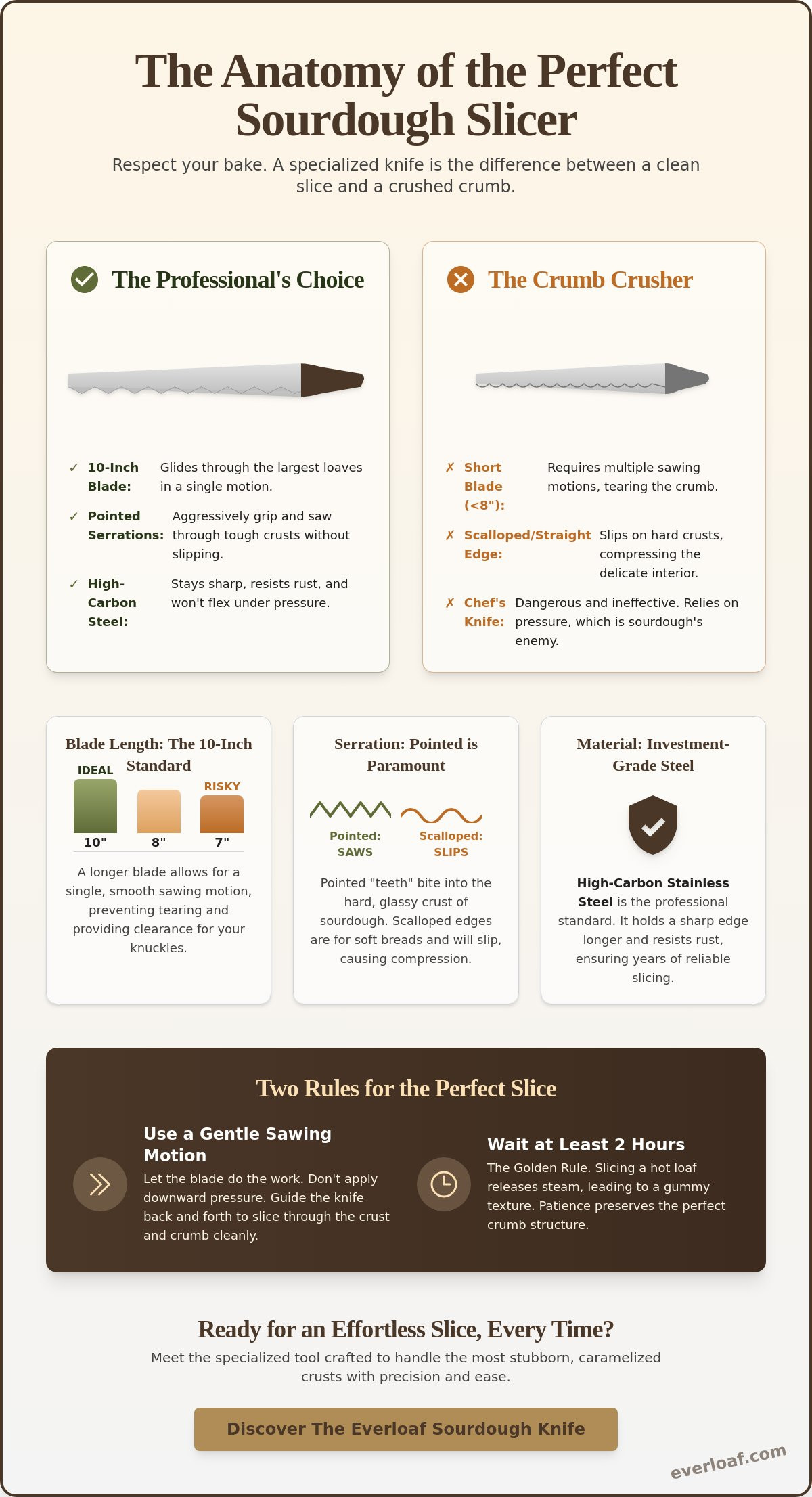
The Anatomy of the Perfect Sourdough Slicer
A blade is more than just a piece of metal. It's a specialized instrument. When you're searching for the best knife for cutting sourdough bread, you must examine the engineering behind the edge. Every tooth and every curve serves a purpose. High-quality sourdough requires a tool that respects its structure. If the anatomy is wrong, the experience fails. It's that simple. Professionals look for specific markers that separate a generic bread knife from a true sourdough slicer.
One often overlooked feature is the "gullet." This is the curved space between the teeth. As you saw through a thick crust, the gullet acts as a clearing house. It catches and removes crumbs from the cutting path. Without a deep enough gullet, the blade becomes clogged. This increases friction and heat, which can actually change the texture of the slice. A clean cut requires clear teeth. Precision engineering ensures that the blade stays efficient from the first slice to the last. Your bread deserves this level of technical attention.
Serration Geometry: Pointed vs. Scalloped
Not all serrations are equal. Pointed serrations are the heavy hitters. They act like a saw, biting into the hardest "ear" with zero hesitation. Scalloped serrations look like gentle waves. These are fine for soft brioche or store-bought white bread. They fail miserably on a crusty boule. You need the aggressive grip of pointed teeth to break the surface tension. Serration pitch, defined as the distance between tooth peaks, also matters. A wider pitch allows for a more aggressive cut through dense artisan loaves. Finding the best knife for cutting sourdough bread means choosing teeth that can handle the bite.
Blade Length and the 10-Inch Standard
Size matters in the bakery. A short knife is a recipe for disaster. If your blade is only 7 or 8 inches, you'll need dozens of short, choppy strokes. This leads to uneven "staircase" slices. A 10-inch blade is the professional standard for a reason. It allows you to span the entire diameter of a large boule. You want to achieve the "One-Stroke" ideal. Long, smooth motions preserve the crumb's integrity. Match your blade to the size of your largest proofing basket. Once you've mastered the perfect slice, keep your hard work soft by using breathable beeswax cotton bread bags to maintain that ideal texture.
Finally, consider blade thickness. A blade that is too thin will flex and wander. This creates slanted slices that look unprofessional. A sourdough knife needs enough stiffness to handle a high-silica crust but enough taper for precision. It's a delicate balance. The right thickness provides the power needed to drive through the bottom crust without slipping. Don't settle for flimsy tools when your craft demands strength.
Comparing Blade Materials and Handle Ergonomics
Steel and grip define the tool's soul. When you're hunting for the best knife for cutting sourdough bread, you aren't just looking for a sharp edge. You're looking for a partner that survives the abrasive nature of high-silica crusts. Sourdough is tough on metal. It demands materials that hold their ground slice after slice. If your knife feels flimsy or dulls after a week, it's failing its duty to your bake. Professional quality starts with the composition of the blade itself.
Weight and balance are equally critical. A well-balanced knife feels like an extension of your arm. We recommend full-tang construction, where the steel extends through the entire length of the handle. This provides the structural integrity needed for heavy artisan loaves. A front-heavy or poorly balanced blade forces you to work harder. With a full-tang, weighted handle, you let gravity do the heavy lifting. The knife drives itself through the bottom crust. Your hands stay fresh, even after slicing for a crowd.
High-Carbon Stainless Steel: The Baker’s Choice
Standard stainless steel is often too soft for serious crusts. It loses its "bite" quickly. High-carbon stainless steel is the professional sweet spot. It offers superior edge retention while remaining resistant to rust. Look for a Rockwell Hardness (HRC) rating between 56 and 58. This ensures the teeth stay sharp without becoming too brittle to saw. Respect the metal by keeping it out of the dishwasher. The high heat and harsh chemicals are blade killers. They ruin the temper of the steel and crack the handle. Hand wash and dry your knife immediately to preserve its longevity for years.
Offset vs. Straight Handles: Saving Your Knuckles
Most people ignore handle geometry until their knuckles hit the cutting board. This "knuckle-banging" is the hallmark of a straight-handle design on a low-profile loaf. It's frustrating and ruins the final inch of your cut. An offset handle is the solution. It lifts your hand above the blade's edge, providing ample clearance. This design is the best knife for cutting sourdough bread for those who bake large, wide boules. It allows for a full, clean stroke without your fingers getting in the way. Choose a textured synthetic or treated wood grip. Flour-covered hands need a secure, non-slip surface to maintain control during aggressive sawing. Your safety and comfort are non-negotiable.
Synthetic handles offer incredible durability and hygiene. They don't absorb moisture or odors from the kitchen. Wood handles, while beautiful and warm, require more care. They need occasional oiling to prevent drying. Regardless of the material, the shape should feel natural. A contoured grip reduces hand fatigue and gives you the confidence to tackle the thickest, most caramelized crusts with ease. Your bread deserves a tool that feels as good as it looks.
Professional Slicing Techniques for Artisan Loaves
Patience is the final ingredient in every great bake. You've spent hours monitoring the proof; don't ruin it in seconds with an early cut. The Golden Rule of sourdough is simple: wait at least two hours before the first slice. Cutting into a hot loaf releases steam too quickly. This results in a gummy, wet interior that never fully sets. Let the starches finish their work. Your patience will be rewarded with a perfect, resilient crumb that holds its shape under the blade.
Choosing the right angle depends on your loaf's shape. For a round boule, start from the center and work outward for large, impressive slices. For a long batard, a slight diagonal bias increases the surface area of each piece. This is where having the best knife for cutting sourdough bread truly pays off. A superior tool allows you to maintain a consistent angle through the entire depth of the loaf. It eliminates the sloping, uneven cuts that make toast difficult to manage.
The Sawing Motion: Let the Blade Do the Work
Stop pushing. Start sawing. Artisan crust is designed to be tough, but it's no match for proper technique. Use the full length of your blade in long, fluid strokes. Let the serrations find their own path through the caramelized exterior. When you "push" a knife, you aren't slicing; you're crushing. Pushing causes the crust to shatter into shards rather than parting cleanly. This ruins the visual appeal and compresses the delicate air pockets inside. The knife is a saw, not a wedge. Zero downward pressure is the goal for maximum crumb integrity.
Slicing for Longevity: Keeping the Crumb Fresh
A clean cut is your first line of defense against staleness. Ragged, torn edges increase the surface area exposed to oxygen. This causes the bread to dry out at an accelerated rate. A perfectly flat, smooth slice creates a tighter seal when you store the loaf. You can use a clean slice to maximize the seal of The beeswax Bread Bag. By reducing air gaps, you keep the moisture where it belongs: inside the crumb. Learn more about how to store homemade bread to ensure your hard work stays delicious for days.
Once you've mastered the sawing motion, you'll notice a dramatic difference in how your bread handles. Clean slices don't just look better; they stay fresher. When you use the best knife for cutting sourdough bread, you're investing in the longevity of every loaf. Don't let a dull blade or poor technique cut your enjoyment short. Treat your bread with the reverence it deserves. Keep your slices uniform and your crusts intact by choosing the ultimate beeswax bread bag for your storage needs.
The Everloaf Sourdough Knife: Crafted for the Craft
Generic knives fail because they don't respect the bread. We spent months watching bakers struggle with dull serrations and crushed crumbs. It was time for a change. That's why we created The Sourdough Knife. It's not just another kitchen tool. It's a specialized instrument built specifically for the rigors of artisan baking. We designed it to be the best knife for cutting sourdough bread for those who refuse to settle for compromised texture. Your bread deserves a blade that understands its soul.
The 10-inch high-carbon blade provides the reach and strength required for massive boules. We chose aggressive, pointed serrations because they act like a professional saw. They bite into the thickest crust instantly. This prevents the blade from slipping and keeps your knuckles safe. We didn't stop at the steel. The ergonomic handle is designed for the home baker’s comfort. It provides a secure, non-slip grip even when your hands are covered in flour. This is a tool built to last a lifetime of Sunday morning bakes. It's an investment in your craft.
Why We Designed a Knife Specifically for Sourdough
Our design journey began in Lyon. We were inspired by traditional French craftsmanship but knew we needed American durability. We merged these worlds. Every blade was tested against the hardest, most caramelized crusts we could bake. We ensured zero crushing and zero slipping during every trial. This knife treats your bread with reverence. It is the perfect companion to our signature beeswax bread bags. When you use a tool designed for the job, the difference is immediate. You'll feel the confidence in every stroke.
Completing Your Sourdough System
The right knife is the first step in the Everloaf freshness ecosystem. You've worked hard for that loaf. Now, you must protect it. Pairing your knife with our beeswax bread bag ensures total loaf care from the first slice to the last toast. A clean, professional cut allows for a better seal. A better seal keeps your sourdough fresh for up to 10 days. It's a complete cycle of respect for the bake. This is the best knife for cutting sourdough bread because it's part of a larger commitment to quality.
Don't let a subpar blade ruin your hard work. Experience the difference of a tool made by bakers, for bakers. It's time to stop fighting your crust and start enjoying it. Your kitchen is your sanctuary; fill it with tools that match your passion. Upgrade your kitchen with the Everloaf Sourdough Knife and reclaim the joy of the perfect slice today.
Master the Art of the Perfect Slice
Your sourdough is a masterpiece that deserves a respectful finish. You've learned how specialized serration geometry and 10-inch blade lengths prevent crumb collapse. High-carbon steel remains the only material tough enough to handle a caramelized crust without dulling. Don't let a generic blade ruin days of hard work. Choosing the best knife for cutting sourdough bread is the final step in honoring your craft. It ensures every slice is as beautiful as the loaf itself.
Our tools are designed by culinary professionals from Lyon to bring European precision to your home kitchen. With high-carbon stainless steel for lifetime durability; it's no wonder thousands of home bakers across the US trust us with their bakes. We treat your bread with the reverence it deserves. Keep your kitchen standards high and your crumb structure intact. Join our community of enthusiasts and experience the difference of a tool made for the craft. Shop the Everloaf Sourdough Knife and Bread Bag Collection today. Your perfect slice is waiting. Happy baking!
Frequently Asked Questions
Can I sharpen a serrated bread knife at home?
You cannot sharpen a serrated bread knife using traditional flat whetstones or pull-through sharpeners. Each individual tooth requires a specialized ceramic honing rod that matches the specific diameter of the serrations. It is a meticulous process that many find difficult to master. Most enthusiasts prefer to invest in a high-quality high-carbon blade that maintains its aggressive bite for years without needing professional intervention.
What is the best blade length for a sourdough bread knife?
A 10-inch blade is the professional standard for the best knife for cutting sourdough bread. This length provides the necessary span to cross a large artisan boule in a single, fluid motion. Shorter blades force you to use choppy, repetitive strokes that mangle the delicate crumb structure. A 10-inch blade offers the leverage and efficiency needed to respect the life of your loaf.
Is an offset bread knife better than a straight one?
An offset bread knife is vastly superior for cutting wide artisan loaves because it protects your knuckles. The handle is elevated above the blade's spine, which ensures your hand never hits the cutting board during the final inch of the cut. This design allows for a full, clean stroke. It provides better visibility and control, ensuring your slices remain uniform from top to bottom.
Why does my bread knife tear the bread instead of slicing it?
Your knife is tearing the bread because the serrations are either too dull or too shallow to grip the crust. Sourdough requires aggressive, pointed teeth to pierce the caramelized exterior without slipping. If the blade is insufficient, it pulls at the gluten fibers instead of severing them cleanly. This creates a shaggy appearance and destroys the beautiful internal architecture you worked so hard to develop.
Do I really need a separate knife just for sourdough?
You absolutely need a specialized tool if you want to preserve the integrity of your artisan bakes. Standard kitchen knives or scalloped bread knives are designed for soft, store-bought loaves and will collapse under the pressure of a 250-degree crust. A dedicated sourdough knife uses specific geometry to respect the bake. It is the only way to achieve professional results without crushing your delicate crumb.
How do I clean my bread knife to prevent rust?
Hand wash your knife with warm, soapy water and dry it immediately with a soft cloth. High-carbon stainless steel is incredibly durable but remains susceptible to spotting if left in a damp sink. Never put your specialized tools in the dishwasher. The extreme heat and harsh detergents will ruin the steel's temper and damage the handle. Proper care ensures your blade remains a faithful companion for a lifetime.
Can I use an electric knife for sourdough bread?
Electric knives are not recommended for artisan sourdough because they lack the necessary precision. The rapid vibration of the blades often shatters the caramelized crust and compresses the airy interior. You lose the tactile feedback required to navigate the tension between a hard crust and a high-hydration crumb. A manual 10-inch serrated blade gives you the control needed to keep your slices perfect and intact.
What is the difference between pointed and scalloped serrations?
Pointed serrations act like a precision saw to pierce the hardest "ear" of a sourdough boule. They are the essential feature of the best knife for cutting sourdough bread. Scalloped serrations are rounded and gentle, making them ideal for soft cakes or brioche. On a crusty sourdough, scalloped blades will slip across the surface, forcing you to apply dangerous downward pressure that ruins the loaf's texture.


