

Your sourdough isn't just bread; it's a living masterpiece that deserves a breathable home instead of a plastic coffin. You've spent hours perfecting that crumb only to watch it go stale in forty-eight hours. It's frustrating. You want a kitchen that respects your craft and the planet, but low-quality alternatives leave behind nothing but sticky residues and broken promises. We understand that your hard work deserves better care.
Using a high-quality bees wrap food wrap transforms your storage from a chore into a preservation science. These wraps act like a natural biological rind, protecting your food while letting it breathe. In this 2026 guide, you'll discover how to keep your bread fresh for over seven days and finally achieve a plastic-free kitchen. We will cover everything from meeting new 2026 environmental regulations to the simple care routine that ensures your wraps stay perfect for a full year. It's time to stop settling for waste and start investing in the longevity your food deserves.
Key Takeaways
- Discover how organic cotton and tree resin create a living barrier that outperforms synthetic alternatives.
- Stop wasting money on plastic and see why one bees wrap food wrap provides a superior return on your kitchen investment.
- Eliminate the "Seal Gap" in your bread storage by transitioning from flat wraps to specialized beeswax bags.
- Protect your tools with the "Cold Water Rule" to ensure your storage solutions last for a full year of use.
- Upgrade your baking craft with professional-grade storage designed specifically for the needs of artisan loaves.
What is Bees Wrap Food Wrap? The 2026 Natural Standard
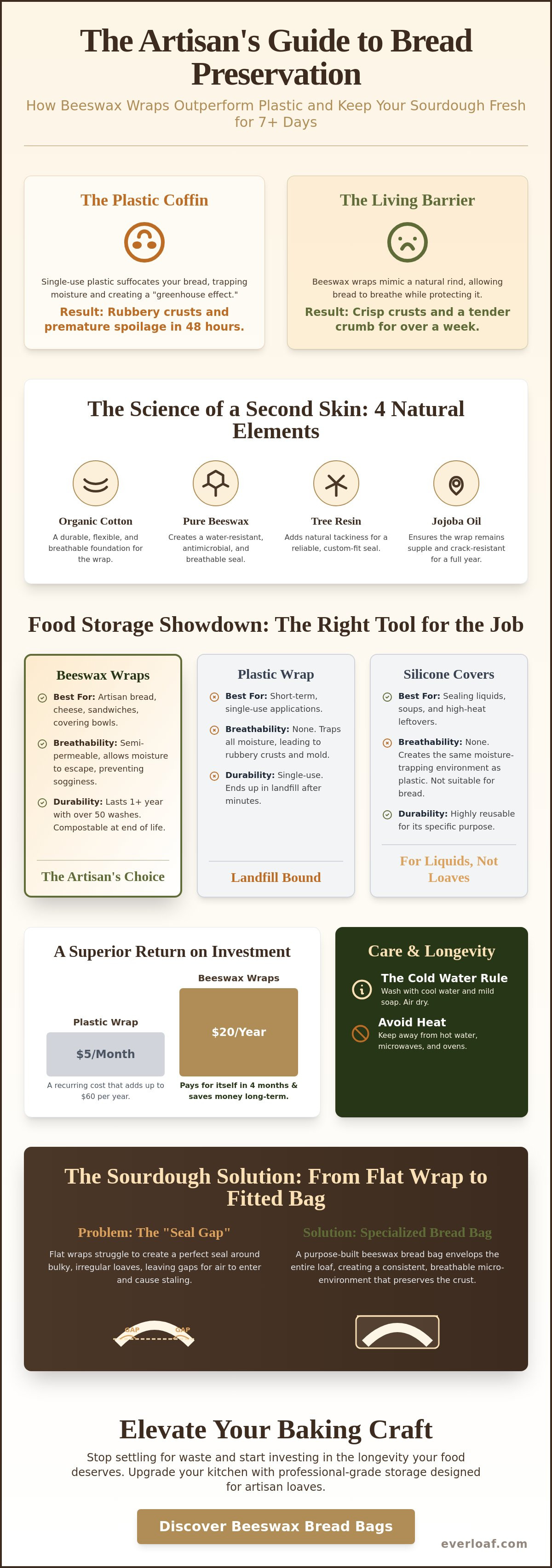
Plastic wrap is a failure of imagination. It is a thin, suffocating sheet that traps moisture and kills the very food you worked so hard to create. By 2026, the world has finally caught up to what artisan bakers have always known. We need a living barrier. A high-quality bees wrap food wrap isn't just a cover; it's a second skin for your ingredients. It mimics the protective properties of a natural rind or a honeycomb. This allows your food to exist in its natural state without the chemical interference of single-use plastics.
This evolution in storage relies on a precise synergy of four natural elements. Organic cotton provides a durable, flexible foundation. Pure beeswax and tree resin create a tacky, reliable seal that responds to the warmth of your hands. Finally, jojoba oil ensures the wrap remains supple and crack-resistant over hundreds of uses. As states like Illinois and Maine enforce strict bans on PFAS in food packaging in 2026, this Beeswax wrap technology has become the gold standard for every design-conscious kitchen. It's a professional tool for a professional result.
The Science of Breathability: Why It Matters
Food needs to breathe. When you seal leftovers or dough in plastic, you create a greenhouse effect that invites mold and mushy textures. The semi-permeable nature of wax allows for a controlled exchange of gases. It lets excess moisture escape while retaining enough hydration to prevent drying. Pure beeswax also brings natural antimicrobial properties to the table, fighting off the bacteria that cause premature spoilage. Retrogradation is the chemical process where starch molecules in bread crystallize and expel water to cause staling; our wax barrier slows this migration significantly to keep your loaves tender. It's science, not just tradition.
Why Your Sourdough Deserves a Better Barrier
Your sourdough is alive. It has a biological rhythm that doesn't stop once it leaves the oven. To maintain that signature crisp crust and airy crumb, you need a storage solution that respects its specific humidity needs. Airtight plastic is the primary cause of "rubbery crust" syndrome. It traps steam against the surface, turning a beautiful bake into a chewy mess. Our beeswax bread bag provides the airflow required to protect the crust's integrity while shielding the interior. Treat your bake with reverence. Don't suffocate it in a bag that wasn't built for the craft.
Comparing Food Storage: Why Beeswax Wins Over Plastic
Plastic wrap is not convenient. It is a frustrating, tangled mess that sticks to itself better than it sticks to your food. We have been told for decades that single-use plastic is the easy choice. It's a lie. A high-quality bees wrap food wrap offers a superior tactile experience that plastic can never replicate. There is no chemical smell. There is no struggle with a serrated cardboard edge. Instead, you get the warm, natural scent of honey and a material that responds to the heat of your own hands. It turns a chore into a moment of connection with your ingredients.
The math also favors the specialist. A single roll of premium plastic wrap might cost five dollars and last a month. A twenty-dollar investment in a set of beeswax wraps lasts a full year. By the time you reach month four, the beeswax has already paid for itself. This isn't just about saving money; it's about investing in a tool that actually works. An environmental impact study from the University of Michigan confirms that reusables are the clear winner for the long-term health of our planet. You get better food, a better experience, and a cleaner conscience.
Bees Wrap vs. Plastic Wrap vs. Silicone
Choose the right tool for the job. Silicone covers are excellent for sealing liquids or high-heat leftovers. However, they fail your bread. Silicone is entirely non-porous. It creates the same moisture-trapping environment as plastic. Your crusty artisan loaves need the semi-permeable seal that only wax can provide. Plastic wrap relies on weak static cling. Beeswax wraps use the physical warmth of your palms to create a custom, airtight bond. If it has a crust, use wax. If it's a bowl of soup, use silicone. If it's destined for a landfill, keep using plastic.
Durability and Longevity: The 12-Month Promise
A professional-grade wrap is built to endure. You should expect over fifty washes from a single sheet without losing its tacky grip. You will notice the fabric getting softer over time. This is a sign of a well-loved tool, not a failure. When the wax eventually begins to flake after a year of heavy use, you can simply compost the cotton. For those handling large artisan loaves daily, reusable bread bags for homemade bread offer even greater durability and surface area. They provide the same biological protection in a format designed for the serious baker. Upgrade your kitchen with our beeswax cotton bread bags to experience this longevity firsthand.
The Sourdough Challenge: Standard Wraps vs. Specialized Bags
Stop wrestling with your bread storage. Using a standard bees wrap food wrap is a beautiful experience for small items like cheese or a half-cut avocado. However, when you try to force a flat sheet around a rustic sourdough boule, you're fighting a losing battle. The stiff nature of the wax makes it difficult to contour around the irregular, high-domed shapes of artisan bakes. You end up with a bulky, unfolding mess that takes up too much space in your bread box. Your bread deserves a solution that fits its form, not a compromise that leaves it exposed.
This struggle leads to the "Seal Gap." This is the localized staling that happens when air finds a way through the inevitable folds and tucks of a flat wrap. A high-quality bees wrap food wrap should simplify your life, not complicate it. No matter how much you warm the wax with your hands, gravity and the bread's natural tension will eventually cause those folds to loosen. This is why we developed the beeswax bread bag. It is the logical evolution of the technology. It replaces the clumsy folding process with a pre-formed, structural home that surrounds your loaf with 360 degrees of protection.
Size Matters: Why 14x14 Isn’t Enough
Do the math before you wrap. A standard 1kg boule is roughly eight inches in diameter and four inches high. To fully encase this volume and create a secure, overlapping seal, you need significantly more surface area than a 14x14 inch sheet provides. When you try to make it work, you create air pockets. These pockets act as mini-environments where moisture escapes the crumb and settles on the crust, leading to that dreaded localized staling. Check our fabric bread bag guide to see how material volume impacts your crust's longevity. Don't let a lack of fabric ruin a forty-eight-hour ferment.
The "Orvix" Advantage: Engineering Freshness
The Orvix bag isn't just a container; it's a piece of baking history. We drew inspiration from the centuries-old baking traditions of Lyon, France, where bread is treated with a level of reverence rarely seen today. By utilizing a 100% organic cotton base and a specialized bag structure, we've eliminated the need for complex folding. You simply slide your loaf in and fold the top. This engineering ensures that every square inch of your crust is in contact with the protective wax barrier. It's a professional-grade home for your most prized bakes. Your sourdough worked hard to rise; give it a place where it can rest properly.
Maximizing Your Investment: Care and Longevity Tips
Your tools have needs. Treat them with reverence. A premium bees wrap food wrap is a long-term investment, not a temporary convenience. If you treat it like a professional instrument, it will reward you with a year of perfect freshness. Respect the craft of the wrap just as you respect the craft of your bake. This isn't a chore. It's a preservation ritual that honors the ingredients inside. A well-maintained wrap is a sign of a kitchen that values quality over waste.
Heat is the absolute enemy of your wrap's integrity. It melts the soul of the wax and resin, stripping the fabric of its protective power. Follow the Cold Water Rule without exception. Use cool or lukewarm water to rinse away crumbs or light residues. If you encounter stubborn spots, reach for a mild, alcohol-free dish soap. Harsh degreasers and alcohol-based cleaners will dissolve the tree resin, leaving your wrap lifeless and non-adhesive. Once cleaned, air dry it over a drying rack or a jar. Don't wring it out. Treat the fibers with care so they can continue to protect your food.
Storage dictates performance. Don't cram your wraps into a cluttered drawer where they can get creased or torn by other utensils. Store them flat in a dedicated tray or roll them loosely to maintain the wax's smooth, even surface. If you prefer folding, keep the folds light and vary them occasionally. This prevents the wax from cracking along permanent seams. A well-stored wrap is always ready for your next boule.
The 2026 Refresh Technique
Even the best tools get tired. If your wrap starts to lose its "tack" after several months of heavy use, don't throw it away. You can reset the wax in under five minutes. Place the wrap on a sheet of parchment paper in an oven set to the lowest possible temperature, ideally around 150°F. Watch it closely. As soon as the wax looks shiny and wet, pull it out and hang it quickly to cool. This redistributes the wax into the cotton fibers, extending its life for another season. When the fabric eventually becomes thin or won't hold a seal despite a refresh, it's time to retire it. Since our wraps are 100% organic cotton, you can simply cut them into strips and add them to your compost pile.
Avoiding Common Pitfalls
Know the limits of the material. Never use your wraps for raw meat or fish. The porous nature of the cotton can trap bacteria that cold water won't kill. Likewise, keep them away from the microwave, dishwasher, or hot leftovers. For daily bread handling, many enthusiasts find that cloth bread bags are easier to manage than flat wraps. They offer a simpler workflow for the constant "in and out" of your morning toast routine.
Keep this daily maintenance checklist in mind:
- Rinse with cold water only.
- Use gentle, eco-friendly soaps.
- Avoid all direct heat sources.
- Air dry completely before storing.
Protect your investment by choosing the right format for your needs. Upgrade your kitchen setup today with our beeswax cotton bread bags for the ultimate in artisan protection.
The Everloaf Advantage: Elevating Your Baking Craft
Everloaf is built by bakers. We understand the early mornings and the long ferments. We know the exact feeling of pulling a perfect boule from the oven. It's a labor of love. We believe that your storage should reflect that same level of dedication. A generic bees wrap food wrap is a useful tool for a modern kitchen. However, it was never designed for the unique challenges of artisan sourdough. Our beeswax bread bag is the logical conclusion for fans who treat their bread with reverence. It's a specialist tool for a specialist craft.
The Orvix line represents our commitment to your results. We don't just sell bags. We provide a system that keeps your loaves fresh for up to 10 days. This isn't just a marketing claim; it's an engineering standard. Every stitch of our 100% organic cotton and every gram of our specialized wax blend serves a purpose. When you choose Everloaf, you join a community of enthusiasts who share your passion. We respect the effort you put into your dough. We ensure that effort isn't wasted on a stale crust.
Beyond the Bag: The Complete Sourdough Kit
Storage is only one part of the preservation equation. You also need the best knife for cutting sourdough bread to maintain the integrity of the crumb. A dull blade crushes the delicate air pockets you worked so hard to develop. It creates a jagged surface area that dries out faster. Slicing and storage work together in a cycle of care. Our Sourdough Knife is designed to glide through the toughest crusts without compressing the interior.
Our entire collection reflects a design-conscious, boutique philosophy. We offer tools like the Danish Dough Whisk and the Everloaf Bread Sling to support every stage of your process. These aren't mass-produced commodities. They're professional instruments for the home baker. When your kitchen is equipped with the right tools, the quality of your experience improves instantly. You'll feel the difference in the weight of the steel and the grip of the cotton. Every item is built to last.
The Final Verdict: Ditch the Plastic
The era of suffocating your bread in plastic is over. It's time to stop settling for rubbery crusts and wasted loaves. Your sourdough deserves the best protection available in 2026. Explore the best beeswax bread bags of 2026 to see our full curated collection. Or, take the first step toward a plastic-free kitchen with our signature beeswax cotton bread bags. Don't let your hard work go to waste. Invest in the longevity your bread needs. Freshness is a commitment.
Reclaim Your Countertop with Professional Care
Your kitchen is a place of craft. It's time your storage reflected that. We've explored how a high-quality bees wrap food wrap acts as a biological rind to protect your most delicate bakes. You now know that breathability is the secret to a perfect crust. You've seen how specialized bags solve the seal gap that flat sheets leave behind. This transition to sustainable storage isn't just a trend. It's a return to quality.
Our Orvix line was designed by culinary professionals from Lyon, France. These tools meet the specific needs of artisan sourdough using 100% organic cotton and pure beeswax. Expert baker reviews confirm that this system keeps bread fresh for 10 days. You don't have to settle for rubbery crusts or plastic waste any longer. Respect the effort you put into your dough by giving it a home that honors the process.
Upgrade your sourdough storage with the Orvix Beeswax Bread Bag.
Join the community of makers who treat every loaf with reverence. Your next bake deserves a better home. Let's keep it fresh together.
Frequently Asked Questions
How long does bees wrap food wrap actually last?
A high-quality bees wrap food wrap typically lasts for one year when used and cleaned correctly. You'll know it's reaching the end of its life when the wax becomes thin or the fabric loses its grip. Regular maintenance and the occasional low-heat refresh can help you hit that twelve-month milestone with ease.
Can I use beeswax wraps for hot food or in the microwave?
Never use your beeswax wraps in the microwave or for covering steaming hot food. High temperatures will melt the wax and resin coating, ruining the wrap's ability to seal. Always wait for your leftovers or bakes to reach room temperature before applying the wrap to ensure the wax stays intact.
Is bees wrap hygienic for storing bread long-term?
Beeswax is naturally antimicrobial and provides a hygienic, breathable barrier for your artisan loaves. Unlike plastic, which traps moisture and encourages mold growth, the wax allows for a controlled exchange of gases. This keeps your bread environment clean and prevents the humid conditions where bacteria thrive.
How do I get the smell of onions or cheese out of my bees wrap?
Rinse your wrap in cold water with a drop of mild, alcohol-free dish soap to remove lingering odors. For particularly stubborn scents like onion or pungent cheese, a quick dip in a diluted vinegar solution can neutralize the smell. Always air dry your wrap thoroughly before its next use to keep it fresh.
What happens if my bees wrap gets too hot and the wax melts?
If your wrap is exposed to excessive heat, the wax will liquify and may pool or smear. You can often save it by using the low-heat oven refresh technique to redistribute the wax across the cotton fibers. However, if the wax has completely dripped off the fabric, the wrap has lost its protective integrity.
Can I use bees wrap to freeze my sourdough bread?
You can use a bees wrap food wrap for short-term freezing of up to three weeks. The wax creates a solid barrier against freezer burn while maintaining the bread's internal hydration. For the best results, ensure the wrap is folded tightly to prevent any cold air from reaching the crust.
Why is my bees wrap not sticking to my bowls anymore?
Your wrap relies on the warmth of your hands to activate the wax and create a seal. If it isn't sticking, try holding it against the bowl for a few extra seconds to soften the resin. If it still fails, it may need a light cleaning to remove dust or a refresh to restore its tackiness.
Is bees wrap food wrap better than a linen bread bag?
Beeswax wraps outperform linen bread bags because they provide a semi-permeable barrier rather than a completely porous one. Linen often allows too much airflow, which leads to your sourdough drying out within twenty-four hours. Our beeswax bread bag offers the perfect balance of breathability and moisture retention for long-term freshness.


