

Your refrigerator is actually a high-speed aging chamber for your sourdough. It is a harsh truth for many home bakers who wonder why does my homemade bread get stale so fast while store-bought loaves last for weeks. You spend hours kneading, proofing, and perfecting your craft. Seeing that beautiful, golden crust turn into a dry brick by the next morning is more than disappointing; it is a waste of your passion and your pantry. You deserve a slice that tastes just as vibrant on day four as it did on day one.
We believe your bread has inherent needs that plastic bags and cold shelves simply cannot meet. This guide explores the hidden science of starch retrogradation and the professional storage secrets that protect the integrity of your loaf. You will learn how to master a sustainable storage routine that works with your bread, not against it. We are diving into the 2026 freshness standards to ensure your hard work stays soft, chewy, and delicious for up to a week. Your masterpiece deserves nothing less than total preservation.
Key Takeaways
- Stop the chemical clock. Understand how starch recrystallization turns your masterpiece into a brick.
- Solve the mystery. Learn why does my homemade bread get stale so fast while chemical-laden store loaves stay soft for weeks.
- Avoid the fridge trap. Cold temperatures accelerate staling. Keep your bread at room temperature for maximum longevity.
- Master the cooling ritual. A full two-hour rest and strategic slicing are your first defenses against moisture loss.
- Embrace the beeswax revolution. Discover how breathable cotton wraps protect your loaf like a second skin.
The Science of Staling: Why Your Bread Changes After Baking
Your bread is a living masterpiece. From the moment it leaves the oven, a chemical clock begins to tick. You pull a golden loaf from the heat, only to find it tough and rubbery by the next morning. This transformation leaves many bakers wondering why does my homemade bread get stale so fast. The answer is not just about the bread drying out. It is a complex internal shift. To truly master freshness, we must look at The Science of Staling. Staling is a chemical betrayal, not just a loss of water.
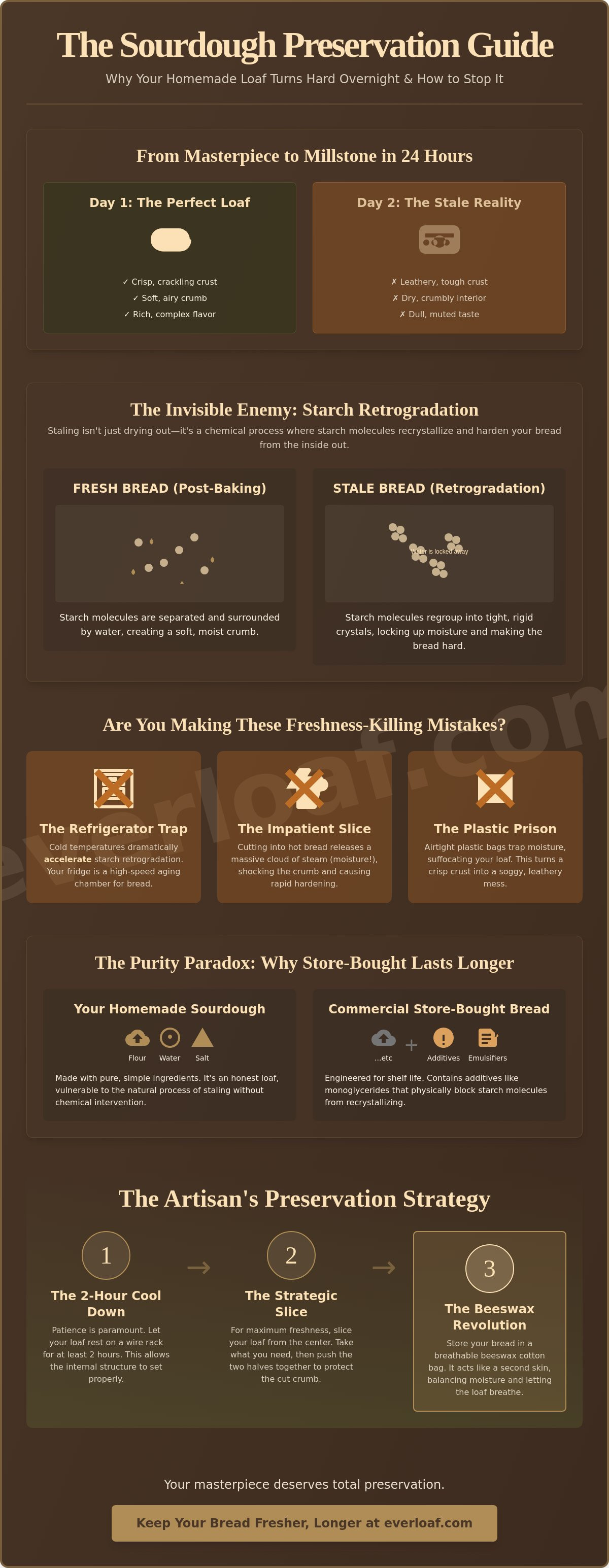
There is a vital distinction between a loaf that is "dry" and one that is "stale." A dry loaf has simply lost its moisture to the air through evaporation. A stale loaf has undergone a structural change called starch retrogradation. Retrogradation is the process where starch returns to a crystalline state. During baking, starch molecules like amylose and amylopectin absorb water and lose their shape. As the bread cools, these molecules begin to regroup. They form tight, rigid structures again. This recrystallization is what turns your soft crumb into something resembling a pumice stone.
Starch Retrogradation: The Invisible Clock
This process happens even if you wrap your bread in airtight plastic. Your bread feels hard because the starch is literally re-forming its crystals, locking up the moisture that is already inside. Temperature is the primary driver of this clock. Starch recrystallizes fastest at temperatures just above freezing. This is why the refrigerator is the enemy of quality. When you chill your loaf, you are effectively telling the starch to harden as quickly as possible.
Patience is your best tool during the cooling phase. If you use your Sourdough Knife to slice into a steaming loaf, you disrupt the setting process. Cutting hot bread allows steam to escape too quickly. This sudden loss of heat and moisture triggers an aggressive round of retrogradation. Your bread needs at least two hours to finish its internal transition. Respect the craft and let it rest.
Moisture Migration vs. Evaporation
While the starch is crystallizing, the water inside the loaf is also on the move. In a fresh loaf, the crumb is moist and the crust is dry. Nature hates this imbalance. Water begins to migrate from the soft center toward the crunchy exterior. This is why a crust that was once shattering and crisp becomes leathery and tough within hours. The crust acts as a natural barrier, but it can only hold so much.
Ambient humidity plays a massive role in this battle. In a very dry kitchen, the moisture leaves the crust and enters the air, making the whole loaf feel like a rock. In a humid kitchen, the crust absorbs moisture from the air and the crumb, turning soft and gummy. Your storage solution must balance these forces. Using a breathable beeswax Bread Bag helps manage this moisture exchange. It allows the bread to breathe without surrendering all its hydration to the room. Without this protection, your loaf loses its battle with the air in a matter of hours.
Why Store-Bought Bread Lasts Weeks (And Why Yours Doesn't)
Your kitchen is a sanctuary for quality ingredients. Industrial bakeries are laboratories for shelf-life engineering. This is the fundamental reason you find yourself asking why does my homemade bread get stale so fast. While you use flour, water, salt, and yeast, commercial loaves are reinforced with monoglycerides and calcium propionate. These additives are not for flavor. They are designed to physically block starch molecules from recrystallizing. They act like tiny wedges, stopping the starch from forming the rigid structures that create a stale texture. Your bread is honest. Store-bought bread is a science project.
The 2026 food landscape shows a massive "Clean Label" transition, yet many commercial brands still rely on these invisible shields. Without these synthetic emulsifiers, your bread is susceptible to the natural laws of chemistry. This is especially true if you store it improperly; for instance, understanding why refrigeration makes bread go stale faster is crucial because your homemade loaf lacks the chemical guardrails to survive the cold. Sugar and fat also play massive roles. A lean baguette has no defense. A rich brioche, loaded with butter and sugar, uses those ingredients as humectants and barriers to slow down the staling process.
The Role of Hydration and Flour Type
Water is your best friend and your worst enemy. High-hydration doughs, like a 75 percent hydration sourdough, naturally resist staling longer because they have more moisture to lose before they turn brittle. However, the type of flour matters. Whole grains are incredibly thirsty. They absorb more water initially, but they can also speed up the staling process as they compete with the starch for moisture. High-protein bread flour creates a stronger network than all-purpose flour, helping to trap moisture within the crumb for an extra day of freshness.
Natural Preservatives for the Home Baker
You don't need a lab to extend your bread's life. Adding natural fats like olive oil or butter coats the starch molecules, making it harder for them to regroup and harden. Honey and maple syrup are excellent natural humectants that bind to water and keep it from migrating to the crust. For the ultimate shelf-life hack, try the Tangzhong method. By pre-gelatinizing a small portion of your flour and liquid into a roux, you lock in moisture that stays for days. Once you've baked your masterpiece, protecting it in a beeswax Bread Bag ensures that your natural preservatives can do their job without the bread suffocating in plastic.
The Refrigerator Trap and Other Common Storage Blunders
Your bread is a delicate ecosystem. It requires the right environment to thrive. Many bakers reach for the refrigerator as a default safety net. They want to prevent mold. They want to save their hard work. In reality, the fridge is a high-speed aging chamber. This is the Refrigerator Paradox. Temperatures between 35 and 45 degrees Fahrenheit are the exact range where starch recrystallization occurs most aggressively. This is The Science of Staling in action. Putting your loaf in the cold makes it go stale up to six times faster than leaving it on the counter.
You might ask yourself, why does my homemade bread get stale so fast even when I use a bread box? A bread box provides a decent shield against drafts, but it is not a perfect seal. It often allows too much air exchange or traps too much moisture depending on the design. Paper bags are equally problematic. They act like a sponge. They pull moisture out of the crumb and release it into the air. Within hours, your heel is a rock. Your bread has inherent needs for breathability and protection. Most common storage methods fail to provide both.
Why the Fridge is Your Bread's Worst Enemy
Starch molecules are most active in their quest to regroup at cold, non-freezing temperatures. This is the danger zone for texture. Your bread becomes hard and crumbly while the internal moisture is still present. Only use the fridge if your bread is highly enriched with perishable items like meat or soft cheeses. If your loaf has already suffered the cold, you must revive it. A quick toast or a few minutes in a 350 degree oven can temporarily melt those starch crystals. It won't be perfect, but it brings back the soul of the loaf.
The Plastic Bag Problem
Plastic is the most deceptive storage choice. It keeps the bread soft, leading many to believe it is fresh. Softness is not the same as quality. Plastic creates a tiny greenhouse. It traps moisture against the crust, turning your artisan masterpiece into a rubbery, gummy mess. This moisture is an invitation for mold. In a sealed plastic bag, spores can take hold in as little as 48 hours. You lose the crunch. You lose the flavor. You lose the reverence for the craft. To maintain the integrity of your bake, you need a solution that balances airflow. A beeswax Bread Bag offers this balance by protecting the crumb while letting the crust breathe.
How to Keep Homemade Bread Fresh: A Practical Strategy
You have mastered the fermentation. You have achieved the perfect ear. Don't let your hard work vanish in a single afternoon. If you are still wondering why does my homemade bread get stale so fast, it is likely because your post-bake routine is working against you. Freshness is not an accident. It is a series of deliberate choices that respect the life of the loaf. Stop treating your bread like a commodity and start treating it like the artisan masterpiece it is.
The first rule is patience. You must allow a full, 2-hour cool-down before any storage. Cutting into a warm loaf releases a massive amount of steam. That steam is the very moisture your bread needs to stay soft. Once cooled, change how you cut. Slice from the middle of the loaf. After taking what you need, push the two cut halves back together. This simple move uses the crust as a natural shield to protect the exposed crumb from the air. To ensure you don't crush the delicate structure during this process, always use a high-quality serrated sourdough knife. A dull blade tears the gluten network and speeds up moisture loss.
The Day-by-Day Freshness Timeline
Your strategy must evolve as the bread ages. On Day 1, your bread is at its peak. Keep it on the counter, cut-side down, to celebrate that shattering crust. By Day 2, the moisture migration we discussed earlier begins to take hold. This is when you transition to a humidity-controlled environment. You need a breathable medium that regulates moisture without trapping it. For deeper insights into this balance, explore The Science of Sourdough Freshness. By Day 5, if you have any loaf left, it is time for a transformation. Turn those slices into vibrant toast or golden croutons. Never settle for a mediocre sandwich when your bread is past its prime.
Freezing: The Only Way to Stop Time
Freezing is the only method that effectively halts the staling process. If you won't finish your loaf within three days, freeze it immediately. Don't wait for it to get hard. Use the 'Slice Before You Freeze' hack. Cut the entire loaf into thick slices, then double-wrap it tightly to prevent freezer burn. This allows you to pull a single slice directly into the toaster for a fresh-baked experience every morning. To maintain this level of quality during the work week, invest in a beeswax cotton bread bag. It provides the ultimate humidity regulation, keeping your crumb soft and your crust intact without the rubbery mess of plastic.
The Beeswax Revolution: Why Breathable Cotton is the Ultimate Solution
You have mastered the science. You have avoided the refrigerator trap. Now, you need a storage solution that respects the craft. If you still find yourself asking why does my homemade bread get stale so fast, the culprit is likely your storage medium. Traditional bread boxes are bulky and inefficient. Plastic bags are a death sentence for a crispy crust. You need a solution that mimics the bread's own natural skin. This is where the beeswax revolution begins. It is the only way to protect your loaf without compromising its integrity.
Beeswax-infused cotton is a living barrier. Organic cotton is naturally porous, allowing carbon dioxide to escape so your bread doesn't "suffocate." Meanwhile, the pure beeswax coating acts as a shield. It locks in the essential moisture within the crumb. This dual action prevents the rapid drying that leads to a rock-hard loaf. Pure beeswax also brings antimicrobial properties to your pantry. It naturally inhibits mold growth, giving your bread a fighting chance to stay fresh for five to seven days. Ditching single-use plastic for a 100% organic, compostable Beeswax Cotton Bread Bag is the ultimate sustainable choice for the serious baker.
How Beeswax Regulates the 'Micro-Climate'
The secret to a perfect loaf is the balance between "too dry" and "too soggy." Linen bags were once the standard, but they are often too porous. They allow moisture to escape too quickly, leading to a dry crumb by day two. Plastic creates the opposite problem, trapping moisture and ruining the crust. Waxed cotton is the superior middle ground. Beeswax provides a semi-permeable barrier that keeps the crumb soft while preserving the crust. Artisan bakers are moving away from linen because waxed cotton creates a stable micro-climate that lasts. Your bread stays vibrant. Your crust stays distinct. The sensory experience remains exactly as you intended.
Caring for Your Everloaf Bag
Maintaining your storage tools is a simple ritual. To preserve the wax coating, always use cold water for cleaning. Hot water will melt the barrier and reduce the bag's lifespan. A mild, eco-friendly soap is all you need. Organic cotton is the superior choice for food contact because it is free from synthetic chemicals and pesticides. It treats your bread with the reverence it deserves. By choosing high-quality materials, you ensure your storage routine is as professional as your baking. For more advanced storage secrets, see our 2026 Freshness Guide. Your loaves are an investment in time and passion. Protect them with the right tools.
Master Your Loaf's Longevity Today
You have unlocked the secrets of the crumb. You now understand that staling is a chemical shift, not just a loss of water. By avoiding the refrigerator trap and ditching the plastic, you are already ahead of most home bakers. Your bread is no longer a mystery; it is a masterpiece that deserves a specialized home. Understanding why does my homemade bread get stale so fast is the first step toward a more sustainable and delicious kitchen routine. You have the knowledge to protect your craft from the first slice to the last heel.
It is time to give your bread the environment it needs to thrive. Our solution is crafted from 100% organic cotton and infused with pure, antimicrobial beeswax. We have tested it on the toughest artisan sourdough to ensure maximum longevity. You don't have to settle for dry, rubbery bread ever again. Keep your bread fresh for up to 10 days with our Beeswax Cotton Bread Bags. You put in the effort to bake perfection. Now, let us help you keep it that way. Happy baking.
Frequently Asked Questions
Can I leave my homemade bread on the counter overnight?
Yes, you can leave your bread on the counter, but it must be shielded from drafts. An unprotected loaf is a common reason why does my homemade bread get stale so fast when left out overnight. The air pulls moisture directly from the exposed crumb. Use a breathable cover to keep the crumb soft while maintaining that signature crust. This is the best way to enjoy your bake within the first 24 hours.
Does sourdough bread stay fresh longer than yeast bread?
Sourdough naturally resists staling better than standard yeast bread. The lactic acid produced during the long fermentation process acts as a mild, natural preservative. This acidity slows down starch recrystallization and naturally inhibits mold growth. It is one of the many reasons why sourdough is the gold standard for home bakers. Your sourdough has inherent needs that its natural acidity helps to protect for several days.
How do I revive a stale loaf of bread?
You can bring a stale loaf back to life with a quick blast of heat. Lightly mist the crust with water and place it in a 350 degree oven for five to ten minutes. This process temporarily melts the starch crystals and restores the soft texture. Eat it immediately. The bread will harden again quickly once it cools down. It is a temporary fix for a loaf that deserves better care than a cold shelf.
Is it better to store bread in paper or plastic?
Neither paper nor plastic provides the perfect balance for your artisan loaf. Paper acts like a sponge and dries the bread out far too quickly. Plastic traps moisture and turns the beautiful crust into a rubbery, gummy mess. For the best results, you must choose a medium that regulates humidity while allowing the bread to breathe. Your bread deserves a storage solution that mimics its own natural skin to maintain its integrity.
Why does my bread get soft and leathery instead of hard?
Your bread becomes leathery when moisture moves from the moist crumb into the dry crust. This moisture migration is a primary reason why does my homemade bread get stale so fast in humid environments. Without a way to vent that moisture, the crust loses its crunch and becomes tough. You need a semi-permeable barrier to stop this process. Proper storage ensures your crust stays crisp while the center remains soft and delicious.
Should I slice my entire loaf at once?
Never slice the entire loaf at once. Slicing exposes the internal crumb to the air, which accelerates the drying and staling process. Use your Sourdough Knife to cut only what you plan to eat for that specific meal. Keep the rest of the loaf intact to preserve its internal moisture. This simple habit respects the craft and keeps your bread fresh for much longer than a pre-sliced loaf would ever last.
How long does bread last in a beeswax bag?
A high-quality beeswax bag can keep your bread fresh for 5 to 7 days. Many artisan loaves stay vibrant for up to 10 days under the right conditions. The beeswax creates a semi-permeable barrier that protects the bread's inherent needs. It is a massive improvement over standard counter storage or plastic bags. This solution offers the longevity and quality that every dedicated home baker expects for their hard work.
Can I store warm bread in a bread bag?
You must let your bread cool completely for at least two hours before placing it in any bag. Storing a warm loaf creates immediate condensation inside the bag. This trapped steam will make your bread soggy and encourage mold growth within 48 hours. Respect the cooling process to ensure your bread stays fresh and delicious. Your masterpiece needs time to set its structure before it is tucked away for the night.


