

Your sourdough deserves better than a plastic sauna or a linen sieve. You spend days nurturing a starter and hours perfecting that golden ear, only to watch your crust turn into a rubbery mess or a literal brick by tomorrow morning. Finding the best bread bag for crusty bread is about more than just convenience; it's about respecting the craft. We agree that your hard work deserves a storage solution that actually protects the soul of the loaf. Discover why beeswax-infused cotton is the ultimate secret to keeping your artisan crust crispy while the crumb stays soft and pillowy.
This 2026 guide will show you exactly how to maintain that "day one" crunch for up to seven days. We are moving past the frustration of moldy loaves and stale ends to embrace a sustainable, professional-grade kitchen. We will preview the top-performing materials and explain why a breathable, beeswax-infused vault is the only way to mimic a professional bakery environment. Your bread works hard for you. It's time to return the favor.
Your sourdough represents hours of dedication and patience. Don't let that effort vanish in a plastic bag or a drying linen wrap. This guide dives deep into the science of the crust, explaining how moisture migration can turn a masterpiece into a rubbery disappointment overnight. We compare every major storage material to prove why beeswax-infused cotton is the best bread bag for crusty bread on the market today. You will learn about the "Breathable Vault" concept, a unique semi-permeable barrier that locks moisture in the crumb while allowing the crust to stay sharp. We also provide a proven five-step routine to maintain "day one" freshness for up to ten days. From cooling techniques to the "middle-out" slicing method, every detail matters. Finally, we introduce the Everloaf Orvix, a professional-grade bag built on heritage culinary standards. It's time to treat your bread with the reverence it deserves!
The Science of the Crust: Why Your Bread Goes Soft or Stale
A perfect sourdough loaf is a masterpiece of physics. It requires a specific balance: a dry, brittle exterior protecting a moist, aerated interior. This contrast is what we crave. Unfortunately, physics is also your greatest enemy the moment the loaf leaves the oven. Understanding why your crust fails is the first step in choosing the best bread bag for crusty bread.
The primary culprit is moisture migration. Water is naturally restless. Inside your loaf, the crumb holds significant hydration. Over time, that water travels outward toward the dry crust. As the crust absorbs this moisture, it loses its brittle snap and becomes leathery. This isn't just about humidity; it's about the internal chemistry of the bread itself.
Even if you seal the bread perfectly, it still changes. This is due to The Science of Staling, also known as starch retrogradation. Starch molecules realign and crystallize, causing the bread to toughen and lose its bounce. Most supermarket storage methods are designed for soft, preservative-heavy industrial loaves. They simply aren't equipped to handle the high hydration and lack of additives in your artisan sourdough.
The Plastic Trap: Why Sourdough Suffocates
Plastic is a death sentence for a good crust. It creates a 100% moisture seal that turns your bread's storage space into a high-humidity sauna. This environment forces the crust to absorb every ounce of escaping steam, leading to a soggy, rubbery texture within hours. Worse, these damp conditions are the perfect breeding ground for mold. Plastic accelerates spoilage by trapping moisture against the bread's surface and preventing any natural respiration.
The Paper and Linen Problem: The Dehydration Risk
On the opposite end of the spectrum, we find paper and linen. These materials are often too breathable, especially in dry or air-conditioned homes. They allow moisture to escape far too quickly, turning your beautiful loaf into a rock-hard brick. While they prevent sogginess, they fail to protect the crumb's hydration. You can learn more about how environmental factors influence this in our guide on How Humidity Affects Bread Storage. Finding the middle ground is essential for anyone seeking the best bread bag for crusty bread while respecting their craft.
Linen vs. Burlap vs. Beeswax: Which Material Wins?
Don't settle for mediocre storage. Your bread is an investment of time and soul. Choosing the best bread bag for crusty bread requires looking at how different fibers interact with air and light. Air permeability isn't just a technical spec; it's the difference between a crisp bite and a stale disappointment. Your loaf has specific needs. It needs darkness. It needs a controlled environment that respects its hydration. Opaque materials win this battle every time. Clear containers or plastic wraps expose your bread to light, which can accelerate staling through photo-oxidation.
Durability also matters for the modern home baker. You want a tool that lasts as long as your sourdough starter. While some materials degrade after a few washes, others become a staple of your kitchen aesthetic. We've seen a massive shift toward sustainable fibers that look as good as they perform. A beautiful bag on your counter sends a message. It says you care about the craft.
Linen Bread Bags: The Traditional Choice
Linen is a classic for a reason. It's highly breathable and looks beautiful in any kitchen. You can easily toss it in the wash, making it a low-maintenance partner. However, that high permeability is a double-edged sword. Unless you live in a very humid climate, linen often lets too much moisture escape. In comparison tests, linen bags typically keep bread fresh for 4 to 5 days. It's a solid choice for bread you plan to devour within the first 24 hours, but it often leaves the crumb dry by day three.
Burlap and Jute: The Rustic Alternative
Burlap offers incredible airflow and keeps the environment dark. It's a favorite for those seeking a rustic, farmhouse look. But there's a catch. Burlap fibers are coarse and prone to shedding. Nobody wants jute hairs on their sourdough. While some suggest the "shake out" method for cleaning, it doesn't compare to the hygiene of a tight-weave fabric. It's simply not airtight enough for a long-term freshness strategy. It protects against light-staling, but it fails to stop the crumb from turning into a brick.
If you're tired of the "hit or miss" results from traditional fabrics, it's time to upgrade. Beeswax-infused cotton bridges the gap by providing a semi-permeable barrier that linen and burlap lack. It's the ultimate "Goldilocks" solution for your counter. You can find the perfect balance of breathability and protection with a beeswax cotton bread bag that truly honors your baking efforts.
The Beeswax Advantage: Why Infused Cotton is the Goldilocks Solution
Most storage options force you to choose between a soggy crust or a dry crumb. Beeswax-infused cotton is the revolution you've been waiting for. It provides a semi-permeable barrier that linen and plastic simply cannot match. This is the "Breathable Vault" concept. It keeps moisture where it belongs: inside the crumb. Meanwhile, it lets the crust breathe just enough to stay sharp and brittle. It is the best bread bag for crusty bread because it respects the science of your bake without compromise.
Protection goes beyond just texture. We infuse our bags with pure jojoba oil for a specific reason. Both beeswax and jojoba oil possess natural antibacterial properties. This helps inhibit mold growth on your expensive artisan loaves. Your sourdough stays fresh and safe for several days longer than in traditional wraps. The warmth of your hands is the only tool you need to activate this protection. Simply press the fabric together. The wax creates a custom, airtight seal that holds its shape perfectly around any loaf size.
Organic Cotton as the Foundation
Quality starts with the base material. We use 100% organic cotton because it is essential for food-safe storage. You don't want synthetic chemicals touching your crust. The weave density is also critical. It must be tight enough to hold the heavy beeswax infusion without becoming stiff or brittle. This ensures the bag remains flexible and durable for hundreds of uses. For a deeper look at this material science, read The Ultimate Beeswax Bread Bag Guide. It is the best bread bag for crusty bread for those who value purity and performance.
The Role of Pure Beeswax and Resin
The infusion process changes everything. Pure beeswax prevents the fabric from acting like a sponge. It won't absorb the bread's internal moisture like plain linen does. This keeps the hydration locked inside the loaf. The self-adhesive nature of these bags is a total game changer. You don't need drawstrings or clips to get a tight seal. Just fold and press. Just like nature, beeswax mimics the natural protective peel of fruit to keep the interior fresh and the exterior shielded from the elements. This is professional-grade storage that truly honors your craft.
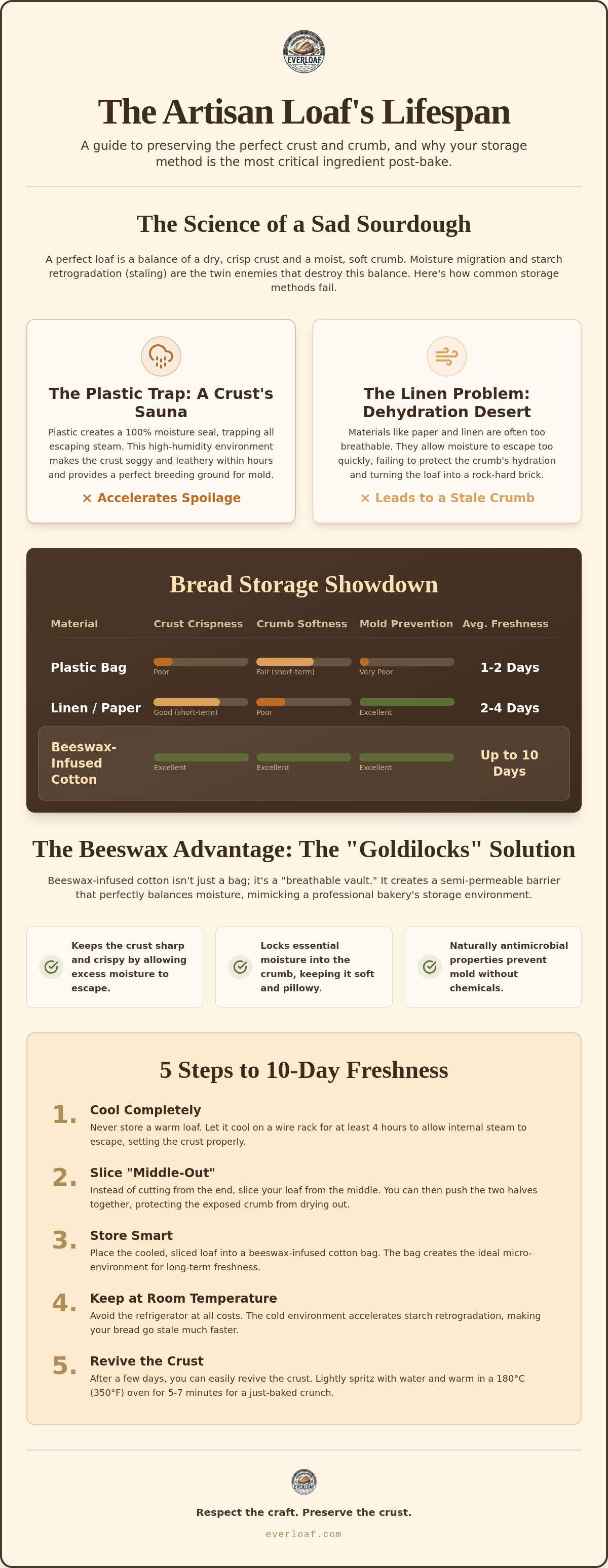
5 Steps to Keeping Your Artisan Loaf Fresh for 10 Days
Storing bread is an art form that begins the moment you pull the Dutch oven from the heat. You've already learned why the material of your storage matters. Now, you must master the technique. Follow these five steps to ensure your sourdough maintains its integrity for over a week. Consistency is the key to professional results.
Step 1: Cool completely. Never bag a warm loaf. Steam is the enemy of a crisp crust. If you seal a loaf while it's still radiating heat, it will sweat. This moisture traps against the crust and leads to immediate sogginess. Wait at least two to three hours until the bread is room temperature to the touch.
Step 2: Slice from the middle out. Most people start at the heel, but this is a mistake. Instead, cut your loaf directly down the center. Take your slices from the middle. When you're finished, press the two remaining halves tightly back together. This protects the soft crumb from air exposure while it sits inside the bag.
Step 3: Use the best bread bag for crusty bread. Slide your pressed halves into the bag. Use the warmth of your hands to mold the beeswax fabric around the loaf. Squeeze out as much air as possible. The wax will hold its shape, creating a custom vault that locks in hydration without suffocating the crust.
Step 4: Find the right environment. Store your bag in a cool, dry place. Avoid the top of the refrigerator or any spot near your stove. External heat sources accelerate starch retrogradation. Keep it away from direct sunlight to prevent the wax from softening prematurely.
Step 5: Refresh the crunch. If your crust softens after several days, don't worry. A five-minute "re-bake" in a 350°F (175°C) oven will draw out surface moisture. This restores the original snap while keeping the interior pillowy. Let it cool for ten minutes before serving.
The Slicing Strategy for Longevity
Precision matters. The "heel-first" method leaves the most vulnerable part of your bread exposed to the elements. By slicing from the center and joining the halves, you create a natural seal. A clean, effortless cut is essential to maintain the bread's structure. Consult our guide on the best knife for cutting sourdough bread to ensure you aren't damaging the crumb during prep. Preservation starts with the first slice.
Caring for Your Beeswax Bread Bag
This bag is a durable tool, but it requires specific care. Wash it only with cold water and a drop of mild soap. Hot water will melt the beeswax infusion and ruin the seal. Always air dry your bag flat or draped over a rack. If the wax begins to show heavy fold lines after months of use, you can refresh it. Place it between two sheets of parchment paper and run a light iron over it to redistribute the wax. Ready to protect your hard work? Invest in the best bread bag for crusty bread and stop settling for stale loaves.
The Everloaf Orvix: Professional Grade Storage for Home Bakers
Your bread is more than just food. It's a living result of patience, temperature, and time. It deserves to be treated with reverence. The Everloaf Orvix beeswax Bread Bag provides that respect. We didn't just stumble upon this design. We looked to the heritage of Lyon, France. This city is the heartbeat of French culinary excellence. Their standards for crust and crumb are legendary. We infused those same professional requirements into every fiber of our heavyweight organic cotton. This is the best bread bag for crusty bread for those who refuse to settle for supermarket standards.
Our 10-Day Freshness promise is a result of the "Breathable Vault" technology we've perfected. Most bakers are used to their loaves failing by day three. We've changed the expectations. The Orvix creates an environment where the crust stays sharp and the interior remains soft. It's a boutique piece that belongs on a designer countertop. The minimalist aesthetic signals your commitment to the craft. Don't hide your passion in a pantry drawer. Let your storage stand as a beautiful testament to your baking journey.
Why Orvix Outperforms Generic Linen
Generic linen is a sieve. It's too light and lacks the structural integrity to protect high-hydration loaves. Our organic cotton weave is specifically weighted to hold a deep, triple-infusion of pure beeswax. This creates a barrier that generic bags simply can't match. Our community knows the difference. We've seen over 10,000 loaves saved from the trash by bakers who finally found a solution that works. "The crunch that lasts!" is the feedback we hear most. It's a shared passion for quality that unites us all. When you choose the best bread bag for crusty bread, you're joining a chorus of enthusiasts who value every slice.
Complete Your Sourdough Ritual
The bag is just one part of the journey. To achieve that perfect loaf, you need the right tools from start to finish. Every step in your process influences the final result. Pair your storage with the Everloaf Danish Dough Whisk for effortless mixing and perfect aeration. When it's time to serve, use the Sourdough Knife to protect that delicate crumb structure you worked so hard to build. Using a dull blade can crush the air pockets and ruin the texture before the first bite. Every tool has a purpose. Your ritual deserves the best. It's time to stop compromising on freshness and start honoring your bake. Shop the Orvix Beeswax Bread Bag today and experience the difference of professional-grade storage.
Honoring Your Craft with Lasting Freshness
Your sourdough is more than a recipe; it's a labor of love and patience. We've uncovered the science behind moisture migration and why standard storage fails artisan loaves. You now have the knowledge to move beyond leathery crusts and rock-hard crumbs. By embracing the "Breathable Vault" of beeswax-infused cotton, you give your bread the specialized attention it deserves. Choosing the best bread bag for crusty bread is the final, essential step in your baking ritual.
The Everloaf Orvix stands apart as a professional-grade solution. It's crafted from 100% organic cotton and infused with pure, food-grade beeswax to mimic nature's own protection. Designed by culinary professionals from Lyon, France, this bag brings heritage standards directly to your designer countertop. Stop letting your hard work go to waste. Keep your sourdough fresh for 10 days with the Orvix Beeswax Bag. Your next masterpiece is waiting for the protection it deserves. Happy baking!
Frequently Asked Questions
Does a beeswax bread bag really keep crusty bread crispy?
Yes, a beeswax bread bag is designed to maintain the delicate balance between a brittle crust and a soft interior. It creates a semi-permeable vault that allows the bread to breathe without losing its essential internal hydration. This prevents the crust from becoming leathery or rubbery. It is widely considered the best bread bag for crusty bread because it respects the specific physics of artisan sourdough.
How do you clean a beeswax bread bag without ruining it?
Clean your bag with cold water and a small amount of mild, alcohol-free soap. Never use hot water, as it will melt the beeswax and ruin the protective seal. Simply wipe the interior or dip it in a cold wash, then hang it to air dry. This gentle care ensures your bag remains a durable staple in your kitchen for years of daily use.
Can I store warm bread directly in a beeswax bag?
No, you must allow your loaf to cool completely to room temperature before bagging it. Warm bread releases steam that will soften the wax and create condensation inside the bag. This trapped moisture ruins the crust and encourages mold growth. Patience is the final step in your baking process, so give your loaf at least two hours to rest before storage.
How long does bread stay fresh in a beeswax bag compared to plastic?
Bread typically stays fresh for 5 to 7 days in a beeswax bag, significantly outperforming plastic. While plastic keeps bread soft for 1 to 2 days, it often leads to a soggy crust and rapid mold growth. The beeswax environment acts as a "Goldilocks" solution. It preserves the crumb's hydration without sacrificing the crust's integrity, extending your enjoyment of every loaf.
Is a linen bag better than a beeswax bag for sourdough?
No, because linen often allows too much moisture to escape, turning your loaf into a brick within 48 hours. While linen is excellent for very short-term use, it fails to protect the crumb's hydration over several days. The best bread bag for crusty bread uses a beeswax infusion to provide a protective shield that linen lacks. It keeps your sourdough fresh for nearly a week.
Do beeswax bread bags smell like honey or affect the bread flavor?
You will notice a faint, pleasant scent of honey when you first use your bag. This is a natural characteristic of pure, food-grade beeswax and jojoba oil. Rest assured that this aroma does not transfer to your bread or alter its flavor profile. Over time and with regular use, this scent will naturally fade while the bag's protective performance remains high.
What is the best way to store bread if I live in a very humid climate?
Use a beeswax bag and keep it in a cool, dark cupboard away from the stove or dishwasher. High humidity can challenge any storage method, but the beeswax provides a natural barrier against external moisture. If you notice the crust softening, a quick five-minute refresh in the oven will restore the crunch. Avoid the refrigerator, as it accelerates the staling process.
Can I freeze bread inside a beeswax bread bag?
Yes, you can use a beeswax bag for short-term freezing of up to two weeks. Ensure the bag is sealed tightly around the loaf to minimize air pockets. For long-term storage, we recommend wrapping the bread more robustly to prevent freezer burn. Always allow the bag to return to room temperature before unfolding it to prevent the wax from cracking or peeling.


