

What if your sharpest chef's knife is actually the reason your sourdough looks like a jagged mess instead of a bakery masterpiece? It's frustrating to spend three days nurturing a starter only to have the dough tear and drag at the finish line. You've likely felt that sinking feeling when a thick blade sticks to the surface, leaving you with a ragged scar instead of a proud ear. When comparing a bread lame vs knife for scoring, the truth is that even the most expensive kitchen knife lacks the surgical precision required to release the tension of a high-hydration loaf.
Stop settling for ragged cuts. You deserve a crust that honors your hard work. A survey of over 23,000 consumers shows that 70% of people believe sourdough tastes better than any other bread. Your loaf should look as good as it tastes. We believe every loaf has a story to tell. It shouldn't be interrupted by a thick, dragging blade. Discover why a specialized bread lame outperforms a standard kitchen knife and how to choose the right tool to achieve professional-grade oven spring. We will look at the physics of the ear, the importance of blade thickness, and the simple techniques that turn a hobbyist's bake into a stunning work of art.
Key Takeaways
- Scoring provides a surgical release for steam, preventing your loaf from bursting at its weakest seams during oven spring.
- The razor-thin edge of a bread lame minimizes drag, allowing you to create a clean, professional "ear" with total ease.
- Understand why the wedge-shaped design of standard kitchen knives causes dough to stick and tear instead of slicing cleanly.
- Settle the debate of bread lame vs knife for scoring by evaluating the precision and control needed for high-hydration sourdough.
- Master the final steps of your bake by using professional tools like the Everloaf Bread Sling for safe, seamless transfers!
Beyond Aesthetics: Why Scoring is Essential for Sourdough
Scoring is the final act of respect for your dough. You've spent days nurturing your starter. You've folded, proofed, and waited. Don't let that effort go to waste by skipping the score. Think of scoring as an intentional release of pressure. It provides a weak point for the dough to expand. Without it, steam builds up inside. Your loaf will eventually burst at its weakest seam. This often happens in an ugly, unpredictable way. A clean cut allows internal gases to expand the crumb structure. This results in a lighter, airier texture that feels professional.
Many beginners debate the merits of a bread lame vs knife for scoring. While a standard kitchen knife is always in the drawer, it lacks the surgical edge of a professional tool. A specialized Lame (kitchen tool) is the traditional choice for bakers who value precision. It ensures your hard work isn't ruined by a dull, dragging blade. Your dough is a living thing. It has inherent needs. It deserves to be treated with care. When you score, you aren't just decorating. You are guiding the final stage of a long journey. A jagged, forced tear is a disservice to the fermentation process.
The Science of Oven Spring
Heat is the ultimate catalyst. In those first ten minutes of baking, CO2 expands with incredible speed. The crust acts like a container for this energy. If you don't provide a designated exit, the pressure will force its own path. A well-placed score releases this tension exactly where you want it. Oven spring is the final expansion of dough before the crust sets. Mastering this expansion is the secret to that coveted, open crumb structure.
Controlling the Bloom
The direction of your cut dictates the final shape of your bread. A single, long slash helps a batard expand outward. A cross pattern is perfect for a round boule. You must distinguish between functional scores and decorative etching. Functional scores are deep. They manage the massive volume of the rise. Decorative etching is shallow and purely for aesthetics. High-hydration loaves are particularly heavy. They require deep, decisive cuts to ensure the dough can fully bloom. Deciding between a bread lame vs knife for scoring is the first step toward achieving that perfect, controlled bloom every time.
The Bread Lame: Precision Engineering for the Perfect Ear
A bread lame (pronounced "lahm") is essentially a razor blade mounted on a handle. It's built for one thing: speed. The primary advantage is the extreme thinness of the blade. This minimizes surface area contact with your dough. Professional chef knives are thick. They are designed for chopping through carrots or joints of meat. Even the most expensive blade in your block has a wedge-shaped cross-section. This creates drag. A razor blade, however, is surgical. It allows for high-speed slashes that prevent the dough from snagging on the metal. When you weigh the options of a bread lame vs knife for scoring, remember that your dough is delicate. It needs a tool that respects its structure. Razor blades are significantly sharper than professional chef knives. They slice through the gluten cloak with zero resistance.
The debate of bread lame vs knife for scoring is often settled the moment you see the clean lift of a razor cut. A basic lame can cost as little as $6.36, while boutique options like the Wire Monkey UFO Corbeau reach $34.95. This small investment pays off in every loaf you bake. You are no longer fighting the dough. You are guiding it.
Straight vs. Curved Blades
Straight blades are best for vertical cuts. Use them for intricate, decorative wheat patterns. If you're practicing culinary arts techniques like wheat stalks or leaves, go straight. Curved blades are different. They create the iconic "ear" by undercutting the dough at an angle. This lip of dough lifts and crisps during the bake. For those who want maximum control, UFO-style lames are ideal. These circular wooden tools sit close to the blade. They feel like an extension of your fingers. You can find these crafted from black walnut or recycled resin for a boutique feel that matches your passion.
Safety and Maintenance
Safety is paramount. Changing double-edged razor blades requires focus. Always hold the blade by the short, blunt ends. Slide it onto the handle with a firm, steady motion. Never use a dull blade on a proofed loaf. A dull edge will pull the dough and deflate your hard work. It's like trying to cut silk with a butter knife. It just doesn't work. Store your lame in a dry place. This protects the edge from oxidation and damage. A sharp blade is a safe blade because it requires less force. Once your masterpiece is out of the oven and cooled, keep it at its peak in one of our beeswax-lined bread bags. Your crust deserves to stay fresh and crisp for days.
The Kitchen Knife: Why Your Sharpest Blade Often Fails
Your sharpest chef knife is a master of the cutting board. It's perfect for dicing onions. It's a disaster for scoring sourdough. The reason is simple physics. Standard kitchen knives feature a "V" or wedge-shaped cross-section. This design is built to push material apart as it descends. Dough doesn't want to be pushed. It's a living, hydrated web of gluten. When a thick blade enters the loaf, the dough clings to the sides of the metal. This creates instant friction.
In the debate of bread lame vs knife for scoring, thickness is the enemy. This thickness causes "drag." Instead of a surgical incision, the dough sticks and tears. You end up with a ragged wound rather than a professional ear. Even a freshly sharpened knife struggles with the sticky surface of high-hydration sourdough. Serrated knives are even worse. They act like a saw. They leave jagged edges that prevent a smooth, glorious bloom. You want your bread to expand with confidence. A jagged cut forces it to struggle.
Most beginners don't realize how blade thickness affects the "gluten cloak." This is the thin, tense skin you create during the shaping process. It acts as the invisible armor of your bread, holding the gases inside. When you score, you're performing surgery on this armor. A thick knife doesn't slice the cloak; it tears it. This causes the dough to deflate or burst in the wrong places. When you compare a bread lame vs knife for scoring, the lame wins because it respects the surface tension. It zips through the skin without disturbing the delicate structure underneath.
The Problem of Blade Drag
Surface tension gives your loaf its shape. When you use a thick kitchen knife, you're fighting that tension. The dough reacts to the heavy blade by pulling away or sticking. This "tearing" effect ruins the smooth gluten skin. It leads to unpredictable blowouts in the oven. Professional bakers avoid chef knives for this exact reason. No matter the brand or price, a knife is too bulky for this surgical task. It's like trying to perform fine embroidery with a pair of garden shears.
When a Knife is the Right Choice
There is still a place for a blade in your ritual. Use a specialized tool for the final presentation. You can find more details in our Sourdough Knife Guide. Scoring tools and slicing tools serve different masters. One creates the life of the loaf; the other shares it. Once your masterpiece has cooled and the crust has set, a dedicated bread knife is essential. You need those sharp serrations to bite through the hard, crackly crust without crushing the airy crumb you worked so hard to achieve. Respect the process from the first slash to the final slice.
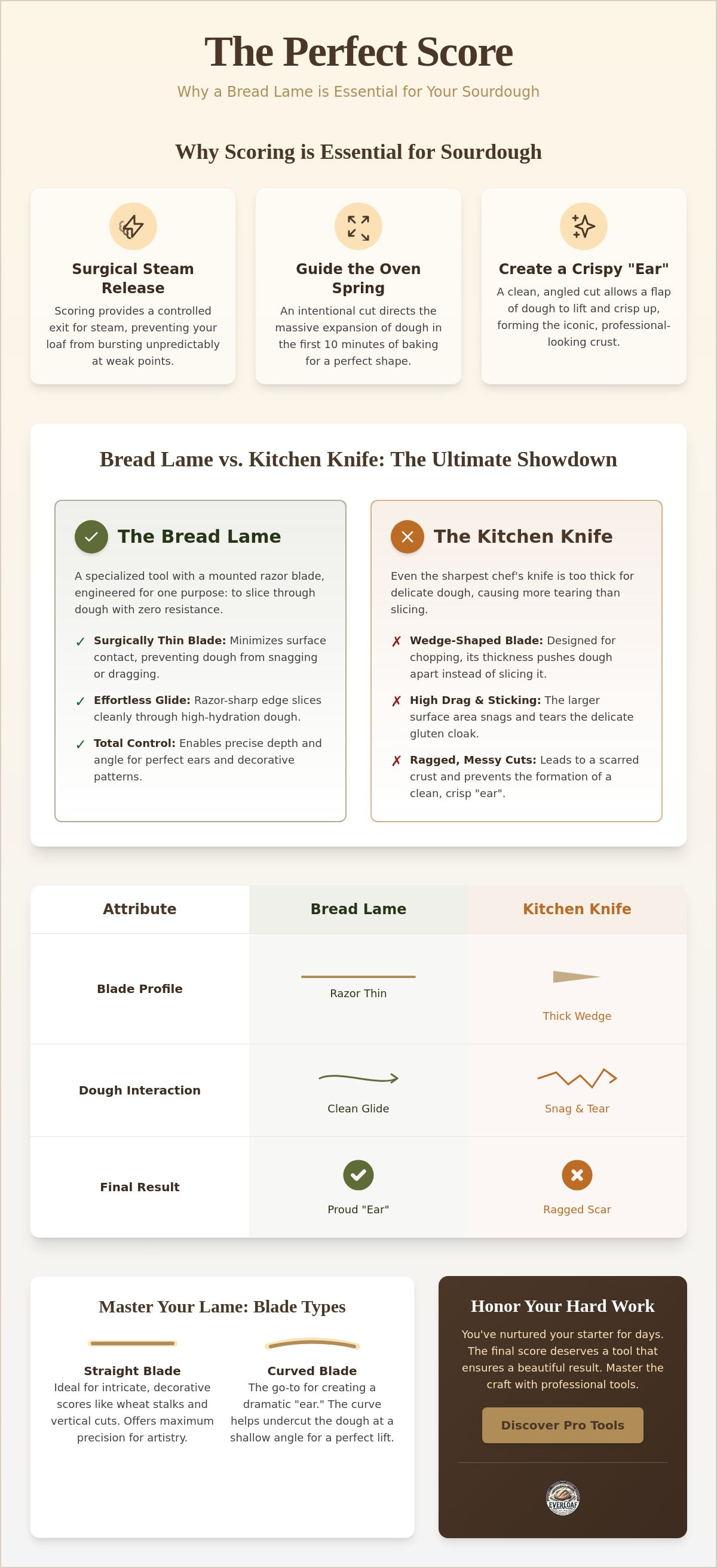
Bread Lame vs. Knife: The Ultimate Scoring Comparison
Choosing your weapon is the difference between a loaf that soars and one that stumbles. When we look at the bread lame vs knife for scoring battle, the results are clear. A standard 75% hydration loaf requires a tool that understands surface tension. A bread lame offers a blade thickness of roughly 0.1mm. Compare this to a chef knife, which usually tapers from 2mm. That massive difference determines whether you achieve a proud, crispy ear or a flat, ragged seam. The cost-to-benefit ratio is undeniable. You can find a basic lame for as little as $6.36. It's a small price for professional results. Stop guessing. Start scoring.
Maneuverability is the silent hero of the scoring process. A lame allows you to change the angle of the blade mid-slash. This is critical for undercutting the dough to create an ear. A heavy kitchen knife lacks this nimbleness. It's too bulky to tilt effectively without dragging the surrounding dough. For functional scoring, the lame is essential. For simple, straight cuts on low-hydration dough, a sharp knife might suffice. But why settle for "suffice" when you've spent days on your ferment? Your bread deserves more than just a passing grade. It deserves excellence.
Performance Metrics!
| Tool | Sharpness | Drag | Ear Quality | Ease of Use |
|---|---|---|---|---|
| Bread Lame | Extreme | Minimal | Professional | High |
| Chef Knife | Moderate | High | Poor | Low |
| Paring Knife | High | Moderate | Average | Moderate |
| X-acto Knife | High | Low | Average | Low |
For the dedicated sourdough baker, the bread lame is the undisputed winner because it is the only tool specifically engineered to respect the delicate gluten skin of your loaf.
Choosing Based on Dough Hydration
Hydration levels change the rules of the game. Wet, sticky doughs with 80% hydration or higher are notoriously difficult to handle. They absolutely require the razor-thin profile of a lame. Anything thicker will simply become a sticky mess. Lower hydration doughs, around 60% to 70%, are slightly more forgiving. You might get away with a very sharp paring knife here, but you'll still miss that signature lift. Cold-proofed dough is your best friend. Scoring it straight from the fridge provides the firmest surface for any tool. If your dough is room temperature, don't even reach for a knife. Only a razor can handle that softness without deflating the structure. Once you've achieved that perfect bake, don't let the freshness fade. Keep your professional results tasting bakery-fresh by storing your loaves in beeswax-lined bread bags. They are the final step in a process built on quality and respect.
Mastering the Craft: Tools That Honor Your Hard Work
The journey doesn't end when the timer beeps. You've spent days perfecting your technique. You've navigated the debate of bread lame vs knife for scoring to achieve that elusive, professional-grade ear. Now is the time to honor that effort. Professional tools lead to professional results. Every step of the process matters. From the first fold to the final slice, your bread has inherent needs. It deserves specialized attention. A jagged cut or a crushed crumb is a disservice to your dedication. Treat your craft with the reverence it deserves.
Safety and precision go hand in hand. Lowering your dough into a 500-degree pot shouldn't be a gamble. Using The Everloaf Bread Sling allows for a safe, centered transfer. It prevents the accidental deflating that happens with clumsy parchment paper. It's about maintaining that maximum volume you worked so hard to create. When you use the right tools, you bake with confidence. You aren't just making food. You are creating an experience for yourself and your community.
From Scoring to Slicing
Transitioning from your lame to a high-quality Sourdough Knife is the ultimate reward. A clean score doesn't just look good; it makes for easier, more uniform slices. You've created an intentional weak point that guides the blade perfectly. There is a profound satisfaction in the perfect "crunch" as you cut through a well-scored crust. Your crumb deserves a clean cut. Don't crush it with a dull blade. Use a tool that respects the internal structure of your loaf.
Preserving the Perfection
Stop suffocating your crust. Plastic bags are where good bread goes to die. They trap moisture and turn your crispy ear into a rubbery mess. The Everloaf beeswax Bread Bag maintains the ideal humidity for sourdough. It's a natural, breathable solution. The science of staling involves starch retrogradation. Organic cotton infused with beeswax slows this process down significantly. It keeps your bread fresh without sacrificing the texture of the crust.
The global baking tools market is projected to reach $17.76 billion in 2026. This growth is driven by home bakers who refuse to settle for average results. You are part of a community that values craft over convenience. When you choose a bread lame vs knife for scoring, you aren't just buying a tool. You are investing in your passion. You are ensuring that every loaf you bake is a testament to your hard work. Treat your bread with reverence. It will reward you with every single bite.
Elevate Every Loaf You Bake
Your bread is a masterpiece in the making. It deserves tools that respect the science of fermentation and the art of the crust. We've seen how the surgical precision of a razor blade prevents drag and allows your dough to bloom with confidence. In the final comparison of bread lame vs knife for scoring, the specialized edge is the only way to achieve professional results. Don't let a thick kitchen blade tear the gluten skin you worked so hard to develop. High-hydration sourdough requires the nimbleness that only a professional lame provides.
Once your loaf emerges from the oven with a proud, crispy ear, protect that perfection. Ready to keep your perfectly scored loaves fresh? Shop the beeswax Bread Bag. These bags are crafted from 100% organic cotton and infused with pure beeswax for natural freshness. Designed by culinary professionals from Lyon, they provide the breathable environment your artisanal bread needs. You've mastered the score. Now, master the storage. Your community will taste the difference in every slice. Keep baking with passion!
Frequently Asked Questions
Can I use a regular razor blade without a handle for scoring?
You can technically use a bare razor blade, but we strongly advise against it for safety reasons. A bare blade lacks the leverage and ergonomic control of a dedicated handle. Holding a razor directly between your fingers significantly increases your risk of deep cuts. A handle allows you to maintain the precise, consistent angle needed for a professional ear. Precision is everything when you are working with delicate, living dough.
Why is my bread lame sticking to the sourdough during the cut?
Your blade is likely sticking because the dough is too warm or the blade has accumulated residue. Cold dough is much firmer and easier to slice cleanly. When comparing a bread lame vs knife for scoring, the thinness of the lame helps, but even a razor needs to be clean. Wipe your blade between every cut. If it still drags, your razor has lost its edge and needs replacement.
How deep should I score my sourdough loaf for the best ear?
Aim for a depth between 1/4 and 1/2 inch. A shallow cut won't release enough pressure to create a significant bloom. Conversely, a cut that is too deep can cause the loaf to collapse or lose its shape. Consistency is key for a professional result. Practice finding that middle ground to allow your bread to expand fully during the initial oven spring.
Is a straight lame or a curved lame better for beginners?
A straight lame is generally easier for beginners to master because it feels more intuitive. It is the perfect choice for simple vertical slashes or cross-shaped patterns on a round boule. If your specific goal is a signature "ear," a curved blade is the superior tool. It naturally undercuts the dough at the necessary angle. We recommend starting with a straight blade until you feel confident in your speed.
How many times can I use a single razor blade in my bread lame?
You can typically score 4 to 6 loaves per corner of a double-edged razor blade. Since most blades have four usable corners, one razor can last for 16 to 24 loaves. Never use a dull edge. It will tear your dough and ruin the surface tension. Freshness matters for your tools just as much as your ingredients. Replace the blade the moment you feel any resistance.
Can I use a box cutter or an X-acto knife instead of a bread lame?
You can use an X-acto knife, but it isn't as effective as a dedicated lame. When comparing a bread lame vs knife for scoring, the razor's extreme thinness is the winning factor. Box cutters are often too thick and may carry industrial oils not meant for food contact. Stick to tools designed specifically for the bakery. Your final results will show the difference in precision and lift.
Do I need to oil my scoring blade before cutting the dough?
Dipping your blade in a neutral oil or water can prevent sticking. This is especially helpful for high-hydration sourdough that is naturally tacky. It creates a temporary barrier that lets the blade glide through the gluten skin. It is a simple trick used by many professional bakers to ensure a clean release. Just a light coating is enough to prevent the dough from snagging during the slash.
What happens if I forget to score my bread before putting it in the oven?
If you forget to score, your bread will burst in unpredictable places. The steam generated during baking must escape. This usually results in a "blowout" at the bottom or side of the loaf where the crust is weakest. It won't ruin the flavor of your bread, but it will significantly affect the volume and visual appeal. Always keep your lame nearby as your final pre-oven ritual.


