

Plastic doesn't preserve your bread. It suffocates it. By trapping moisture against the crust, plastic turns a crusty masterpiece into a rubbery disappointment within hours. You've worked hard on that crumb. You've waited for the perfect rise. It's time to learn how to keep homemade bread fresh without plastic while maintaining that satisfying, shatter-crisp crust you love. Over 50% of consumers now favor products that use less plastic. Your kitchen shouldn't be the exception.
We know the frustration of watching a beautiful loaf go stale in a paper bag or turn soggy in a poly-sleeve. You want a solution that respects the craft and the environment. This guide shows you how to master the art of plastic-free storage to keep your bread fresh for five to seven days. We will cover the essential methods for balancing moisture and airflow. You'll discover how to maintain the perfect contrast between a crispy crust and a tender interior. Your loaves are about to get the specialized treatment they deserve.
Key Takeaways
- Stop the greenhouse effect. Learn why plastic suffocates your crust and destroys the texture you worked so hard to create.
- Understand the science of staling. Master the balance of airflow and moisture to keep your bread’s crumb elastic and tender.
- Discover how to keep homemade bread fresh without plastic by comparing linen, paper, and beeswax alternatives.
- Perfect your post-bake routine. Use the cut-side-down strategy and proper cooling techniques to extend your loaf's life.
- Give your bread the specialized treatment it deserves. See why a breathable cotton and beeswax microclimate is the gold standard for longevity.
Why Plastic is Actually the Enemy of Good Bread!
You spent eighteen hours nurturing your sourdough starter. You perfected the stretch and fold. You achieved the ultimate oven spring. Then, you made a fatal mistake. You put that beautiful loaf into a plastic bag. Plastic is not a protector. It is a trap. It creates a non-breathable greenhouse effect that ruins your hard work. This is the primary reason people struggle with how to keep homemade bread fresh without plastic. You are literally drowning your crust in its own evaporated moisture.
Bread is dynamic. It releases moisture as it sits. In a plastic bag, that moisture has nowhere to go. It migrates from the tender crumb into the once-crispy crust. This leads to "Rubbery Crust Syndrome." Your artisan loaf loses its soul. It becomes a chewy, disappointing version of its former self. Beyond the texture, plastic traps heat. This creates a humid, stagnant environment. It is the perfect incubator for mold. You aren't preserving freshness. You are accelerating decay.
- Moisture Migration: Water moves from the crumb to the crust, making it soggy.
- Texture Loss: The distinct "shatter" of a good crust disappears.
- Mold Acceleration: Trapped humidity creates a fungal playground.
- Chemical Exposure: Potential leaching from non-food-grade plastics.
The Problem with Polyethylene
Polyethylene is the standard for mass-produced goods. It is built for convenience, not quality. It prevents the natural gas exchange that keeps bread tasting "alive." When you bag a loaf in plastic, the crunch factor dies within hours. The crust softens into a leathery skin. There is also the hidden cost of chemical leaching. Cheap plastic wraps can transfer microplastics or chemical residues to your warm bread. Your craft deserves a clean, specialized environment. If you want to know how to keep homemade bread fresh without plastic, the first step is to discard the polyethylene shroud.
Why "Airtight" Isn't Always Better
We have been conditioned to believe that airtight equals fresh. This is a myth born from the industrial bread aisle. Store-bought loaves rely on preservatives to stay soft for weeks. Your homemade bread is a different species. It has a living crust that acts as a natural barrier. It needs a breathable home. The Science of Staling reveals that bread hardens due to starch retrogradation, not just air exposure. Trapping moisture in plastic doesn't stop this process; it only ruins the texture. You need a solution that allows moisture to vent while protecting the crumb. A high-quality beeswax cotton bread bag offers this balance. It respects the integrity of the loaf by providing a controlled microclimate.
The Science of Staling: Airflow and Moisture Balance
Bread doesn't just dry out. It undergoes a complex chemical transformation. Most bakers assume air is the only thief, but the real culprit is a process called starch retrogradation. This is why your loaf can feel hard even when it hasn't lost all its moisture. Understanding this chemistry is the secret to how to keep homemade bread fresh without plastic. You've put in the work to build a beautiful crumb; now you must protect it.
Humidity is the guardian of the crumb. Without it, the interior of your bread loses its elastic, pillowy quality. However, too much humidity turns your crust into a soggy mess. Finding the "Sweet Spot" means creating an environment that breathes while retaining enough internal hydration to keep those starch molecules flexible. Recent research on bread staling highlights how water redistribution within the loaf dictates its shelf life. Your bread is a living system. Treat it with the reverence it deserves by choosing a storage method that works with its biology, not against it.
Understanding Retrogradation
Retrogradation is the crystallization of starch molecules as they cool and age. This process happens fastest at cold temperatures. This is why the refrigerator is the absolute worst place for your bread. It accelerates staling by up to three times compared to room temperature storage. As the starch crystallizes, moisture moves from the center of the loaf toward the edges. If that moisture hits a plastic barrier, it pools on the surface. If it hits a breathable beeswax cotton bread bag, it vents slowly. This keeps the crumb soft without sacrificing the exterior.
Sourdough vs. Yeast: The Preservation Battle
Not all loaves are created equal. Sourdough is a natural survivor. The lactic acid bacteria and wild yeast in a sourdough starter lower the pH of the bread. This acidity acts as a natural preservative. It inhibits mold growth far more effectively than commercial yeast ever could. This leads to the "5-day freshness rule." A well-crafted sourdough loaf can stay delicious for nearly a week if stored correctly. Yeast-based breads lack this acidic shield and often fail within 48 hours. You can learn more about how environmental factors play a role in how humidity affects bread storage to better protect your bakes. Your craft is an investment. Don't let a lack of science ruin the results.
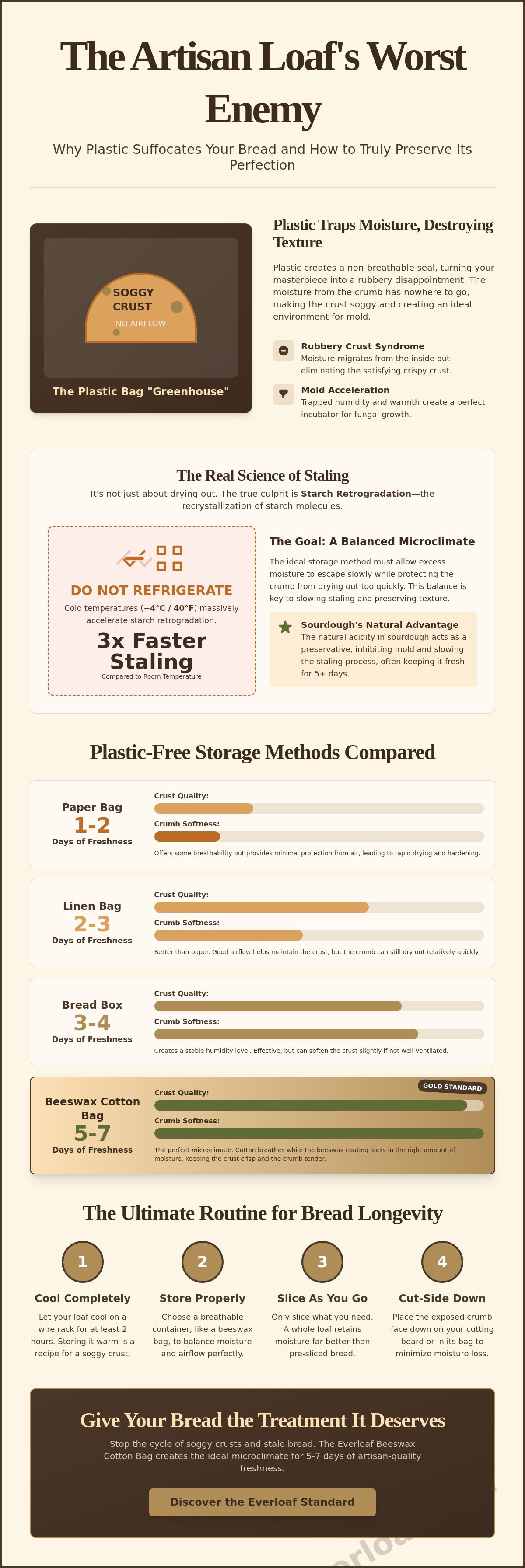
5 Plastic-Free Storage Methods Compared!
You understand the science of the crumb. Now you need the right tools for the job. Choosing how to keep homemade bread fresh without plastic depends on your specific goals for crust texture and crumb softness. Not every method is equal. Some are traditional relics; others are modern essentials. Your loaf deserves a home that respects its biology.
- Linen Bags: These offer superior airflow. They are excellent for keeping a crust shatter-crisp for the first 24 hours. However, they often lead to rapid drying. The crumb can become quite hard by day two.
- Paper Bags: This is the classic "bakery standard." It works for the walk home, but it fails after 12 hours. Paper is too porous. It pulls moisture out of the bread and offers zero protection against staling.
- Ceramic Bread Crocks: These are beautiful and traditional. They provide a stable temperature environment. Unfortunately, they lack portability and visibility. You can't see your loaf, and they take up significant counter space.
- Beeswax Bread Bags: This is the modern hybrid solution. They offer the perfect balance of breathability and moisture retention. They mimic a natural rind to keep bread fresh for up to a week.
- Freezing: This remains the only long-term solution for large batches. Slice your bread first. Wrap it tightly in beeswax wraps and toast individual slices as needed.
The Linen and Cotton Debate
Raw fabric storage is a step in the right direction. It avoids the suffocating greenhouse effect of plastic. But there's a catch. Single-layer cloth often lets bread get too hard too fast. Natural fibers like linen and cotton are highly absorbent. They act like a wick, drawing essential moisture out of the crumb and into the air. This results in a loaf that is bone-dry within 48 hours. While natural fibers are a great foundation, they often need a secondary barrier to truly preserve freshness.
Why Beeswax-Infused Cotton Wins
Beeswax changes the game. It creates a semi-permeable barrier. This allows the bread to breathe while locking in the essential moisture that keeps the crumb elastic. Think of it as a natural peel or rind for your loaf. Unlike metal tins that can be bulky, a beeswax bread bag is flexible and space-efficient. It provides a specialized microclimate that plain linen cannot match. For a deeper dive into this method, check out The Ultimate Beeswax Bread Bag Guide. Your bread has inherent needs. It's time to meet them with a solution designed for the craft.
The Ultimate Routine for Bread Longevity
Your storage strategy starts before the bread ever touches a bag. It begins the moment you pull that golden loaf from the oven. You've invested hours into the fermentation and the bake. Don't sabotage your results in the final minutes. Mastering how to keep homemade bread fresh without plastic requires a disciplined daily routine. Your bread is a living masterpiece. It deserves a process that respects its delicate balance of moisture and air.
Temperature control is your first line of defense. Keep your bread away from the toaster, the oven, or direct sunlight. Heat accelerates starch retrogradation and encourages mold growth. A stable, cool, and dark environment is the only way to preserve that bakery-fresh quality. Treat your loaf with reverence, and it will reward you with a tender crumb for nearly a week.
The Perfect Cool-Down
Steam is the enemy of a long-lasting loaf. If you store your bread while it is still warm, you trap moisture against the crust. This creates a soggy environment that leads to instant mold. Follow the "2-hour rule" for artisan loaves. Place your bread on a wire rack to allow air to circulate around the entire surface. Wait at least 120 minutes before storing. To check if it's ready, touch the bottom center of the loaf. If it feels even slightly warm, the internal steam is still migrating. Patience at this stage is the secret to a crisp crust.
Daily Maintenance Tips
How you slice your bread dictates its lifespan. Never pre-slice the entire loaf. Pre-slicing is a freshness killer. It exposes the maximum surface area of the crumb to the air, leading to rapid drying. Instead, slice only what you need as you go. Use a professional bread knife to ensure clean cuts. Ragged edges increase the surface area and speed up staling.
Try the "middle-out" strategy. Slice your loaf from the center rather than the end. When you are finished, push the two remaining halves back together. This physically protects the exposed crumb from the air. Slide the joined halves into your beeswax bread bag and use the warmth of your hands to seal the fabric around the loaf. This creates a custom, semi-permeable microclimate. Always store the bag "cut-side-down" on your counter to add an extra layer of protection against the air. Ready to upgrade your kitchen routine? Secure your beeswax bread bag today and keep your bakes fresh for days.
Invest in Quality: The Everloaf Orvix Standard!
You've mastered the science. You've perfected the routine. Now, you need the right environment. The Everloaf Orvix bag is the definitive answer to how to keep homemade bread fresh without plastic. We don't just make storage. We create a sanctuary for your bakes. Designed in the culinary heart of Lyon, France, this bag represents a high standard for quality. It respects the craft. It honors the crumb. Your bread is a living thing. Give it a home that breathes.
Crafted from 100% organic cotton, the Orvix bag ensures maximum breathability. We infuse every fiber with pure beeswax to lock in essential moisture. This creates a specialized microclimate that no paper bag or plastic wrap can replicate. It is a modern, design-conscious solution that looks beautiful on your countertop. We believe that professional-grade tools should be accessible to every home baker who treats their craft with reverence. This bag is the culmination of that belief.
Better for Your Bread, Better for the Planet
Eliminate the guilt of single-use waste once and for all. Using an Orvix bag can remove the need for over 100 plastic bags every year. It is an investment that pays for itself by drastically reducing food waste. You will stop throwing away leathery, rubbery loaves that have been suffocated by polyethylene. Instead, you'll enjoy bakery-fresh quality for five to seven days.
There is also a deep sensory satisfaction in using natural materials. The tactile grip of the waxed cotton and the faint, sweet scent of the hive elevate your daily kitchen ritual. It's a specialized experience that connects you back to the traditional roots of baking. Over 50% of consumers now favor products that use less plastic. By choosing Orvix, you are joining a global movement toward quality and sustainability. Your kitchen deserves this level of specialized attention.
Join the Everloaf Community
Everloaf is more than a distributor. We are a community of passionate specialists. We understand the effort behind every stretch and fold. Our mission is to provide the tools you need to succeed, from the Sourdough Knife to the Everloaf Bread Sling. We invite you to explore our full collection of baking accessories to complete your professional setup. Don't let your hard work go to waste in an inferior container. Keep your bread fresh today!
Give Your Loaves the Sanctuary They Deserve
You've worked too hard on your bakes to let them die in a plastic bag. We have uncovered the science of retrogradation and the routine needed for longevity. Mastering how to keep homemade bread fresh without plastic is about more than just avoiding waste. It's about respecting the biology of your loaf. You need a storage solution that balances airflow with moisture retention to protect that beautiful crumb. Your kitchen is a space for quality; don't settle for less.
The Everloaf Orvix bag is that perfect home. Our Lyon-inspired design uses 100% Organic Cotton to create a breathable microclimate. It is a specialized tool that keeps bread fresh for up to 10 days. This is where your artisan craft meets professional-grade protection. It is time to ditch the rubbery crusts and embrace the crunch. Your next masterpiece is already proofing. Ensure it has the perfect home waiting for it.
Upgrade Your Storage: Shop the Orvix Beeswax Bread Bag
Your journey to better bread doesn't end at the oven door. Treat every loaf with the reverence it deserves. We don't just sell bags; we support your passion for the perfect bake. We can't wait to see what you create next.
Frequently Asked Questions
Can I store homemade bread in a paper bag?
Paper is a temporary fix. It works for the walk home from the bakery. Beyond that, it's a disaster for your crust. Paper is highly porous and wicks moisture away from the interior. Your loaf will lose its elasticity within 12 hours. It's an insufficient solution for anyone serious about quality. Use a more specialized, breathable barrier instead.
How long does homemade sourdough stay fresh without plastic?
Sourdough is a natural survivor. It can stay fresh for 5 to 7 days in a proper environment. The natural acidity from fermentation acts as a shield against mold. This is the secret to how to keep homemade bread fresh without plastic. You just need to provide a microclimate that balances airflow with moisture retention. Respect the fermentation process by choosing the right home.
Is it better to store bread on the counter or in the fridge?
Never put your bread in the fridge. Cold air is the absolute enemy of a tender crumb. It triggers starch molecules to crystallize rapidly. This process, called retrogradation, makes bread go stale three times faster than at room temperature. Keep your loaf on the counter in a cool, dark spot. It's a living product that needs a stable environment to thrive.
How do you refresh a loaf of bread that has gone hard?
You can revive a hard loaf with a simple steam treatment. Run the bread quickly under a cold tap. Don't soak it; just dampen the crust. Place it in a 350°F oven for 5 to 10 minutes. The moisture penetrates the crust and softens the internal starch. Your bread will regain its bakery-fresh texture instantly. Always serve it warm for the best results.
Do beeswax bread bags really work for sourdough?
Beeswax bread bags are the ultimate tool for sourdough enthusiasts. They provide a semi-permeable barrier that plain cloth cannot match. The wax allows the bread to breathe while locking in the essential hydration of the crumb. It mimics the protective role of a natural rind. This specialized treatment ensures your artisan bakes stay soft and crusty for nearly a week.
Should I slice my bread before storing it?
Don't slice your bread until you're ready to eat. Pre-slicing is a freshness killer. It increases the surface area exposed to air, which leads to instant drying. Keep the loaf whole to preserve its internal moisture. Use a Sourdough Knife to take what you need. This simple habit respects the integrity of the bake and extends its life significantly.
How do I clean a beeswax bread bag?
Cleaning your beeswax bag is a simple ritual. Shake out any loose crumbs after every use. Wipe the inside with a damp, cool cloth. If a deeper clean is necessary, use cool water and a drop of gentle soap. Avoid hot water at all costs. Heat will melt the protective wax and destroy the bag. Air dry it flat to keep it beautiful.
Can I freeze bread without using plastic bags?
You can freeze bread successfully using large beeswax wraps. These wraps provide a thick, natural barrier against freezer burn. Wrap your loaf tightly to exclude as much air as possible. This method is far superior to thin plastic films. You can even wrap individual slices for a quick breakfast. Just toast them straight from the freezer to enjoy that perfect, fresh-baked crunch.


