

Your plastic wrap isn't preserving your sourdough; it's suffocating it. Forcing a living, fermented loaf into an airtight seal is the fastest way to ruin the crust you worked so hard to perfect. Finding the best way to store sourdough bread shouldn't feel like a losing battle against physics. You deserve a slice that tastes just as vibrant on day five as it did on day one.
We know the frustration. You've watched expensive organic flour go to waste because your bread turned into a rock in a paper bag or a rubbery mess in plastic. It feels like a betrayal of the craft. With the sourdough market reaching over $3 billion in 2026, more bakers than ever are demanding a better, more sustainable solution for their daily bread.
The good news is that true freshness is a humidity balancing act, not a seal. This guide reveals the scientific truth behind sourdough storage so you can keep your loaves fresh for up to ten days. We are busting five common myths and showing you how to maintain a crispy crust and soft interior without the waste.
Key Takeaways
- Stop fighting moisture loss and start managing starch retrogradation. Learn how the science of staling dictates how you should treat your crust.
- Stop suffocating your bread. Discover why plastic and paper are the enemies of a perfect crumb and how to choose a breathable alternative instead.
- Master the best way to store sourdough bread by balancing airflow and humidity. Keep your loaves artisan-fresh for up to 10 days without using single-use waste.
- Protect your hard work with the right tools. From the internal temperature of a sliced loaf to the secret of freezer preservation, we cover the pro-level rules of bread care.
- Meet the Orvix solution. See how beeswax-lined organic cotton acts as a protective second skin to keep your sourdough's soul alive.
Why Your Sourdough Goes Stale (And Why the Fridge is a Myth)
Your refrigerator is a graveyard for good bread. While it seems logical to chill your food to keep it fresh, sourdough is a different beast entirely. Most people believe staling is just a simple case of the bread drying out. They assume that if they can just lock in the moisture, the loaf will stay soft. This is a fundamental misunderstanding of bread chemistry. Understanding the science is the first step toward finding the best way to store sourdough bread.
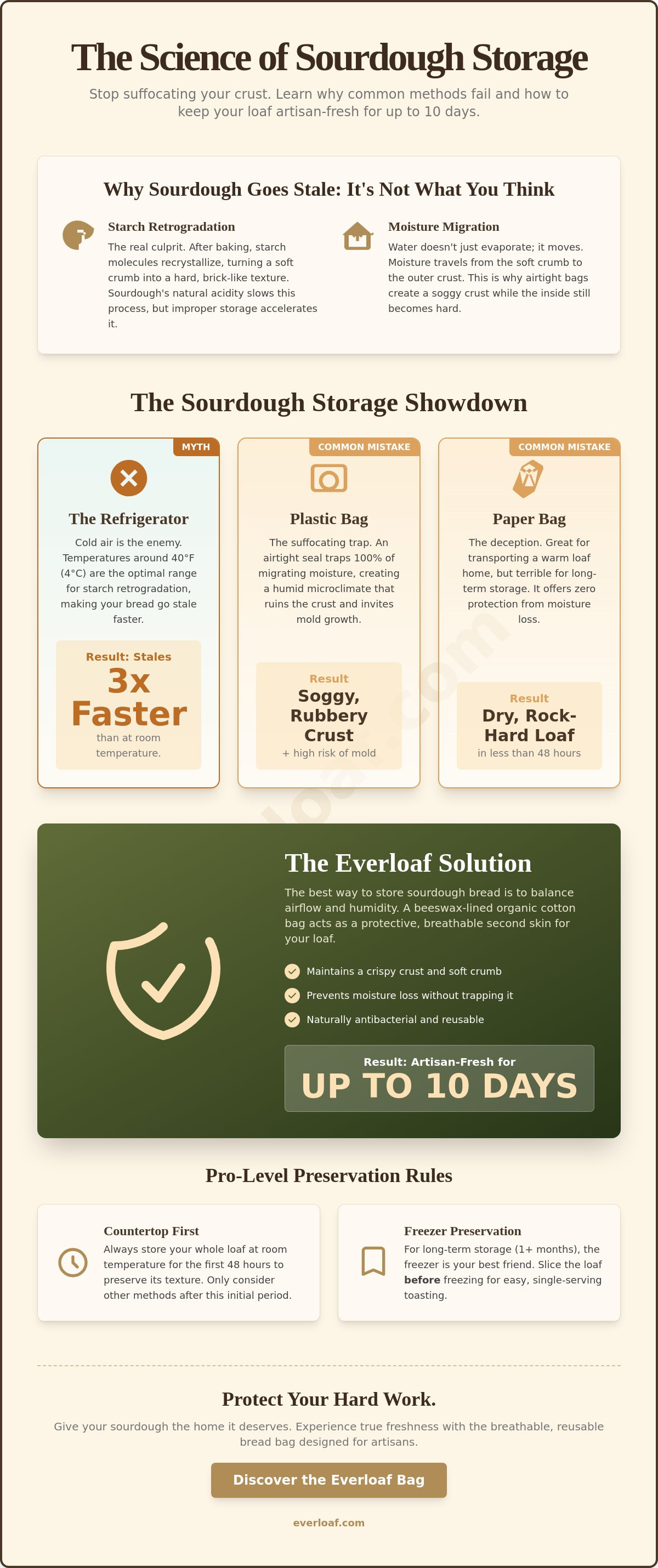
Staling is a deceptive process. It is actually a chemical shift known as moisture migration. Think of your loaf as a living ecosystem where water is constantly on the move. During storage, water molecules travel from the soft, hydrated center of the crumb toward the outer crust. This movement leaves the interior feeling like a parched rock while the crust becomes a tough, leathery skin. This migration happens regardless of how tightly you wrap the loaf if the environment isn't right.
Understanding Starch Retrogradation
The real culprit behind a hard loaf isn't just lost water. It is a process called starch retrogradation. When you bake your bread, the starch molecules gelatinize and soften. As soon as the loaf begins to cool, those molecules start to realign into a rigid, crystal-like structure. Retrogradation is the recrystallization of starch molecules. This process is what turns a pillowy slice into something that resembles a brick.
Sourdough has a massive advantage over commercial sandwich bread. The natural fermentation process improves its keeping qualities by lowering the pH level of the dough. This acidity naturally slows down the recrystallization of starches. It acts as a built-in preservative that keeps the crumb flexible for much longer than a standard yeast loaf. However, even the best sourdough can't survive the wrong temperature.
The Refrigerator Trap
The cold air in your fridge is a catalyst for disaster. Most refrigerators hover around 40°F, which is the exact temperature range where starch crystallization happens most rapidly. In fact, research shows that bread stales three times faster in the refrigerator than it does at room temperature. You are essentially fast-tracking the death of your bread by putting it next to the milk.
There is only one rare exception to this rule. If you have already sliced your loaf and plan to toast every single piece later, the fridge can prevent mold in very humid climates. For everyone else, it is a recipe for disappointment. Stick to the "Countertop First" rule for the first 48 hours. Using a beeswax cotton bread bag on your counter provides the breathable barrier your loaf needs to stay soft without the risk of the fridge trap.
Plastic vs. Paper: Why Both Are Ruining Your Crust
Your crust is under attack. Most home bakers reach for plastic or paper by default. It is an instinctive move that often ends in disappointment. These materials represent two extremes that ignore the biological reality of a fermented loaf. Finding the best way to store sourdough bread means solving the Breathability Paradox. You need a barrier that is protective yet semi-permeable. Without this balance, your bread is either drowning in its own moisture or drying out into a brick.
The Death of the Crispy Crust
Plastic is a suffocating trap. It seals in 100% of the moisture, which sounds like a benefit until you see the results. That moisture migrates from the soft crumb and gets trapped against the crust. We call this Soggy Crust Syndrome. For a high-hydration sourdough, this is a total sensory failure. Your crackling, artisan exterior becomes a rubbery, unappealing skin in a matter of hours. Beyond the texture loss, airtight plastic creates a humid microclimate. This environment invites rapid fungal growth and mold. While many people think they are helping their bread, improper wrapping often speeds up the staling process by ruining the balance of the loaf. If you want to keep that crunch alive, reusable bread bags for homemade bread provide the airflow that plastic simply cannot offer.
The Paper Bag Deception
Paper bags are the ultimate bait-and-switch storage method. We see them at high-end bakeries and assume they are the gold standard for freshness. They aren't. Bakeries use paper for one specific reason: short-term transport. It allows a warm loaf to finish cooling without "sweating" on the drive home. This is what we call the One-Hour Rule. Once you pass that first hour, the paper starts acting like a giant wick. It pulls essential moisture directly out of the sourdough crumb and releases it into the dry air of your kitchen. By the next morning, your beautiful loaf is as hard as a rock. Paper is far too porous for long-term care. It leaves your bread vulnerable and parched.
You deserve a solution that respects the craft. You need a storage method that allows for gas exchange without sacrificing the soft interior. Sourdough is a living product that needs to "breathe" without "gasping." This is why the community is shifting toward a beeswax-lined bread bag. It provides the essential "second skin" your sourdough needs to stay perfect for days. It blocks the wicking effect of paper while preventing the moisture trap of plastic. It's the modern standard for 2026.
The 2026 Guide to Sourdough Storage Methods
Stability is the secret to longevity. Once you've moved past the pitfalls of plastic and the fridge, you need a reliable system. The best way to store sourdough bread is to create a micro-climate that mimics the natural environment of the loaf itself. This isn't about hermetic seals. It is about managed airflow. From traditional European techniques to modern material science, your options have never been better.
Before you reach for a bag, use the "Cut-Side Down" trick. This is the simplest immediate defense for a sliced loaf. Place the exposed crumb face-down on a clean wooden cutting board. The wood creates a natural seal that prevents the interior from drying out while allowing the crust to stay exposed to the air. It is a perfect short-term solution for the first 24 hours of a loaf's life. It respects the integrity of the bread without requiring any extra equipment.
Linen vs. Beeswax: The Showdown
Linen bags are a beloved classic. They offer maximum breathability and keep your crust exceptionally crispy. However, linen has a weakness. In low-humidity environments, it can be too porous. It often leads to a loaf that dries out within two days. This is where the modern sourdough bread bag takes the lead. By infusing organic cotton with pure beeswax, you get the "Goldilocks" of storage. The wax creates a natural, anti-bacterial barrier that mimics the bread's own crust. It allows for gas exchange without the wicking effect of plain fabric, keeping the crumb soft for up to five days on the counter.
The Role of the Bread Box
A high-quality bread box is a dedicated sanctuary for your bake. Whether it is crafted from breathable bamboo or heavy ceramic, the box acts as a thermal and humidity buffer. It shields your loaf from kitchen drafts and temperature spikes. Experts often discuss how to properly store sourdough bread by emphasizing this stable environment. One critical rule: never put a warm loaf inside. The residual steam will turn your box into a sauna, ruining the crust instantly. For the ultimate 2026 setup, place your loaf inside a beeswax bag and then tuck it into a wooden bread box. This double-layer approach provides unmatched freshness and protection for your artisan investment.
Pro-Level Preservation: Slicing and Freezing
Patience is the final ingredient in every great bake. You spent days nurturing a starter and hours watching dough rise. Don't ruin that effort in the final ten minutes. Slicing into a steaming loaf is a common mistake that destroys the internal structure of your bread. Your loaf needs time to breathe and settle before it meets the blade. While countertop methods are ideal for daily use, freezing remains the best way to store sourdough bread when you can't finish a loaf within five days. It stops the staling clock entirely.
When the internal temperature of your bread is above 90°F, the starches are still setting. Slicing too early causes gumminess. It turns a beautiful, airy crumb into a sticky, compressed mess that never recovers. Wait until the loaf is completely cool to the touch. This ensures the moisture has distributed evenly, leaving you with the perfect texture you worked so hard to achieve.
The Art of the Slice
A dull blade is an insult to an artisan loaf. It crushes the delicate alveoli of your crumb instead of gliding through them. Using the best knife for cutting sourdough bread ensures every slice is a masterpiece. For small households, only slice what you need for the current meal. Keeping the rest of the loaf intact is a natural defense against drying out. If you do slice the whole loaf, have a plan to protect those exposed surfaces immediately.
The Correct Way to Freeze
Freezing is a time machine for freshness if you do it right. Don't just toss a whole loaf into the freezer; you'll never be able to cut it. Follow this pro-level process for the best results:
- Step 1: Slice the loaf completely once it has reached an internal temperature below 90°F.
- Step 2: Flash freeze the slices. Lay them out on a baking tray for one hour so they don't stick together.
- Step 3: Transfer the frozen slices to a heavy-duty, airtight bag. This protects them from freezer burn for up to 3 months.
You can revive a loaf that has lost its spark. Spritz a stale, unsliced loaf with a fine mist of water and pop it into a 350°F oven for ten minutes. The water turns to steam, re-gelatinizing the starches and bringing the crust back to life. It's like magic for your morning toast. To keep your bread in peak condition before it ever needs reviving, store your daily bakes in a beeswax cotton bread bag for a breathable, protective seal.
The Everloaf Solution: Why Beeswax is the Ultimate Sourdough Bread Bag
Your sourdough isn't just a commodity. It is the culmination of time, heat, and wild yeast. It deserves a home that respects that effort. Standard storage methods fail because they aren't built for the unique biology of a fermented loaf. The Orvix Bread Bag is our answer to this problem. It combines 100% organic cotton with pure beeswax to create a sanctuary for your bake. This isn't just a container. It is a specialized tool designed by bakers who understand the stakes of a ruined crust.
Beeswax is nature's own preservative. When infused into organic cotton, it creates a semi-permeable barrier that solves the breathability paradox. This is the "second skin" your loaf has been gasping for. It locks in enough moisture to keep the crumb supple while allowing the crust to stay crisp. This balance is the best way to store sourdough bread in 2026. It honors the craft and protects your investment in high-quality ingredients.
Everloaf was born in a kitchen, not a boardroom. We started with a deep reverence for the baking process. We know the frustration of watching a perfect loaf turn into a rubbery mess in plastic. That is why we ditched the synthetic materials. Our bags are sustainable and built to last. With proper care, one Orvix bag can replace hundreds of single-use plastic wraps over the course of a year. It is a win for your kitchen and the planet.
Why 10-Day Freshness is Possible
The secret lies in the wax. Beeswax is naturally antibacterial and antifungal. It actively works to prevent the mold growth that typically thrives in airtight plastic environments. By regulating the internal humidity of the bag, the Orvix infusion ensures your bread doesn't reach the "point of no return" for over a week. Our community consistently gives us high recommendations for this longevity. As one enthusiast put it: "The last bag you will ever need for your sourdough."
Caring for Your Craft
Using high-quality bread bags provides an emotional reward that plastic simply cannot match. There is a tactile satisfaction in wrapping your loaf in a natural, artisan material. Maintenance is simple. Just wipe the interior with a damp cloth and cool water. Use a mild soap if necessary, but never use hot water. Heat will strip the wax and ruin the protective seal. Treat your bag with the same respect you give your starter. Upgrade your kitchen with the Orvix Beeswax Bread Bag and experience the difference that specialized care makes for your daily bread.
Master the Art of Freshness
Sourdough isn't just bread; it's a living craft that requires respect long after it leaves the oven. You've discovered that the refrigerator is a trap and plastic wrap is a suffocating cage for your crust. True preservation is a delicate balance of humidity and airflow. By understanding the science of starch retrogradation, you can finally stop the cycle of wasted organic flour and rock-hard loaves. Your hard work deserves a storage method that matches the quality of your bake.
Implementing the best way to store sourdough bread means moving beyond outdated myths and embracing tools that actually work. The Orvix Beeswax Bread Bag is the ultimate sanctuary for your sourdough. It is crafted from 100% organic cotton and infused with pure beeswax to create a breathable, protective seal. Designed by culinary professionals, this plastic-free and sustainable solution keeps your bread in peak condition. Keep your sourdough fresh for 10 days with the Orvix Beeswax Bread Bag. Your next slice should be just as perfect as the first. Go ahead and bake with confidence.
Frequently Asked Questions
Can I store sourdough bread in a linen bag?
Yes, you can use a linen bag if you prioritize a crispy crust above all else. Linen is highly breathable, which prevents the crust from becoming soggy but allows moisture to escape the crumb quickly. In dry environments, your bread might turn into a rock within 48 hours. For a better balance of airflow and moisture retention, consider a beeswax-lined option that acts as a protective second skin for your loaf.
How long does sourdough bread last in a beeswax bag?
Sourdough bread can stay remarkably fresh for up to 10 days when stored in a high-quality beeswax bag. The wax creates a natural, antibacterial barrier that slows down the staling process without suffocating the bread. This method is often cited as the best way to store sourdough bread for long-term counter use. It keeps the interior soft while maintaining enough crust integrity for a satisfying crunch.
Is it better to store sourdough bread sliced or whole?
Always store your sourdough whole to preserve its internal moisture. Slicing exposes the delicate crumb to the air, which accelerates drying and staling. If you've already cut into the loaf, place it cut-side down on a wooden board or tuck it tightly into a beeswax bag. Only slice what you plan to eat immediately to ensure the remaining portion stays hydrated and delicious.
Should I store sourdough in the fridge if it contains inclusions like cheese?
Yes, you should refrigerate sourdough containing perishable inclusions like cheese or meat after the first 24 hours. While the fridge accelerates the staling process, food safety is the priority. To mitigate the damage, wrap the loaf tightly or use a beeswax wrap to block the cold, drying air. Always toast these slices to revive the texture and melt the inclusions before serving.
How do I revive a sourdough loaf that has gone hard?
You can bring a hard loaf back to life with moisture and heat. Spritz the entire crust with a fine mist of water until it is damp but not soaking. Place the loaf in a 350°F oven for about 10 minutes. This process turns the water into steam, which softens the internal starches and restores the crackling texture of the crust for a final meal.
Does sourdough bread go bad faster than store-bought bread?
Sourdough actually has a longer shelf life than standard store-bought bread because of its natural acidity. The fermentation process lowers the pH of the dough, which inhibits mold growth and slows down starch recrystallization. While commercial bread relies on chemical preservatives, sourdough uses its own biological makeup to stay fresh. This natural defense makes it a superior choice for those who value longevity.
Can I use a beeswax wrap instead of a dedicated bread bag?
Yes, a large beeswax wrap is an excellent alternative to a dedicated bread bag. It provides the same breathable, antibacterial protection that your bread needs to thrive. Simply fold the wrap around the loaf and use the warmth of your hands to seal the edges. While a bag offers more convenience for daily access, a wrap is perfect for odd-shaped boules or preserving smaller remnants of a loaf.
What is the best temperature for storing sourdough on the counter?
The ideal temperature for storing your bread on the counter is between 60°F and 70°F. This range keeps the bread stable without triggering the rapid staling that occurs at colder temperatures. Avoid placing your loaf near heat sources like the toaster or in direct sunlight. Stable, moderate conditions are essential for maintaining the best way to store sourdough bread and ensuring it stays vibrant.


