

What if that rock-hard loaf on your counter isn't waste, but the secret ingredient to your best dinner this week? It's frustrating to watch premium organic ingredients and days of patient fermentation turn into a dry, inedible brick. You hate the waste. You respect the craft. We understand that your sourdough deserves better than the compost bin. It's time to stop feeling guilty about a crust that's lost its luster.
If you're wondering what to do with stale sourdough bread, you're in the right place. Our community of enthusiasts knows that a dry loaf is just a new beginning. We'll show you how to breathe life back into a dry loaf and discover professional ways to transform stale sourdough into gourmet meals. You'll learn the exact water and heat method to revive tonight's dinner. We'll help you stock your pantry with gourmet breadcrumbs. We'll even share the storage strategy that prevents staling in the future. Your bread has inherent needs; treat it with the reverence it deserves.
Key Takeaways
- Learn the rehydration miracle that uses moisture and heat to reverse starch crystallization and refresh your loaf instantly.
- Discover exactly what to do with stale sourdough bread by turning hard crusts into gourmet croutons and professional-grade breadcrumbs.
- Master sweet sourdough classics where dry slices provide superior custard absorption compared to fresh bread.
- Stop the stale; it's time to ditch plastic for a breathable beeswax Bread Bag to maintain a crisp crust for 10 days.
Can You Save a Stale Loaf? The Professional Refresh Technique
A hard loaf isn't a failure. It is an opportunity. Many bakers feel a sense of defeat when their beautiful boule turns into a brick, but your sourdough isn't dead; it's just sleeping. Sourdough is a masterpiece of craft and patience. It deserves a second chance before you even consider the compost bin. If you are staring at a crusty boule and wondering what to do with stale sourdough bread, the answer is simpler than you think. You can bring it back to life.
The secret lies in the rehydration miracle. The Science of Starch reveals that bread doesn't just dry out; its molecules reform into a hard, crystalline structure. This process is called retrogradation. Fortunately, it is reversible. Sourdough is the best candidate for this revival because of its high hydration and acidic environment. Its robust structure can handle the thermal shock that would turn commercial white bread into mush. If you've been keeping your loaf in a breathable environment, like a beeswax Bread Bag, the refresh will be even more successful.
The 4-Step Sourdough Revival Process
Don't settle for a dry crumb. Follow this professional method to restore that bakery-fresh experience. It's fast, efficient, and deeply satisfying.
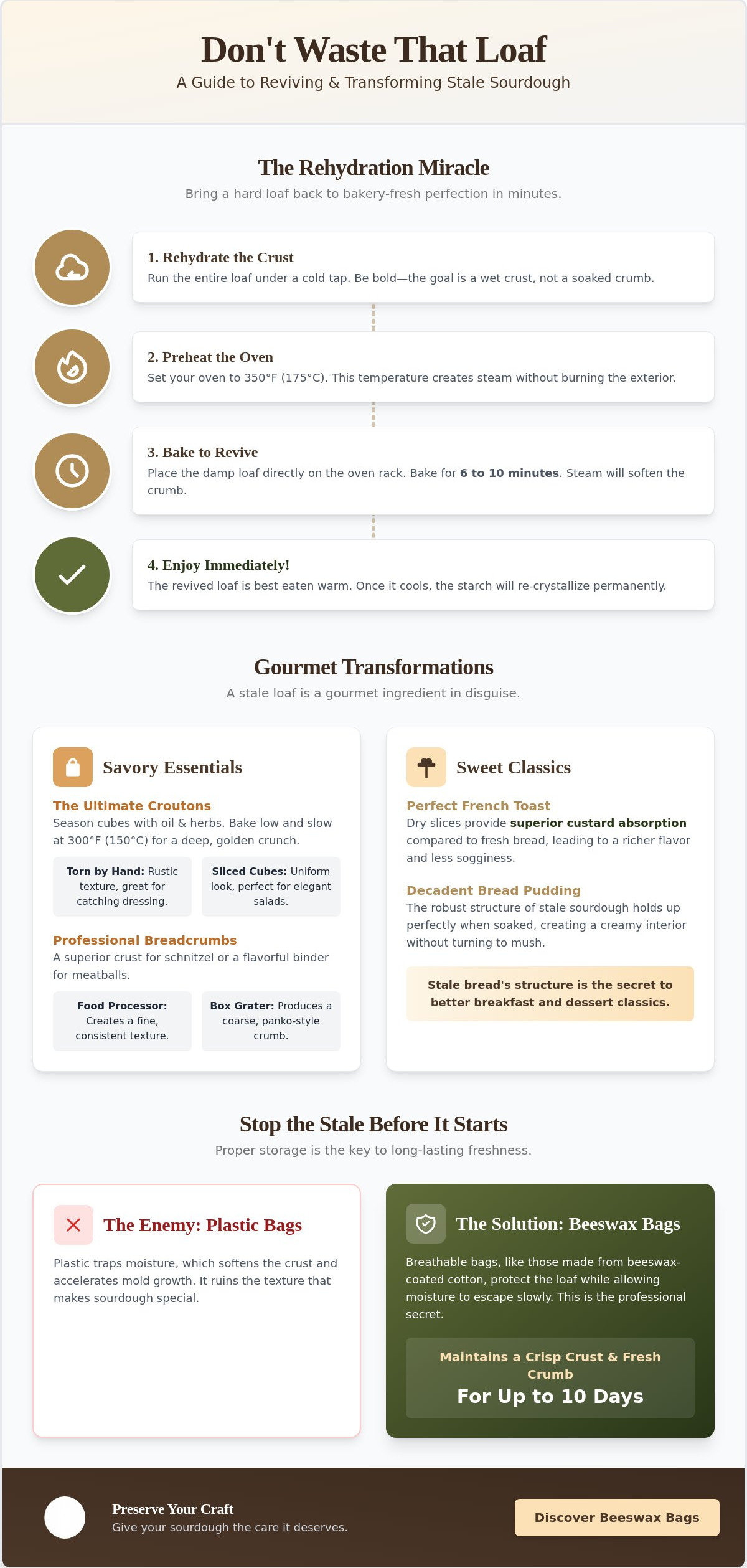
- Step 1: Run the entire loaf under a cold tap. Be bold. You want the crust wet, but don't soak the exposed crumb if the loaf is already sliced.
- Step 2: Preheat your oven to 350°F. This temperature is the sweet spot for creating steam without burning the exterior.
- Step 3: Place the damp loaf directly on the oven rack. Bake for 6 to 10 minutes. The water turns to steam, penetrating the crust and softening the heart of the bread.
- Step 4: Follow the cooling rule. You must eat this bread immediately. Once it cools a second time, the starch will re-crystallize permanently.
Dealing with "Rock-Hard" Slices
Whole loaves are easy to save, but individual slices require a different touch. If you only have a few pieces left, the oven might dry them out further. Try a steamer basket instead. Place your slices in the basket over boiling water for 30 seconds. This gently pushes moisture back into the grain. It's a game-changer for breakfast.
In a true emergency, use the microwave hack. Wrap a slice in a damp paper towel and heat it for exactly 10 seconds. It won't be perfect, but it will be edible. Avoid the toaster for extremely dry slices. The intense, dry heat of a toaster often turns a stale slice into a literal rock. Respect the grain, use moisture, and enjoy your revived sourdough tonight.
Savory Transformations: From Hard Crusts to Gourmet Essentials
Stale sourdough isn't a problem to solve; it's a gourmet ingredient waiting for a transformation. While most people see a dry loaf as a loss, professional chefs see an asset. The unique acidity of sourdough provides a flavor profile that commercial white bread simply cannot replicate. When you are deciding what to do with stale sourdough bread, look toward savory essentials that benefit from a robust, tangy foundation. The hardened crust is a result of polymer crystallization, which provides a structural integrity that soft bread simply can't match.
Safety is your first priority. A rock-hard boule can easily deflect a standard kitchen blade, leading to slips and injuries. Don't risk your fingers. Use The Sourdough Knife. Its high-carbon serrated edge is specifically designed to bite into the toughest crusts without slipping. Once you've safely broken down the loaf, you can begin the transformation. Infuse your stale cubes with rosemary, crushed garlic, and high-quality olive oil to create a base that rivals any high-end bistro.
The Ultimate Sourdough Crouton
Texture is everything. You have two choices: tearing or slicing. Tearing the bread by hand creates jagged edges and deep nooks that catch oil and salt. It produces a rustic, crunchy exterior with a slightly chewy heart. Slicing provides a clean, uniform look for elegant dinner parties. For the best results, use the "low and slow" oven method. Bake your seasoned cubes at 300°F for 20 to 30 minutes. This slowly draws out moisture and creates a deep, golden crunch that won't break your teeth. Store your finished croutons in a cool, dry place to prevent the fats from going rancid.
Sourdough Breadcrumbs and Crostini
Sourdough breadcrumbs are the secret to a superior crust on schnitzel or a more flavorful binder for meatballs. For a fine texture, pulses in a food processor work best. If you prefer a coarse, crunchy panko-style crumb, use a box grater on a very dry loaf. If you still have a semi-soft center, you can create perfect crostini. Slice the bread into thin rounds using your serrated knife. Because sourdough is dense, you can slice it thinner than other breads without it crumbling. Brush with butter and toast until crisp. To keep your next loaf from reaching this "rock-hard" stage too quickly, consider switching to a breathable beeswax Bread Bag for better moisture regulation.
Sweet Sourdough Seconds: Breakfast and Dessert Classics
Stale bread isn't a kitchen tragedy. It's a breakfast miracle. When you're deciding what to do with stale sourdough bread, think beyond the savory. Its unique acidity creates a complex flavor profile that balances perfectly with sweet syrups. Dry bread acts like a sponge. Fresh bread collapses under the weight of custard. Stale sourdough stands firm. It absorbs every drop of vanilla-scented cream without losing its character. This structural integrity is why your favorite brunch spot likely uses bread that's a few days old.
The "tang factor" is your secret weapon. Sourdough acidity cuts through the heavy sweetness of maple syrup and sugar. It adds a sophisticated layer to desserts that usually feel one-dimensional. To achieve the best results, use the overnight soak technique. Submerge your dry slices in a custard mix and let them rest in the fridge. This allows the liquid to reach the very center of the dense crumb. By morning, you'll have a base that's ready to transform into a gourmet masterpiece.
Sourdough French Toast for a Crowd
Slice your bread thick. We recommend a "Texas Toast" style, at least two inches thick, for the most satisfying results. This thickness allows for a custardy, pudding-like center while the exterior crisps up in the pan. Sourdough's crust remains its greatest asset here. It provides a satisfying chew that soft white bread cannot offer. Pair your French toast with honey, fresh berries, and a dollop of mascarpone. The bread's natural tang complements the richness of the cheese beautifully. Your guests will notice the difference immediately.
The Richness of Sourdough Bread Pudding
Sourdough bread pudding is a masterclass in texture. Don't be afraid to mix different ages of bread. Combine a few rock-hard ends with some slightly soft slices. This variety creates a more interesting mouthfeel in every bite. Sourdough is the perfect foil for heavy cream and sugar. It prevents the dessert from becoming cloying or overly sweet. Stale bread is the structural skeleton that supports the weight of a great pudding. This method respects the effort you put into the original bake by ensuring every crumb is savored. Your sourdough deserves this level of attention.
The Science of Starch: Why Sourdough Stales (and Why Plastic is the Enemy)
Your sourdough is a living masterpiece. It doesn't just "get old". It undergoes a complex chemical transformation known as retrogradation. Starch molecules, once soft and hydrated from the oven's heat, begin to reform into a rigid, crystalline structure. This is the root cause of that rock-hard texture. While you've already learned what to do with stale sourdough bread in our previous chapters, understanding the "why" helps you prevent it entirely. Sourdough has a secret weapon: lactic acid. This byproduct of fermentation acts as a natural preservative. It slows down the staling process compared to commercial loaves. But even the best fermentation can't survive poor storage decisions.
Artisan bread loses its life force through two main paths: evaporation and distribution. Evaporation is the loss of water to the surrounding air, which happens rapidly in paper bags. Distribution is more subtle. It is the movement of water from the moist interior to the dry crust. When this happens, the crumb becomes dry and the crust becomes leathery. Sourdough's dense structure and unique acidity help manage this moisture better than most breads, but only if the environment allows it. Your bread needs to breathe, but it shouldn't be exposed to the elements. It is a delicate dance between keeping the water in the crumb and keeping the crust dry enough to stay crisp.
Why Traditional Storage Fails
Plastic is the enemy of the artisan crust. It creates a moisture trap. As the bread breathes, moisture migrates from the crumb to the crust. In a plastic bag, this water has nowhere to go. It sits on the surface, creating the "sweat effect". Within 48 hours, your beautiful, crackly crust becomes rubbery and tough. Worse, this trapped humidity encourages mold growth. Paper bags aren't much better. They allow too much evaporation. A paper bag is a 12-hour solution at best. You need a middle ground that balances breathability with protection. Learn How Humidity Affects Bread Storage to master this delicate balance.
Temperature Matters: The Fridge Fallacy
Stop putting your bread in the fridge. It is a common mistake to think the cold keeps it fresh. In reality, the refrigerator accelerates retrogradation. The "danger zone" for bread texture is between 35°F and 45°F. At these temperatures, starch molecules crystallize significantly faster than at room temperature. Your loaf will turn into a brick in half the time. The only time sourdough belongs in the cold is when it is sliced and tucked into the freezer for long-term storage. Otherwise, keep it on the counter at room temperature. Respect the science of your craft. Treat your loaf with the reverence it deserves by using a breathable beeswax Bread Bag to maintain its life force.
Stop the Stale: Professional Storage Secrets for 10-Day Freshness
Sourdough is an investment of time, spirit, and premium ingredients. You've mastered the fermentation. You've learned what to do with stale sourdough bread when the worst happens. Now, it's time to stop the cycle of waste before it begins. Traditional storage is a betrayal of your hard work. Plastic suffocates the crust and encourages mold. Paper dehydrates the heart of the loaf within hours. You need a professional solution that respects the inherent needs of your bread. Your loaf deserves a storage environment that breathes with it.
Beeswax is the gold standard for bread preservation. It is nature's perfect sealant. A beeswax-infused barrier provides a breathable shield that mimics the biological function of a rind. This allows just enough air circulation to keep the crust crackly while trapping essential moisture inside the crumb. Beeswax also possesses natural antibacterial properties. It actively works to extend the life of your bread. This isn't just storage; it's a preservation system for the modern, zero-waste kitchen. Move toward a sustainable lifestyle with organic cotton that lasts for years.
The beeswax Bread Bag Advantage!
Achieve 10-day freshness without compromise. Our 100% organic cotton and beeswax blend acts as a "second skin" for your sourdough boules. It regulates humidity perfectly to prevent the dreaded leathery texture. You will never go back to wasteful plastic or rock-hard loaves. Our community of enthusiasts highly recommends this method for its consistency and ease of use. The beeswax Bread Bag is the ultimate solution for bakers who demand bakery-quality results every single morning. It is a specialized tool for a specialized craft.
A Zero-Waste Sourdough Lifecycle!
Treat your bread with the reverence it deserves. For half-loaves or smaller boules, use beeswax wraps to seal the exposed crumb. This simple ritual of care improves your entire baking experience. It bridges the gap between a large-scale waste and a local, specialized approach to food. You've worked hard for that perfect crumb. Protect it with confidence. When you treat your bread as a living thing with specific needs, the results speak for themselves. Respect the crust. Save your next loaf today. Join the chorus of passionate specialists who have ditched plastic forever.
Respect Your Craft: Never Waste a Loaf Again
Your sourdough is the result of patience and skill. Don't let a hard crust end that journey. We've explored the rehydration miracle that restores life to a dry boule in minutes. We've seen how stale slices transform into gourmet French toast and professional-grade croutons. Knowing what to do with stale sourdough bread is a vital skill for any baker, but true mastery lies in preventing the stale before it starts. You've worked hard for that perfect crumb. It's time to protect it with the reverence it deserves. Respect the effort. Respect the ingredients.
Stop the cycle of waste today. Stop the stale and keep your sourdough fresh for 10 days with the beeswax Bread Bag. Designed by culinary professionals from Lyon, these bags are crafted from 100% organic cotton. Each one is infused with pure, antibacterial beeswax to create the perfect breathable environment. Your bread has inherent needs; treat it well. Join our community of enthusiasts and ensure every loaf stays as fresh as the moment it left the oven. Happy baking.
Common Questions About Sourdough Revival
Is it safe to eat stale sourdough bread if it is very hard?
Yes, it is perfectly safe to eat very hard sourdough bread. Staling is a chemical change in the starch known as retrogradation, not a sign of rot. As long as the loaf is free from mold and off-smells, it is an ideal candidate for revival. You are simply dealing with a loss of moisture and starch crystallization. Use our refresh technique to bring it back to life.
Can I use stale sourdough bread if it has a small spot of mold?
No, you must discard the entire loaf if you see mold. Mold is not just on the surface; it sends invisible roots deep into the porous crumb of your bread. Cutting off the spot is insufficient and unsafe. Respect your health as much as you respect your craft. If you are unsure what to do with stale sourdough bread, remember that safety always comes first.
How long does sourdough bread stay fresh in a beeswax bag?
Your sourdough will stay bakery-fresh for up to 10 days in a beeswax Bread Bag. This specialized environment allows the loaf to breathe while retaining its essential moisture. Unlike plastic, which encourages mold, the beeswax provides a natural, antibacterial barrier. It is the professional standard for preserving the life force of your artisanal bakes without the "sweat" effect of plastic.
What is the best way to slice a very hard, stale sourdough loaf?
Use a high-carbon serrated knife, such as The Sourdough Knife, to tackle a hard loaf. A straight-edged blade will slip and cause injury. Position the loaf securely and use a steady, sawing motion without applying excessive downward pressure. This ensures clean slices for croutons or crostini without crushing the internal structure. Safety is paramount when handling hardened crusts.
Does refreshing a loaf in the oven work more than once?
Refreshing a loaf in the oven typically only works once. The first time you add moisture and heat, you successfully reverse the starch crystallization. However, a second attempt usually results in a gummy crumb or a crust that is too hard to eat. Once you have refreshed a loaf, enjoy it immediately while it is at its peak. Do not try to refresh the same loaf twice.
Can I freeze stale sourdough bread to use for croutons later?
Yes, freezing is an excellent strategy for future repurposing. Slice or cube your bread before placing it in the freezer to make it easier to handle later. This stops the staling process in its tracks and prevents mold from taking hold. When you are ready to make croutons, you can toss the frozen cubes directly into the pan with oil and herbs for an instant gourmet addition.
Why does sourdough bread last longer than store-bought white bread?
Sourdough lasts longer because of its unique fermentation process. The lactic acid produced by the starter acts as a natural preservative, lowering the pH of the bread. This acidic environment is hostile to mold and spoilage bacteria. Commercial white bread lacks this protection and relies on artificial additives to achieve a similar shelf life. Sourdough's natural structure is built for longevity.
Can I use a Danish Dough Whisk to help with repurposing recipes?
Absolutely. The Danish Dough Whisk is a versatile tool that excels at mixing the heavy custards needed for French toast and bread pudding. Its unique design incorporates ingredients thoroughly without overworking the mix. It is perfect for ensuring your sweet sourdough transformations have a light, airy texture. Every tool in your kitchen should support the quality of your final dish and the integrity of your ingredients.


