

Your favorite linen bread bag might actually be the reason your expensive sourdough loaf is turning into a brick by tomorrow morning. It's a frustrating reality for every home baker. You spend thirty-six hours nurturing a starter and perfecting the crumb, only to have the air steal the life out of it. When comparing linen vs cotton bread bags, most people assume any natural fabric is a safe bet. They're wrong. Plain cloth often acts like a wick, pulling moisture away from your bread and leaving it stale before you can even make a second sandwich.
We know you respect the craft and value every organic ingredient. You deserve a storage solution that treats your bread with the same reverence you do. This guide reveals the definitive winner in the fabric debate and explains why traditional wraps are falling short in 2026. We'll show you how to maintain that elusive crispy crust while keeping the interior pillowy soft for over five days. You will learn why a beeswax-infused hybrid is the only way to stop mold and staleness in their tracks. It's time to stop settling for rubbery plastic or bone-dry cloth. Give your loaves the sanctuary they deserve.
Key Takeaways
- End the confusion over linen vs cotton bread bags and discover which material keeps your sourdough freshest.
- Stop suffocating your loaves in plastic and learn how to preserve that signature artisan crunch.
- Discover why beeswax-infused cotton is the 2026 breakthrough for extending bread life to five days.
- Master the balance of airflow and moisture to prevent mold without drying out your crumb.
- Treat your craft with reverence by choosing storage that actually works for your bread.
Stop Suffocating Your Sourdough: The Fabric Revolution
You didn't spend three days nurturing a starter just to let a plastic bag ruin the result. Most bakers treat storage as an afterthought. That's a mistake. Your sourdough is a living masterpiece. It needs an environment that respects its structure. In 2026, the debate over linen vs cotton bread bags has evolved. We've moved past simple cloth to smarter, more specialized solutions. If your crust feels like rubber or your crumb is hard as stone, your storage is failing you. It is time to upgrade your expectations.
The Problem with Plastic and Paper
Plastic bags are a death sentence for artisan crusts. They trap every ounce of moisture inside. This creates a tiny greenhouse effect that invites mold spores to feast. Your beautiful, crackling crust turns into a soggy, rubbery mess within hours. Paper bags sit at the other extreme. They act as a desiccant. They suck the soul out of your bread, leaving you with a rock-hard loaf by dinner time. Fabric is the only medium that understands the breathability your bread requires. It provides a buffer that plastic and paper simply cannot match. It respects the baker's craft by allowing the loaf to age gracefully.
Your Bread is Alive: Treat it With Respect
Staleness isn't just about drying out. It is a chemical process called starch retrogradation. As bread ages, water moves from the soft crumb to the crispy crust. If that water has nowhere to go, the crust gets soft and the crumb gets tough. If it escapes too fast, the whole loaf dies. The unique properties of linen and cotton help manage this migration. They allow just enough air to pass through to keep the crust alive while protecting the interior moisture.
The emotional reward of slicing into a perfect loaf on day four is incomparable. You deserve that satisfaction! That's why we advocate for the beeswax Bread Bag. It combines the natural breathability of organic cotton with a protective beeswax seal. It's the 2026 standard for bakers who refuse to compromise on quality. Your bread deserves a sanctuary, not a coffin. Let it breathe. Let it last. Give your hard work the protection it has earned.
Linen Bread Bags: The Old-World Standard for Crispy Crusts
Linen is the undisputed king of the traditional French bakery. For centuries, boulangeries have relied on this flax-based fabric to protect their legendary baguettes. It is a material built for strength, endurance, and performance. When you weigh the options of linen vs cotton bread bags, you are essentially choosing between maximum airflow and moderate insulation. Linen is famously porous. This allows your sourdough to breathe exactly the way it needs to during those first critical hours out of the oven. It is the romantic choice for any baker who values heritage.
Flax fibers are truly remarkable. They are naturally antimicrobial. This inherent quality helps ward off mold spores that love to hide in dark, damp storage areas. Adhering to the principles of proper food storage is essential for any serious home baker. Linen supports these standards by preventing the "greenhouse effect" that ruins artisan bread. It remains the gold standard for loaves you plan to slice and enjoy within 24 to 48 hours. If you want that bakery-fresh experience on day one, linen is your best companion.
The Pros of Flax-Based Storage
Superior airflow is the secret to a world-class crust. Linen provides unmatched ventilation that keeps the "crunch" in your sourdough while letting excess steam escape safely. These fibers are also incredible workhorses in the kitchen. They can hold up to 20% of their weight in moisture before they even begin to feel damp. This helps regulate the immediate micro-environment around your loaf. Better yet, linen is a sustainable choice that actually improves with age. It softens and becomes more effective with every wash. It is a lifetime investment for your craft. You will feel the quality every time you handle it.
The Linen Downside: The Staleness Factor
The very breathability that saves your crust can eventually kill your crumb. High porosity means moisture escapes the interior of the bread quite quickly. If you live in a dry climate or have a low-humidity kitchen, linen might be too aggressive for your needs. It acts like an open window in a storm. Without a very tight weave, your sourdough will turn into a giant crouton faster than you'd like. It simply doesn't offer the insulation needed for a slow, controlled age.
Linen is a beautiful choice, but it often lacks the moisture seal required for long-term freshness. It is perfect for a dinner party but risky for a week-long loaf. For those who want the breathability of fabric with the protective seal of a modern solution, consider how a beeswax-infused option bridges the gap. It provides the best of both worlds without the drying risks associated with pure flax. Treat your bread with the reverence it deserves. Don't let a simple fabric choice ruin your hard work. Your loaves deserve better.
Cotton Bread Bags: Softness Meets Daily Durability
While linen is the romantic choice of the French countryside, cotton is the practical powerhouse of the modern kitchen. Many bakers dismiss cotton as a budget alternative to flax. That is a mistake. In the ongoing debate of linen vs cotton bread bags, cotton offers unique structural benefits that linen simply cannot match. It provides a tighter weave and a more consistent moisture barrier. This makes it an essential tool for anyone who bakes more than just crusty boules. If you love soft rolls, brioche, or standard sandwich loaves, cotton is your best ally.
We respect the effort you put into every knead. You shouldn't have to settle for a storage solution that treats your bread like an afterthought. Cotton is accessible, durable, and highly effective when used correctly. It bridges the gap between the extreme breathability of linen and the suffocating grip of plastic. It is the reliable, daily-driver of the bread storage world. Your kitchen deserves a material that works as hard as you do.
Why Weave Density Matters
Not all cotton bags are created equal. The density of the weave dictates exactly how long your loaf will stay soft. A thin muslin bag is often too porous; it lets moisture escape almost as fast as linen does. On the other hand, a heavy canvas can be too restrictive. We recommend a medium-weight organic cotton for the best results. This specific density provides several key benefits:
- Light Protection: Cotton blocks UV rays that can degrade the quality of your bread.
- Dust Barrier: The tighter weave keeps kitchen debris away from your crumb.
- Controlled Gas Exchange: It allows the bread to "exhale" without losing its vital internal hydration.
Always look for GOTS-certified organic cotton. Your sourdough is a porous sponge. It will absorb whatever chemicals are present in the fabric it touches. Choosing organic ensures your food stays pure and chemical-free.
Maintenance and Longevity
Cotton excels in a busy home. It is significantly easier to maintain than specialty linen. You can toss it in the wash without worrying about the extreme shrinkage or permanent wrinkling that plagues flax fibers. It handles the high hydration of modern sourdough recipes with ease, absorbing excess exterior moisture without becoming a soggy mess. It is a resilient material that stands up to years of daily use. Cotton is the dependable foundation of a sustainable, plastic-free bread storage routine.
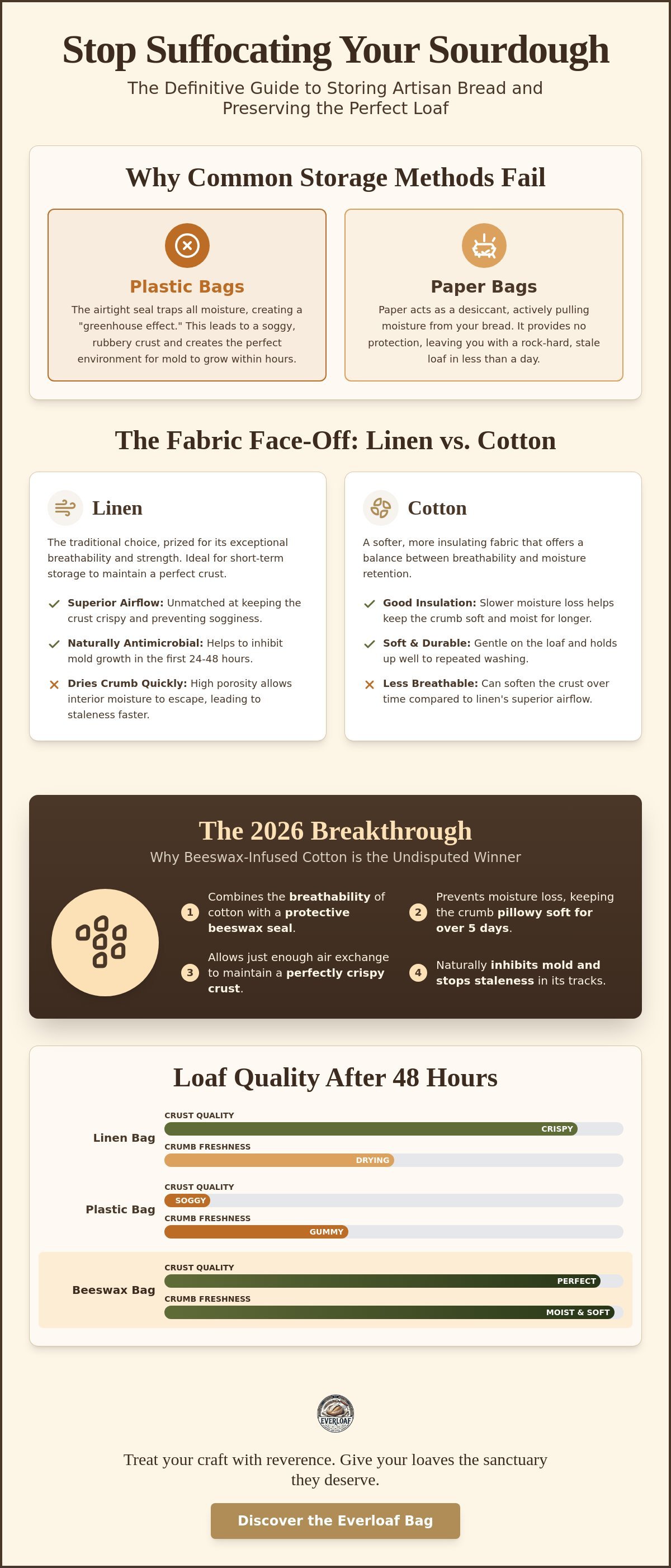
The 48-Hour Face-Off: Linen vs. Cotton Performance
The forty-eight-hour mark is the moment of truth for any artisan loaf. This is when the battle between hydration and evaporation reaches its peak. When you compare linen vs cotton bread bags, you are looking for a winner that protects the integrity of your work. Your sourdough has a personality. It reacts to the air, the heat, and the fabric surrounding it. We've tested the limits of both materials to see which one truly honors your craft after two days on the counter.
The Science of Staling
Environment is everything. The way humidity affects bread storage determines whether your loaf stays succulent or turns into a brick. Linen is a high-performance athlete in humid kitchens. It wicks away excess moisture to prevent the crust from becoming a swampy mess. However, in cooler or drier settings, that same breathability can be a liability. Temperature acts as a catalyst for staling. Cold air accelerates starch crystallization. Fabric storage requires a stable, room-temperature environment to succeed. Breathability is a double-edged sword. It saves the crust but can eventually starve the crumb of its vital water content.
Sustainability also plays a role in your choice. Flax farming, which produces linen, is an ecological hero. It requires significantly less water and fewer pesticides than conventional cotton. If you choose cotton, prioritize organic options to ensure your storage remains as pure as your ingredients. Both fabrics offer a plastic-free, sustainable footprint that respects the planet while respecting your bread.
Which Should You Choose?
Your choice depends on your personal bread philosophy. Do you live for the "crunch"? Choose linen. It is the only material that maintains a hard, European-style crust for the full 48-hour window. It feels specialized and professional. Do you prefer a versatile, softer loaf for daily sandwiches? Choose cotton. Its tighter weave provides the insulation needed to keep the interior pillowy for longer. It is also more flexible and easier to store in crowded pantries.
The reality is that neither fabric is a miracle worker. By day five, both plain linen and cotton will struggle to keep a loaf from drying out. They are excellent short-term solutions, but they lack a true moisture seal. For those who demand perfection beyond the second day, the 2026 standard has shifted. Experience the difference for yourself by switching to the beeswax Bread Bag. It provides the breathability of fabric with the longevity of a sealed container. Don't settle for half-measures. Give your sourdough the five-day freshness it deserves.
Beyond Plain Fabric: Why Beeswax-Infused Cotton Wins in 2026
You have seen the limits. Linen dries the crumb too fast. Cotton breathes just enough to let the moisture slip away. It is time to stop choosing between two half-measures. Choosing between linen vs cotton bread bags is a 20th-century problem. In 2026, the most dedicated bakers have moved beyond plain fabric. Your sourdough is a masterpiece of fermentation. It deserves a shield, not just a covering. We have engineered a solution that respects the biological needs of your bread.
Infusing organic cotton with pure beeswax creates the perfect micro-environment. It mimics the natural protection of a fruit peel. The wax allows the bread to breathe while locking in the essential hydration that keeps the crumb pillowy. This is the engineered evolution of bread storage. The Everloaf beeswax Bread Bag is the definitive choice for the modern kitchen. It ends the trade-off between a crispy crust and a soft interior. You can finally have both.
The Everloaf Difference: 10-Day Freshness
While plain fabrics struggle after forty-eight hours, our infusion process changes the game. The wax layer prevents the crumb from drying out entirely. It acts as a moisture-regulating barrier that plain linen simply cannot match. Beeswax is also naturally antimicrobial. It provides an active defense against mold that raw fabric lacks. Your bread stays safe, fresh, and delicious for much longer. Check out The Best Bread Bags of 2026 to see how this technology ranks against the competition. You will see why the community is making the switch.
Caring for Your Premium Storage
Maintaining your bag is simple and sustainable. You don't need harsh chemicals or high heat. A quick rinse in cold water maintains the wax integrity for years. It is a one-time investment that pays for itself in saved loaves and reduced waste. Join the thousands of bakers who have abandoned single-use plastic and ineffective cloth. Treat your craft with the reverence it deserves. Your hard-earned loaves are worth the upgrade. Give them the sanctuary they need to thrive on your counter. Experience the joy of a fresh slice, even on day seven. It is time to bake with confidence.
Protect Your Craft with 2026 Standards
Your journey through the linen vs cotton bread bags debate ends here. You now understand that while linen preserves the crunch and cotton offers softness, both fall short of long term freshness. Your artisan loaves are living things. They require more than just a simple cloth covering to survive the week. Don't let your hard work go to waste because of outdated storage methods. Respect the process and the ingredients you have chosen.
It is time to embrace a professional solution. Upgrade to the Orvix Beeswax Bread Bag for 10-Day Freshness. This specialized tool is crafted from 100% organic cotton and infused with pure, antibacterial beeswax. It was designed by culinary professionals from Lyon, France, to ensure your bread receives the reverence it deserves. You have mastered the bake. Now, master the storage. Your kitchen, your family, and your sourdough will thank you. Keep baking with passion.
Frequently Asked Questions
Is linen better than cotton for sourdough bread?
Linen is superior for maintaining a crackling, artisan crust because of its high breathability. When comparing linen vs cotton bread bags, linen allows more moisture to escape, which prevents the crust from becoming rubbery. Cotton is often a better choice for softer sandwich loaves that require more insulation. Choose the material that respects the specific needs of your bake!
Can I wash my linen or cotton bread bag in the machine?
Yes, you can machine wash plain linen and cotton bags on a gentle cycle with cold water. Avoid scented detergents that could transfer chemical odors to your fresh bread. If you are using a beeswax Bread Bag, never put it in the machine. Simply wipe it down or rinse with cool water to preserve the protective wax layer and ensure its longevity.
How long does bread stay fresh in a fabric bag?
Artisan bread typically stays fresh for two to four days in a high-quality fabric bag. Plain linen or cotton bags are best for the first forty-eight hours of enjoyment. For extended freshness reaching five days or more, specialized beeswax-infused options are the 2026 standard. They provide the moisture seal necessary to keep the interior crumb soft and succulent.
Do fabric bread bags prevent mold?
Fabric bags prevent mold by allowing air to circulate around the loaf. Unlike plastic, which traps moisture and creates a greenhouse for spores, breathable cloth keeps the surface of the bread dry. This airflow is your best defense against spoilage! For added protection, beeswax-infused fabrics offer natural antibacterial properties that further discourage mold growth on your hard-earned loaves.
Should I put my bread bag in the refrigerator?
Never store your bread bag in the refrigerator. Cold temperatures actually accelerate the staling process through starch retrogradation. It will turn your beautiful sourdough into a dry, crumbly mess much faster than room temperature storage. Keep your bag in a cool, dry spot on your counter to ensure your bread receives the treatment it deserves.
What is the best way to store bread with a very high hydration?
High-hydration sourdough needs a storage medium that manages significant moisture without suffocating the crust. A breathable fabric bag is essential for these loaves. It allows excess water to evaporate slowly rather than pooling on the surface. This delicate balance ensures the bread remains structural and delicious rather than becoming soggy or inviting mold growth.
How do I stop my bread from getting hard in a cloth bag?
Stop your bread from hardening by ensuring the bag has a tight weave or a protective coating. If you find your linen vs cotton bread bags are drying out your loaves too quickly, ensure the bag is closed tightly. For maximum protection, use a beeswax-infused bag. It creates a natural barrier that locks in the crumb's moisture while the fabric protects the exterior.
Are beeswax bread bags better than plain cotton?
Beeswax bread bags are the superior choice for bakers seeking maximum longevity and performance. While plain cotton is a great starter option, the beeswax infusion provides a natural seal that mimics a fruit peel. It offers the breathability of fabric with the moisture retention of a sealed container. It is the ultimate upgrade for anyone serious about their sourdough craft!


