

Plastic isn't a storage solution for artisanal bread; it's a death sentence for its texture. You've spent hours kneading, proofing, and baking to achieve that perfect golden crust. It's frustrating to wake up to a rubbery loaf that's lost its life because you didn't know how to store homemade bread without plastic. We've all felt the guilt of tossing another single-use bag into the bin while wondering why our bread goes moldy so fast. With annual plastic packaging waste projected to increase by 31 percent by 2040, the need for a change is urgent.
You deserve a better way. This guide reveals the professional secrets to maintain a bakery-quality crust for three days or more. You'll discover how to honor your craft using natural, breathable materials that respect the environment as much as your kitchen. In 2026, texture is the ultimate priority for enthusiasts. We'll dive into the science of bread spoilage and explore sustainable, lifelong storage solutions that keep your crumb soft and your crust crisp. It's time to treat your bread with the reverence it deserves.
Key Takeaways
- Stop suffocating your crust. Discover why plastic bags trap moisture and how to avoid the "sweat effect" that ruins artisan texture.
- Master how to store homemade bread without plastic using traditional linen methods and stable micro-environments for room-temperature freshness.
- Learn the professional two-layer freezing secret. Use foil and fabric to lock in flavor for months without relying on single-use waste.
- Revive rock-hard loaves with ease. Our miracle Water Bath Method brings stale bread back to life in minutes.
- Experience 10-day freshness. Find out why the hybrid design of the beeswax Bread Bag outperforms every other storage solution on your counter.
The Problem with Plastic: Why Your Crust Goes Rubbery
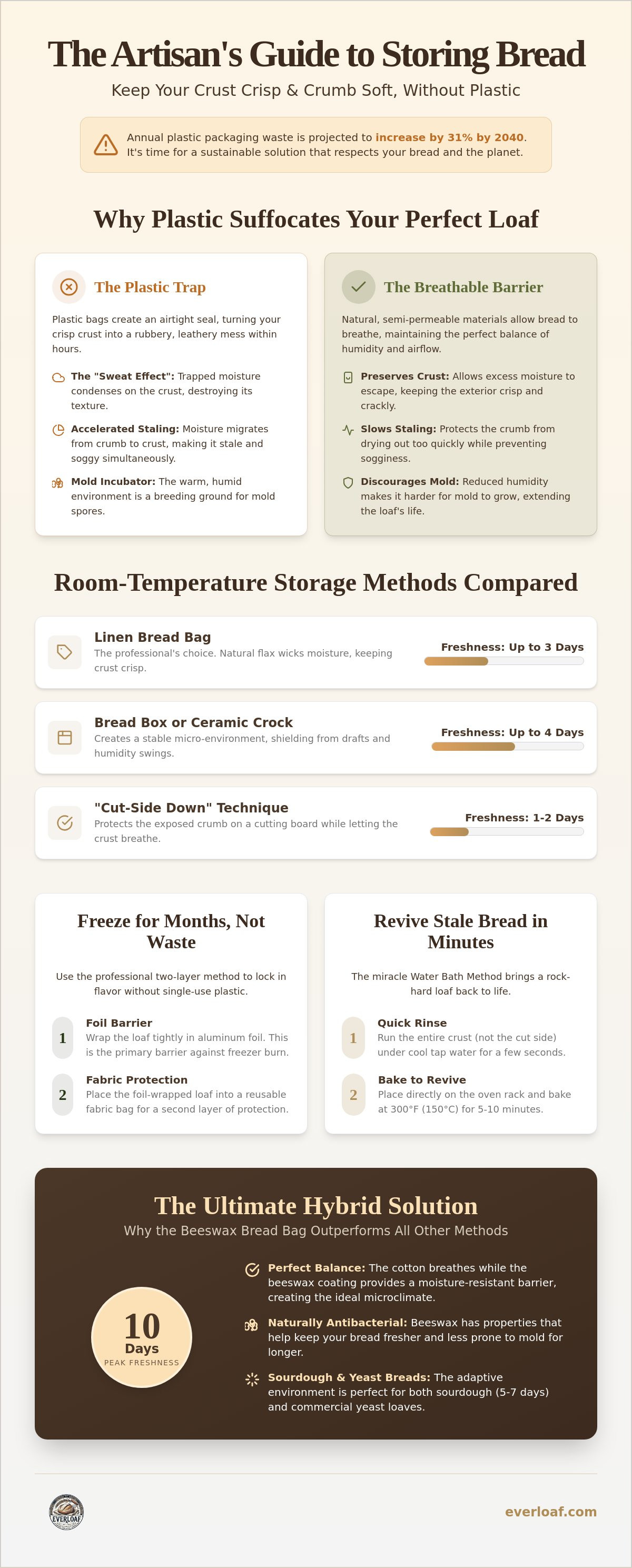
You didn't spend twelve hours nurturing a starter just to wrap the result in a grocery bag. Plastic is the ultimate enemy of the artisan loaf. It turns a crisp, crackling crust into a leathery, rubbery mess within hours. This happens because of the "Sweat Effect." As bread cools, it naturally releases moisture. In a plastic bag, that steam has nowhere to escape. It settles back onto the crust, destroying the tension you worked so hard to create during the bake. It's a trap that many home bakers fall into, but it's entirely avoidable.
Staling isn't just about your bread drying out. Even in a sealed environment, the process of bread staling continues as starch molecules recrystallize. This is known as starch retrogradation. Airtight storage actually accelerates the migration of moisture from the soft crumb to the crispy crust. By trying to keep the bread "fresh" in plastic, you're actually making it go stale and soggy at the same time. Professional bakers know that true freshness requires a barrier that breathes.
Then there's the issue of mold. A plastic bag creates a warm, humid microclimate. It's a literal incubator for spores. In humid environments, a loaf trapped in plastic can develop mold spots in half the time of a loaf stored in a breathable medium. Plastic doesn't protect your bread; it suffocates it. Understanding how to store homemade bread without plastic is the first step toward respecting your craft and your health.
Humidity vs. Airflow: Finding the Balance
A fresh boule needs a semi-permeable environment. Paper bags often swing too far in the opposite direction. They allow too much airflow, which turns your beautiful bread into a rock by morning. The secret is the "cut side down" technique. Place the sliced end of your loaf firmly against a wooden cutting board or inside a dedicated breathable bag. This protects the exposed crumb while letting the crust stay dry and crisp. It's the simplest way to maintain that bakery-quality contrast between the exterior and interior.
Sourdough vs. Yeast Bread Storage
Not all loaves are created equal. Sourdough is a natural survivor. It can stay fresh for 5 to 7 days on your counter because its lactic acid acts as a natural preservative. Commercial yeast loaves lack this biological defense. They are more prone to drying out and require slightly more moisture protection than their tangy sourdough counterparts. If you are looking for a solution that handles both styles, the beeswax Bread Bag provides the perfect middle ground between airflow and hydration. It respects the unique needs of every loaf you bake.
The Best Plastic-Free Storage Methods for Room Temperature
Stop treating your hard-earned loaves like commodities. Your bread is alive, and it needs to breathe. Mastering how to store homemade bread without plastic is a journey back to traditional, high-quality craft. For centuries, master bakers relied on natural materials to preserve the "shatter-crisp" crust. These methods don't just look better on your counter; they perform better. They respect the integrity of your ingredients and the hours of labor you've invested.
Linen bread bags are the gold standard for high-turnover loaves. Unlike plain cotton, which can leave your bread dry within 24 hours, natural flax linen has unique wicking properties. It manages humidity by drawing excess moisture away from the crust while keeping the crumb tender. This is the traditional French method for a reason. It works. For those seeking expert validation, King Arthur Baking's guide to storing bread confirms that cloth is a superior choice for maintaining the integrity of artisan crusts compared to airtight alternatives.
If you want a more stable environment, look to the classic bread box. It creates a draft-free micro-environment that shields your boule from temperature swings. For even better results, consider a ceramic crock. The thermal mass of ceramic keeps humidity consistent. This prevents the rapid staling caused by dry kitchen air. It's a professional setup that delivers consistent, bakery-quality results every time you slice.
Why Linen is the Professional's Choice
Flax fibers are the secret. They are naturally breathable and incredibly durable. To get the most out of your linen bag, place your bread inside and tighten the drawstring. If you live in a very dry climate, try doubling up. Place the linen-wrapped loaf inside a wooden bread box. This creates a two-stage barrier. It maximizes longevity without sacrificing that signature crunch. It's the ultimate way to learn how to store homemade bread without plastic while keeping your kitchen beautiful.
Using Beeswax for Targeted Protection
Beeswax wraps offer a modern, high-performance alternative. They are perfect for protecting the cut side of your loaf. Simply mold the warm wrap over the exposed crumb to seal in moisture. Pure beeswax has natural antimicrobial properties. This helps keep your bread fresh and safe from spores. It's flexible, reusable, and remarkably effective. If you're ready to upgrade your kitchen, the beeswax Bread Bag combines the best of both worlds by pairing breathable cotton with the protective power of natural wax.
How to Freeze Homemade Bread Without Plastic
Freezing is the ultimate pause button for your baking. Many guides insist that double-wrapping in plastic is the only way to prevent freezer burn. They are wrong. You can achieve professional-grade results using sustainable materials that respect your bread and the planet. Learning how to store homemade bread without plastic in the freezer is about creating a multi-layered defense against cold, dry air. It is simple, effective, and keeps your hard work tasting fresh for months.
Decide on your strategy before you start. Pre-slicing your loaf offers maximum convenience for morning toast. However, freezing a whole loaf preserves the most internal moisture and flavor. If you choose to slice, use the "Flash Freeze" technique. Lay your slices on a stainless steel baking sheet for 40 to 60 minutes until they are firm. This prevents them from fusing into a single block. Once they are solid, you can stack them into a large glass jar or wrap them together without any sticking issues.
The most effective plastic-free method uses a two-layer approach: foil and fabric. Heavy-duty aluminum foil provides an excellent moisture barrier that is easily recyclable. For the best protection, wrap your cooled bread tightly in compostable parchment paper first, then a layer of foil. This prevents the foil from sticking to the crust. Finally, place the entire package inside a breathable outer layer to provide insulation against temperature fluctuations.
The Step-by-Step Plastic-Free Freeze
Precision matters here. Never rush a loaf into the freezer. You must cool the bread completely to 70°F before packing. If the bread is even slightly warm, it will create steam. That steam turns into ice crystals, which leads to the very freezer burn you are trying to avoid. Wrap the cooled loaf tightly in heavy-duty foil. For the ultimate defense, place the wrapped loaf inside a beeswax Bread Bag. This extra layer of wax-coated cotton provides a stable micro-environment that keeps the cold at bay. It is a professional setup that ensures your bread emerges with its soul intact.
Thawing for Bakery-Fresh Results
Your thawing method is just as important as the freeze. Never let bread thaw at room temperature inside a sealed bag; the moisture will migrate to the crust and make it soggy. For slices, go straight from the freezer to the toaster. The high heat of the "Toaster Transformation" revives the starches instantly. For a whole loaf, remove it from its wrappings and let it sit on the counter for two hours. Once thawed, mist the crust lightly with water and bake it at 350°F for 10 minutes. This regenerates the crust and makes it taste like it just came out of the oven for the first time.
Reviving Stale Bread: Don't Let Your Hard Work Go to Waste
Every baker knows the heartbreak of finding a rock-hard loaf on the counter. It feels like a betrayal of the hours you spent kneading and proofing. Stop throwing your hard work in the bin. Stale bread is not a failure; it is simply a change in state. Before you toss it, you must distinguish between "stale" and "spoiled." Staling is a scientific process where moisture moves from the starches to the crust. Spoiling, however, involves mold. If you see fuzzy spots or smell something sour and "off," it is time to say goodbye. If it is just hard, it is ready for a resurrection.
Mastering how to store homemade bread without plastic reduces staling, but even the best-stored loaf eventually loses its luster. When your bread becomes too tough to slice, you need to manage the humidity to bring it back to life. This prevents the "leathering" effect where the crust becomes chewy instead of crisp. You've already learned how to keep it fresh; now you need to learn how to save it when things go wrong. It is a vital skill for any serious home baker who respects their ingredients.
The 10-Minute Oven Resurrection
This sounds counterintuitive, but you need to get your bread wet. Run your stale, whole loaf briefly under a cold tap. You want the crust to be damp but not soaked. Place the wet loaf directly on the oven rack at 350°F for 10 to 12 minutes. The water turns to steam, penetrating the crust and re-gelatinizing the starches inside the crumb. This method only works once because the second time you heat it, the moisture is permanently driven out, leaving the structure brittle and dry.
Zero-Waste Culinary Ideas
Sometimes bread is past the point of a full resurrection. This is where your creativity shines. Authentic French croutons require the low moisture of sourdough scraps to achieve that perfect crunch. Similarly, the secret to a world-class Panzanella salad is using bread that is "too dry" to soak up the vinaigrette without turning to mush. For more tips on stopping this before it starts, check out our guide on How Humidity Affects Bread Storage. It is better to prevent staling than to cure it.
The best way to avoid the resurrection cycle entirely is to use a storage solution that manages moisture for you. Treat your next bake with the reverence it deserves by using a beeswax Bread Bag to maintain that perfect texture for days.
The Ultimate Hybrid: Why Beeswax Cotton Bags Win
You've mastered the bake. Now master the preservation. The search for how to store homemade bread without plastic ends with the hybrid beeswax bag. Standard linen bags are a noble start, but they often leave your bread dry and brittle by day three. Plastic is even worse; it turns your crust into a soggy, leathery sponge. The beeswax Bread Bag is different. It combines the natural breathability of organic cotton with the moisture-retention power of pure wax. It is the ultimate evolution in kitchen craft.
This choice isn't just about texture. It is about responsibility. The food and beverage sector generates 25 percent of all plastic packaging waste globally. Every time you reach for a reusable solution, you're voting for a cleaner planet. A high-quality beeswax bag replaces hundreds of single-use sleeves over its lifetime. It is a cost-effective, sustainable choice that pays dividends in flavor and environmental peace of mind. Truly understanding how to store homemade bread without plastic means choosing tools that respect both your loaf and the earth.
Engineered for Sourdough!
Artisan loaves have unique needs. They are often larger and more irregular than commercial bread. The Orvix design is specifically sized to accommodate substantial boules and batards without crushing the crust. We use 100 percent organic cotton to ensure no chemical leaching into your food. The "seal" factor is the secret weapon. Use the natural warmth of your hands to mold the bag around your bread. This creates a custom fit that locks in hydration exactly where it belongs while letting the crust stay crisp.
Caring for Your Natural Storage!
Maintenance is effortless and quick. Clean your bag with cold water and mild soap to preserve the integrity of the wax coating. Avoid hot water and direct heat, as these will melt your protective barrier. A single bag is designed for longevity, lasting for over a year of daily bakes. It is a professional-grade tool that becomes a staple of your morning routine. Ready to ditch the plastic? Shop the Orvix Beeswax Bread Bag here.
Master the Art of Lasting Freshness
Your artisan loaves deserve better than a plastic death sentence. Stop settling for rubbery crusts and premature mold. You now understand the science of how to store homemade bread without plastic using traditional linen, stable bread boxes, and professional freezing techniques. True respect for your craft means using materials that allow your bread to breathe while keeping the crumb perfectly soft. It's time to treat your kitchen to a storage solution that works as hard as you do.
Experience the difference of a professional hybrid. Our beeswax Bread Bag is crafted from 100 percent organic cotton and infused with pure, antimicrobial beeswax. Designed by culinary professionals from Lyon, it provides a stable micro-environment for your most prized boules. Keep your sourdough fresh for 10 days with the Orvix Beeswax Bread Bag. You've mastered the bake; now master the preservation. Go forth and share your best loaf yet!
Frequently Asked Questions
Does homemade bread stay fresh in a paper bag?
Paper bags are excellent for a single day of "shatter-crisp" crust. However, they allow too much moisture to escape the crumb. Your loaf will turn into a rock within 24 to 48 hours in a standard paper bag. It is a temporary fix, not a long-term solution for those who value a soft interior.
How do you store sourdough bread without plastic?
Sourdough thrives in breathable environments like linen or beeswax cotton. Its natural acidity acts as a preservative, allowing it to stay fresh for 5 to 7 days on the counter. Focus on protecting the cut side while letting the crust breathe. Learning how to store homemade bread without plastic is easiest with sourdough because of its resilient nature.
Can I use a tea towel to wrap my bread?
A clean tea towel is a fantastic short-term option. It provides a basic breathable barrier that prevents the crust from going soft. For better results, wrap the loaf tightly and place it in a draft-free spot like a wooden bread box. It's a simple, traditional method that respects the integrity of your bake.
How long does bread last in a beeswax bag?
A high-quality beeswax bag can keep your bread fresh for up to 10 days. The wax creates a semi-permeable seal that locks in moisture without causing the "sweat effect" found in plastic. This is the gold standard for longevity. It maintains the perfect balance between a tender crumb and a firm crust.
Is it better to store bread in the fridge or on the counter?
Never store your bread in the fridge. The cold temperature actually accelerates the staling process through starch retrogradation. Your loaf will become dry and crumbly much faster than it would at room temperature. Always keep your fresh bakes on the counter in a breathable, plastic-free environment.
Can I use aluminum foil to store bread long-term?
Aluminum foil is an excellent tool for long-term storage, especially in the freezer. It provides a total moisture barrier that prevents freezer burn. For the best results, wrap the bread in parchment paper first. This prevents the foil from sticking to the crust and ensures a clean release when you're ready to thaw.
How do I prevent my bread from getting moldy without plastic?
Preventing mold requires managing humidity and airflow. Plastic traps moisture and creates a breeding ground for spores. By switching to breathable materials like linen or beeswax, you eliminate the damp microclimate mold loves. Proper airflow is your best defense against spoilage in humid environments.
What is the best way to store bread once it is sliced?
Store sliced bread "cut side down" on a wooden board or inside a beeswax bag. This protects the exposed crumb from drying out while the crust remains exposed to air. If you've already sliced the whole loaf, stack the pieces tightly together to minimize the surface area exposed to the air. It's a simple trick that yields professional results.


