

Your artisan sourdough is a living thing that needs to breathe. Stashing your hard-earned loaf in a plastic bag is effectively building it a tomb! It is a common mistake that turns a beautiful, crunchy crust into a rubbery mess within hours. Finding the right bread loaf bags is about more than just storage; it is about respecting the craft you put into every bake. With 2026 regulations now prohibiting single-use plastic in many areas, there has never been a better time to upgrade your kitchen ritual for the long haul.
We know the frustration of watching a perfect loaf turn into a brick in a paper bag or lose its soul in a plastic wrap. You deserve better, and so does your bread. Our community of enthusiasts agrees that quality storage is the secret ingredient to a perfect meal. This guide will show you exactly how to master the art of storage to keep your crust crispy and your crumb soft for seven days or more. You will learn which materials actually work as a second skin for your bread and how to find a sustainable solution that lasts for years.
Key Takeaways
- Stop fighting dryness and start managing retrogradation. Learn the science behind why bread actually goes stale.
- Choose the right bread loaf bags for your specific crust. Plastic is for speed, but beeswax is for quality and longevity!
- Master the airflow balance. High-hydration loaves require a "second skin" that breathes without sacrificing the crumb.
- Bag like a pro. Discover why you should never store a warm loaf and the secret to slicing from the middle.
- Protect your craft naturally. Use the anti-bacterial power of beeswax to extend your bread's life to 7+ days.
Understanding the Science of Staling: Why Your Choice of Bag Matters
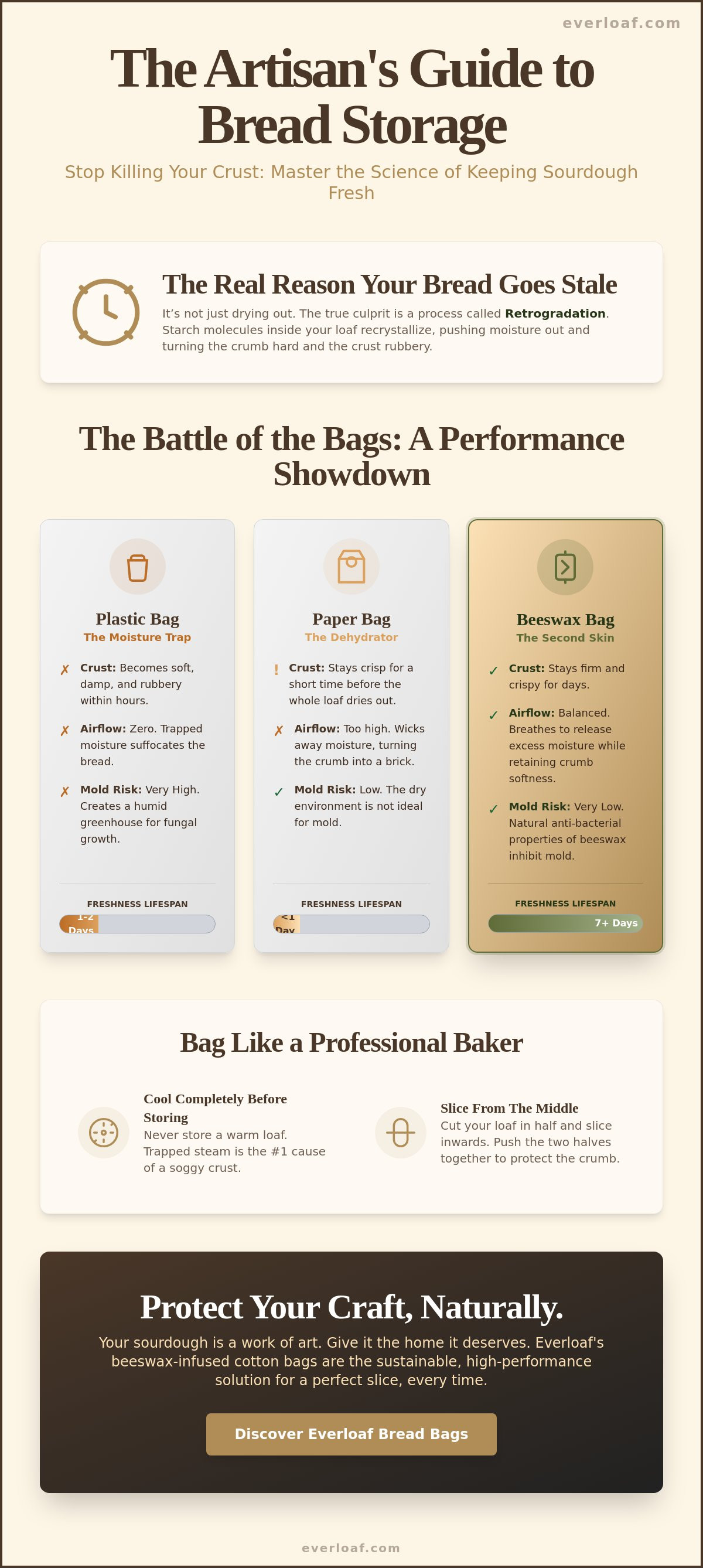
Most people think bread goes stale because it simply dries out. That is only half the truth. Real staling is a complex chemical transformation. As soon as your loaf leaves the oven, the clock starts ticking on a process called retrogradation. This is the science of staling in action. Starch molecules inside the crumb begin to crystallize, physically pushing water out of the bread's structure. If your bread loaf bags cannot handle this moisture migration, your beautiful loaf is doomed.
This creates what bakers call the "Skin Problem." When you use a standard plastic bag, that expelled water has nowhere to go. It sits on the surface of the bread. The once-shattering crust absorbs this moisture and turns into a soft, rubbery mess. You lose the very texture that makes artisan bread special. On the flip side, a paper bag allows too much moisture to escape. The crumb loses its hydration and your bread turns into a literal brick. Air is the thief of softness, but total sealing is the mother of mold. You need a solution that acts as a second skin.
Humidity vs. Airflow: The Baker’s Balancing Act
Artisan bread is a living product that needs to breathe. It continues to release natural gases and moisture long after the bake is finished. Your storage environment must be semi-permeable to maintain the perfect balance. High-quality bread loaf bags made from breathable materials manage this gas release without stripping the bread of its soul. Breathability is the specific ability of a storage material to regulate moisture exchange so the crust stays firm while the interior remains tender.
The Mold Factor: Why Plastic Can Be Dangerous
Plastic bags are a high-stakes gamble for your health and your pantry. They create a humid, stagnant microclimate that is a literal breeding ground for fungal spores. Condensation often forms inside the plastic, providing the exact environment mold needs to thrive. While the natural acidity of sourdough offers some protection, it is not a total shield. If your kitchen counter hits the temperature danger zone between 70 and 80 degrees Fahrenheit, a sealed bag becomes a greenhouse for decay. Professional bread loaf bags avoid this by preventing the "sweat" that ruins a good ferment. Respect the craft you put into your baking by choosing a home that keeps it safe.
Navigating the World of Bread Loaf Bags: From Plastic to Beeswax
Choosing the right storage is a choice between convenience and quality. The market for bread loaf bags is flooded with options that prioritize the retailer's bottom line over your crust's integrity. Most grocery stores rely on thin, clear plastic. It is cheap. It is fast. But it is not designed for your bread's health. Research from the Quadram Institute on the science of bread staling confirms that temperature and environment are everything. If you want your bread to taste as good on day four as it did on day one, you have to look beyond the supermarket standard.
Don't be fooled by the charming paper sleeve from the local bakery. It is a transport tool, not a storage solution. Paper is incredibly porous. It pulls moisture out of the crumb and releases it into the air. Leave your loaf in paper overnight and you'll find a dry, flavorless stone by morning. We are seeing a natural fiber revolution for a reason. Linen and cotton are the traditional heroes of the pantry. They allow just enough air to move while holding onto the core moisture of the crumb. It is a delicate dance that plastic simply cannot perform.
Disposable Plastic and Poly Bags
Plastic bags have one job: moisture retention. They excel at keeping soft-crust breads like brioche or sandwich loaves tender for days. However, they are a disaster for artisan sourdough. The trapped humidity destroys the crust texture and turns it into a gummy layer. There is also the environmental cost. With global sustainable food storage markets projected to reach over $240 billion by 2035, sticking to single-use plastic feels outdated. Use these only for short-term transport or when you need to freeze highly processed loaves.
Reusable Fabric and Beeswax Options
Beeswax-infused cotton is the ultimate upgrade for the serious baker. The mechanism is brilliant. The wax creates a semi-permeable barrier that mimics a natural rind or peel. It protects the interior while letting the bread "sweat" just enough to keep the crust firm. Organic cotton is also incredibly durable. It stands up to the sharp, jagged crusts of a well-baked sourdough without tearing. Our community highly recommends The Orvix Bread Bag as the premium standard for beeswax storage. It respects the effort of your 24-hour ferment by giving your bread a home that actually cares for it.
Comparing Performance: Which Bag Wins for Your Specific Loaf?
Your bread is an individual. A baguette is not a brioche. The "best" bread loaf bags don't exist in a vacuum. It depends entirely on the hydration of your crumb and the thickness of your crust. High-hydration sourdough requires constant airflow to prevent the interior from becoming soggy. A standard white loaf has lower moisture and needs a tighter seal to stay soft. Stop treating every bake the same way. The results speak for themselves when you match the bag to the bread's specific needs.
Consider the "Freezer Test." Not all bread loaf bags are ready for cold storage. Plastic becomes brittle and prone to cracking at low temperatures. Paper provides no barrier against the drying effects of the freezer. High-quality beeswax bags and wraps excel here. They provide a dense, protective shield that blocks ice crystals from reaching the crumb. While a paper sleeve gives you one day of peak flavor, and plastic offers three days of mediocre texture, beeswax extends your window. You get seven days of "just-baked" satisfaction without the rubbery side effects.
Best Bags for Crusty Sourdough and Artisan Boules
Beeswax-infused cotton is the gold standard for your sourdough. It maintains "the crunch" by acting as a breathable second skin. It allows the loaf to release gases without drying out. Paper-only storage is a trap for artisan bread. It leads to a "rock-hard" transition where the bread becomes a weapon by day two. Our community of bakers has found that you can keep your sourdough fresh for 10 days with the right care and a premium beeswax home. Respect the 24-hour ferment by choosing a bag that understands the science of the crust.
Best Bags for Soft Sandwich Breads and Brioche
Enriched doughs need a different touch. Brioche and sandwich loaves thrive on higher moisture retention because they lack a thick, protective crust. If you use a cloth bag, choose one with a very tight weave. This limits the air exchange and keeps the crumb pillowy. In desert climates or high-altitude areas, moisture vanishes instantly. Wrap your soft loaves in a beeswax wrap before placing them in a bag. This creates a moisture-lock that prevents the crust from turning into parchment paper. Your bread deserves an environment that fits its personality.
How to Bag Your Bread Like a Professional Baker
Mastering your bake is only half the battle. If you don't respect the storage process, you are throwing away hours of hard work. Professional bakers follow a strict set of rules when handling their loaves. The first and most vital is the Golden Rule: never bag a warm loaf. Doing so creates a "steam trap" that turns your crust into a soggy sponge. Your bread loaf bags are designed to protect your craft, not suffocate it. Give your bread the space it needs to settle before you tuck it away for the night.
Next, rethink your slicing strategy. Most people start at the end of the loaf. This is a mistake. Cut from the middle instead. When you are finished, press the two open faces together before placing them back into the bag. This creates a natural seal that keeps the crumb moist. For added protection, use the "Face-Down" technique. Place the cut side of your bread directly onto a wooden cutting board before sliding the bag over the top. This secondary seal acts as a barrier against the air, keeping the interior soft while the crust stays firm.
Maintenance is just as important as the technique itself. If you use reusable bread loaf bags, you must treat them with care. Wash them in cool water with a tiny drop of mild soap. Hot water is the enemy of beeswax. It will melt the protective coating and ruin the integrity of the fabric. Air dry your bags completely before the next use. A clean bag is a safe bag. Our community knows that a perfect loaf deserves a perfect finish.
The Cooling Phase: Patience is a Virtue
Patience is your best friend in the kitchen. Large boules need at least 2 to 4 hours to cool completely. The internal steam must escape naturally to set the crumb. If you bag too early, you're inviting mold to move in. You don't need a thermometer to know when it's ready. Simply press the bottom of the loaf against your inner wrist. If you feel even a hint of warmth, the bread is still breathing and is not ready for its home.
Maximising the Seal
Your folding technique matters. When using a beeswax bag, use the warmth of your hands to mold the fabric. This creates a custom, airtight seal that still allows the bread to breathe. In dry winter months, try the "Double Bag" method. Place your loaf in a linen liner before sliding it into the beeswax bag. Finally, choose your storage spot wisely. Never keep your bread on top of the fridge. The heat from the appliance's motor accelerates staling and ruins your hard work. Keep it in a cool, dark corner of the counter instead.
Ready to upgrade your storage game? Grab our professional beeswax bread loaf bags and give your bread the home it deserves.
Why Beeswax-Infused Cotton is the Future of Bread Storage
Your bread deserves a guardian, not just a container. Beeswax-infused cotton is that guardian. These bread loaf bags work harder than any plastic alternative could ever dream. Beeswax is naturally anti-fungal and anti-bacterial. It actively resists the spores that lead to decay and mold. This is not just a trend. It's a return to traditional pantry wisdom backed by modern, design-conscious engineering. When you choose beeswax, you're choosing a material that actually cares for the health of your food.
Think about the effort you put into your bake. You spend 24 hours or more on a single ferment. You obsess over the hydration and the oven spring. Why would you ruin that craft with a five-cent plastic bag? A high-quality storage solution respects the time you invested. It treats your bread with a level of reverence that matches your passion. Investing in the Everloaf Beeswax Bag is a statement. It says that the quality of your daily bread matters as much as the bake itself.
Sustainability is the other half of the story. One reusable beeswax bag can replace over 150 single-use plastic bags in a single year. With nearly 70% of shoppers now willing to pay more for sustainable packaging, the shift is undeniable. New 2026 regulations, like California’s SB 1053, are already pushing plastic out of our stores. You're saving more than just your crust. You're keeping microplastics out of your kitchen and your body. It's a cleaner, smarter way to manage your pantry.
The Natural Preservation of Beeswax
Beeswax creates a unique breathable barrier. It slows down moisture loss while preventing the stagnant humidity that ruins a crust. The sensory experience is a major bonus. You get a subtle, natural scent of honey every time you open the bag. Compare that to the clinical, chemical smell of factory plastic. It makes every sandwich feel like a boutique experience. Check out our deep dive into the best bread bags of 2026 to see how this natural solution leads the pack.
Sustainability Without Sacrificing Freshness
The lifecycle of an organic cotton bag is a closed loop. It serves your kitchen faithfully for a year or more with proper care. When it finally reaches the end of its journey, it doesn't sit in a landfill. It is fully compostable. "Plastic-Free" is not just a buzzword. It is a commitment to better eating and a healthier home. Our community of enthusiasts has already made the switch. Respect your bread. Ditch the plastic for good. Your sourdough will thank you for it.
Master Your Bread Storage Ritual Today
Your bread is a masterpiece. It deserves an environment that respects the chemical science of its crust and the soul of its crumb. You now understand that staling is a complex process of starch retrogradation; it is not just a simple loss of water. By choosing the right materials and mastering professional cooling and slicing techniques, you can maintain peak freshness for seven days or more. It's time to move beyond the suffocation of plastic and the dryness of paper. High-quality bread loaf bags are the final, essential step in your baking journey.
Protect your hard-earned loaves with a solution specifically designed for the craft. Our community of enthusiasts relies on materials that are 100% Organic Cotton and Infused with Pure Beeswax. This is a sustainable choice that honors your long ferment and your commitment to quality. It is more than just a bag; it is a second skin for your artisan creations. This storage method is Trusted by Artisan Bakers who refuse to compromise on texture or taste.
Take the final step toward perfect preservation. Upgrade your kitchen with the Orvix Beeswax Bread Bag. Give your bread the home it deserves and enjoy every crunchy, tender bite for days to come. Happy baking!
Common Questions About Artisan Bread Storage
Can I use these bread bags for freezing my loaves?
Yes, you can use beeswax bread bags for freezing, but they require a tight seal. Beeswax acts as a barrier against ice crystals. For the best results, wrap the loaf tightly in a beeswax wrap first, then place it inside the bag. This prevents freezer burn and keeps the crumb from drying out during long-term storage. It is a smart, plastic-free way to build a bread stash.
How do I clean a reusable beeswax bread bag?
Clean your bag with cool water and a drop of mild, alcohol-free soap. Never use hot water or put it in the dishwasher; heat will melt the wax coating instantly. Simply wipe it down or rinse it, then hang it to air dry completely. This simple routine maintains the anti-bacterial properties of the wax for a year or more. It is efficient and respects the material.
Will a bread bag prevent my crust from getting soft?
The right bread loaf bags maintain the crunch by allowing the loaf to breathe. Unlike plastic, which traps moisture and turns the crust rubbery, breathable beeswax or linen allows gas to escape. This regulation is the key to preventing that soggy texture. Always ensure your bread is fully cooled to room temperature before bagging to protect the crust's integrity and keep that shattering bite.
How long does sourdough bread stay fresh in a beeswax bag?
Sourdough typically stays at peak freshness for 5 to 7 days in a quality beeswax bag. Some enthusiasts in our community report great results for up to 10 days. The natural acidity of sourdough combined with the anti-fungal properties of beeswax creates a protective environment. This significantly extends the window for enjoying that perfect, tender crumb without the fear of rapid mold growth or drying.
Are linen bread bags better than plastic for artisan bread?
Linen is vastly superior to plastic for artisan loaves because it offers superior airflow. Plastic is a tomb that suffocates the bread and ruins the crust. Linen allows the bread to release moisture slowly. However, if you live in a very dry climate, a beeswax-infused cotton bag is even better. It provides the breathability of linen with a moisture-lock that prevents the bread from turning into a brick.
Do I need different bags for different sizes of bread, like baguettes?
Yes, using the correct size ensures the best seal and moisture regulation. A long, narrow baguette bag prevents too much air from circulating around the crust, while a large boule bag accommodates wider artisan rounds. Matching the bag to the shape of your loaf minimizes empty space. This helps maintain the internal humidity of the crumb while protecting the entire surface area of the crust effectively.
What happens if I put a warm loaf in a bread bag?
Putting a warm loaf in a bag creates immediate condensation and ruins the bread. The trapped steam will make the crust soggy and creates a damp environment where mold thrives. You must wait at least 2 to 4 hours for the internal temperature to stabilize. Professional results require patience. Bagging too early is the fastest way to waste a beautiful bake and invite decay into your pantry.
Can I use these bags for store-bought sliced bread?
You can use these bread loaf bags for store-bought slices, but the results differ from artisan loaves. Commercial bread often contains preservatives and has a very high moisture content. A beeswax bag will keep it soft, but it may not last as long as it would in its original airtight plastic. It is a fantastic way to ditch single-use plastic for your daily toast while keeping your kitchen organized.


