

Is your plastic bag actually suffocating your sourdough? Most bakers think they're protecting their craft by sealing it tight, but they're actually inviting a rubbery, moldy disaster. It's time to stop treating your bread like a commodity and start giving it the reverence it deserves. You spent days culturing that starter and hours perfecting the fold. It's heartbreaking to watch a beautiful loaf go stale or lose its signature crunch to a plastic wrapper.
With 70% of shoppers now demanding sustainable packaging and states like California banning plastic bags entirely as of January 2026, the shift is undeniable. You deserve a kitchen that reflects your values and your skill. Discover why artisan bakers are ditching plastic for reusable organic cotton bread bags and how a beeswax-infused microclimate preserves your sourdough crust for up to 10 days. This analysis explores the 2026 storage standards and the essential tools you need to maintain a professional-grade loaf at home. It's time to embrace a plastic-free, sustainable kitchen that actually works.
Key Takeaways
- Stop suffocating your bread. Learn why plastic is the enemy of the artisan crust and how to reclaim your kitchen’s quality.
- Master the science of breathability with reusable organic cotton bread bags to keep your sourdough in the perfect humidity "Goldilocks Zone."
- Explore the beeswax innovation. Discover how a controlled microclimate preserves your loaf’s integrity for up to 10 days.
- Size matters for freshness. Find out how to choose the right bag for your boules and baguettes to ensure a protective seal.
- Complete your craft. Storage is the final, crucial step in the baking process; treat your bread with the reverence it earned.
The 2026 Bread Storage Revolution: Why Reusable is Winning
Plastic is a relic. It is the silent killer of the artisan loaf. For decades, we accepted a compromise. We traded the soul of our bread for the convenience of a clear bag. That era is officially over. 2026 marks the year the home kitchen reclaims its standards. Bakers are no longer willing to sacrifice their hard-earned crusts to a single-use trap. We are witnessing a massive shift from disposable convenience to true culinary preservation. This isn't just about storage; it's about reverence for the craft. Choosing reusable organic cotton bread bags is a bold statement. It says you value the environment as much as you value a perfect, open crumb. Your bread worked hard to get here. Don't let it die in a plastic shroud.
The Death of the Plastic Bread Bag: "Finally, a bag that actually works!"
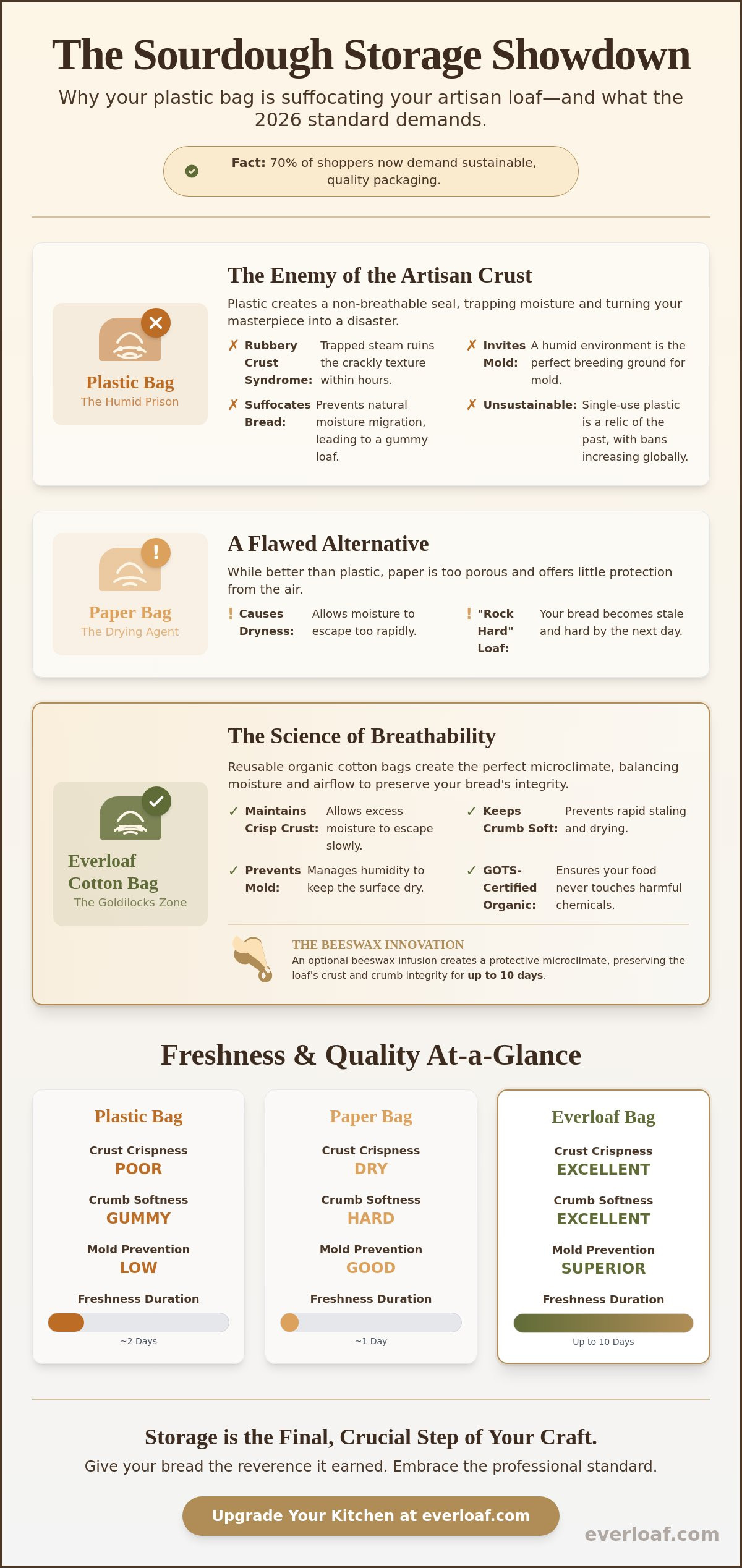
Plastic is a humid prison. It creates an environment where moisture has nowhere to go. This trapped steam settles on the surface of your loaf. Within hours, your crisp, crackly crust turns into a soft, rubbery mess. This is "rubbery crust syndrome," and it's the fastest way to ruin a sourdough masterpiece. Worse yet, that moisture invites rapid mold growth. Paper bags are not the answer either. They offer no defense against the air, leading to a dry, rock-hard loaf by the next morning. Understanding the science of food storage reveals that bread needs a specific balance. It must breathe to stay crisp, but it needs a barrier to stay soft. Plastic fails on both counts.
Defining the New Standard for Bread Care: "The only way I store my sourdough now."
A reusable organic cotton bread bag is a breathable microclimate designed to balance moisture and airflow perfectly. It's a specialized environment that respects the life of your loaf. Quality is the foundation of this new standard. GOTS-certified organic cotton ensures your food never touches synthetic pesticides or toxic chemicals. This is the gold standard for food contact in 2026. The Orvix aesthetic is taking over modern kitchens, replacing cluttered plastic with clean, minimalist design. Our beeswax cotton bread bags bring this professional standard to your counter. They look as beautiful as the bread they protect.
The numbers don't lie. With plastic bag bans like California’s SB 1053 now in full effect, the transition is a necessity. Nearly 70% of shoppers are now choosing sustainable packaging over cheap alternatives. They want longevity. They want quality. They want a kitchen that reflects their passion for real food. Switching to reusable organic cotton bread bags reduces waste and saves your bread. It's a win for your counter and a win for the planet. Stop settling for rubbery crusts. Give your bread the home it deserves.
The Science of Breathability: Why Organic Cotton Outperforms Plastic
Your bread is a living, breathing thing. Once it leaves the oven, it begins a complex chemical journey. This isn't just about "getting old." It's about retrogradation. Starch molecules that softened during baking start to recrystallize and return to a hard state. This process is inevitable, but its speed and result depend entirely on the environment. Plastic is a trap. It creates a humid prison that forces moisture back into the crust. This results in a gummy, rubbery texture that ruins the artisan experience. Using reusable organic cotton bread bags changes the physics of your counter. The heavyweight fabric acts as a thermal buffer. It protects your loaf from temperature spikes while allowing the starch to stabilize naturally.
Moisture Migration and the Crumb: "Finally, a crust that stays crisp!"
Moisture is always on the move. It travels from the hydrated center of your loaf toward the dry exterior. In a sealed plastic bag, this moisture hits a wall. It condenses and creates a swampy surface. This is how mold starts. Organic cotton is an active partner in preservation. It absorbs surface moisture and releases it slowly into the air. By adhering to safe food storage guidelines, you maintain a clean, breathable space for your bread. Natural fibers provide the "Goldilocks Zone" of humidity. It's just enough moisture to keep the crumb soft, but dry enough to keep the crust crackling. You don't have to settle for soggy bottoms ever again.
Preventing the Dreaded "Hard as a Rock" Loaf: "It stays soft for a week."
Many bakers confuse "stale" bread with "dry" bread. Staling is an internal chemical change; drying is a physical loss of water. Paper bags are too porous. They let water escape too fast, leaving you with a rock-hard batard by morning. Cotton slows this evaporation. It holds the line against dehydration. This is especially vital in high-altitude or arid climates where the air is hungry for moisture. If you want even more control, our beeswax cotton bread bags add an extra layer of protection. They mimic the protective skin of a fruit. They keep the internal moisture where it belongs while letting the bread breathe. It's the difference between a loaf that lasts two days and one that stays delicious for ten.
The Innovation Gap: Beeswax-Infused vs. Plain Cotton
Plain cotton is a massive victory for sustainability, but it has a secret weakness. In arid climates or low-humidity kitchens, standard reusable organic cotton bread bags can sometimes be too breathable. They allow moisture to escape so efficiently that your beautiful batard turns into a giant crouton within forty-eight hours. This is the innovation gap. While we celebrate the benefits of organic cotton for its purity and environmental impact, it needs a partner to reach professional-grade performance. That partner is pure, natural beeswax. It is the difference between a bag that just "holds" bread and a bag that actually preserves it.
Beeswax: Nature’s Smart Packaging: "The mold-fighting miracle!"
Beeswax isn't just a coating; it's a living shield. It transforms the fabric into a semi-permeable membrane. This creates a "smart" barrier that mimics the natural skin of a fruit. It keeps the internal crumb hydrated while allowing just enough air exchange to maintain a crisp exterior. Beeswax also brings natural antibacterial properties to your counter. It actively fights off mold spores, extending the life of your bread well beyond the typical three-day window. The warmth of your hands is all it takes to seal the bag. This custom fit locks in freshness and ensures your loaf is treated with the reverence it deserves. These bags don't just last months; they last years.
Performance Comparison: "The missing link in my baking routine."
When you stack materials against each other, the results are clear. Linen is beautiful but often too porous for long-term storage. Plain cotton offers better thermal protection but lacks a moisture seal. Beeswax is the missing link in bread storage because it bridges the gap between breathability and hydration. The Orvix Bread Bag stands as the premium choice in this category. It delivers on a 10-day freshness promise that rivals professional bakery environments. Don't settle for "good enough" when your craft deserves the best.
- Linen: High breathability, low moisture retention. Best for same-day consumption only.
- Plain Organic Cotton: Moderate breathability, moderate protection. Reliable for 2-3 days of storage.
- Beeswax-Infused Cotton: Controlled microclimate, antibacterial protection. Superior for 7-10 days of freshness.
You've put the work into your sourdough. You've waited for the perfect rise and the ideal bake. Don't let a sub-par storage solution steal the reward. Upgrade to a system that understands the needs of your bread. It's time to experience the Orvix standard.
Selecting and Caring for Your Organic Cotton Bread Bag
Your bread is an investment in time and passion. Don't let a poor storage choice undermine your hard work. Choosing the right reusable organic cotton bread bags is about more than just aesthetics. It's about engineering the perfect environment for your specific loaf. A baguette has different needs than a heavy rye boule. One requires length; the other requires volume. If the bag is too small, you crush the crust. If it's too large without a proper seal, you lose that vital moisture balance. Respect the loaf by giving it the space it needs to thrive. Proper selection is the first step toward lasting freshness.
Finding the Perfect Fit: "It fits my large sourdough boules perfectly!"
Size matters. For the standard artisan sourdough boule, you need a large bag, typically around 12"x15". This provides enough room for the bread to sit comfortably without compressing the airy crumb. Traditional French baguettes require a long, narrow profile to protect their delicate, extended shape. Beyond the dimensions, look at the closure. A double drawstring is essential. It allows you to cinch the opening tight, creating a secure, protective seal that mimics a professional bakery's climate. Without this, even the best fabric can't do its job. Your bread deserves a custom fit that prevents unwanted air exchange.
Longevity and Maintenance: "Easier to clean than I expected!"
Maintenance is where most people fail. If you're using a beeswax-infused bag, heat is your enemy. Never use hot water. A simple cold water rinse is all you need to remove crumbs or flour. If there's a stubborn spot, use a tiny amount of mild, alcohol-free soap. Air drying is the only option. Machine drying will melt the protective wax and ruin the "smart" membrane. To keep your bag in peak condition, store it flat or rolled when not in use. This maintains the structural integrity of the fibers. After months of heavy use, you can refresh the wax by using the warmth of your hands to redistribute the natural oils. Treat your bag with care, and it'll protect your bread for years.
Ready to upgrade your kitchen's preservation game? Explore our premium beeswax cotton bread bags and experience the difference that professional-grade storage makes. Your crust will thank you.
The Professional Baker’s Toolkit: From Whisk to Bag
Storage is not an afterthought. It is the final act of the baker. You spend days culturing your starter and hours monitoring the bulk ferment. To toss that masterpiece into a random drawer or a plastic wrap is a betrayal of the craft. Your bread has inherent needs that don't end when it leaves the oven. Professional-grade reusable organic cotton bread bags are the bridge between a hot oven and a satisfying meal ten days later. If you treat storage as a secondary concern, you are settling for a sub-par experience. Reclaim your standards. Every step of the process deserves reverence, from the first mix to the final slice.
A well-developed crumb is the foundation of storage performance. When you build a strong gluten network, you create a structure that holds moisture effectively. This internal hydration is what keeps your bread soft while the bag protects the exterior. Even the way you cut your bread matters. A ragged, torn edge from a dull blade exposes more surface area to the air. This causes the crumb to dry out at an accelerated rate. Using a professional tool like The Sourdough Knife ensures a clean, surgical cut. This preserves the integrity of the loaf and prevents unnecessary moisture loss. Every tool in your kit should work in harmony to protect the quality of your bake.
The Sourdough Lifecycle: "Everything I need for the perfect loaf!"
Better bread starts before the oven. Using a Danish Dough Whisk allows for efficient, gentle mixing that builds superior structure without overworking the dough. This leads to the airy, open crumb that stores so beautifully in a natural microclimate. For a deep dive into the mechanics of preservation, consult The Ultimate Beeswax Bread Bag Guide. Treating your bread with this level of respect offers a psychological reward. It transforms a simple meal into a specialized ritual. You aren't just eating; you are honoring a process.
Final Thoughts on Sustainable Baking: "No more wasted bread!"
A zero-waste kitchen is a joy that doesn't require sacrifice. In 2026, sustainability and flavor are no longer at odds. Investing in quality reusable organic cotton bread bags saves you money by ending the cycle of wasted ingredients and stale loaves. You've done the hard work of baking. Now, let the right tools finish the job. Stop settling for rubbery crusts and plastic waste. It's time to join the community of enthusiasts who demand more from their kitchen. Upgrade your bread storage with the Orvix bag today and keep your craft fresh for longer.
Reclaim Your Counter and Your Crust
Your bread is the heart of your kitchen. Don't let it wither in a plastic shroud or dry out on a cold counter. We've explored how the science of retrogradation and the shift toward sustainable, plastic-free living are redefining modern baking. 2026 is the year of the controlled microclimate. By choosing reusable organic cotton bread bags, you aren't just following a trend. You are joining a global movement of artisan bakers who refuse to compromise on quality or the environment. It's time to treat your loaves with the reverence they deserve.
The Orvix standard is now the benchmark for a reason. It combines 100% GOTS Certified Organic Cotton with pure, food-grade beeswax to create a breathable, antibacterial shield. Professional bakers from Lyon to New York trust this technology to protect their work every single day. It's time for you to do the same. You've already put in the hours to master the bake. Now, master the preservation and enjoy that perfect crunch for longer.
Keep your bread fresh for 10 days with the Orvix Beeswax Bag. Your kitchen is ready for this upgrade. Welcome to the future of bread care.
Frequently Asked Questions
Do reusable organic cotton bread bags really prevent mold?
Yes, they prevent mold by eliminating the swampy environment that spores love. Unlike plastic, which traps moisture against the crust, cotton allows your loaf to breathe. This consistent airflow keeps the surface dry enough to discourage mold growth while maintaining the soft hydration of the internal crumb.
Can I use these bags for store-bought bread or just homemade loaves?
You can use these bags for any type of bread in your kitchen. While they are a favorite for artisan sourdough, store-bought loaves also benefit from the improved air circulation. It is a great way to keep sandwich bread from becoming gummy or losing its texture in a standard plastic sleeve.
How long does sourdough stay fresh in a beeswax-infused cotton bag?
Sourdough typically stays fresh for up to 10 days in a beeswax-infused bag. The natural wax creates a semi-permeable seal that slows down the staling process significantly. It is the professional standard for enthusiasts who want to enjoy their bake throughout the entire week without losing that signature crunch.
Are organic cotton bread bags freezer-safe for long-term storage?
Yes, these bags are freezer-safe, but there is a trick to doing it right. Reusable organic cotton bread bags provide an excellent first layer of protection against freezer burn. For long-term storage beyond two weeks, we recommend adding a secondary airtight layer to ensure your bread stays in peak condition.
What is the difference between a linen bread bag and a cotton one?
Linen is highly porous and allows for maximum airflow, which often dries bread out too quickly. Heavyweight cotton offers a superior thermal buffer and much better moisture control. If you want longevity rather than just a quick cooling solution, cotton is the clear winner for your counter.
How often should I wash my reusable bread bag?
Wash your bag only when you notice significant flour buildup or stray crumbs. You don't need to wash it after every single loaf. A simple shake-out is usually enough for daily maintenance. When it is time for a deep clean, stick to cold water to preserve the natural fibers and oils.
Will the beeswax smell transfer to my fresh bread?
You might notice a faint, sweet scent of honey when you first open a new beeswax bag. This is a sign of purity and high-grade materials. This natural aroma does not transfer to the flavor of your bread; it simply adds a clean, organic feel to your food storage routine.
Can I store warm bread directly in an organic cotton bag?
Never put steaming hot bread into a beeswax-infused bag because the heat will melt the protective wax. Wait until the loaf reaches room temperature. However, plain reusable organic cotton bread bags are excellent for warm bread because they allow excess steam to escape without making the crust soggy or rubbery.


