

Your plastic bag is suffocating your sourdough. It turns a beautiful, crackling crust into a rubbery disappointment in just a few hours. You are likely asking yourself, do cotton bread bags keep bread fresh or will they just leave you with a rock-hard loaf? It is a valid concern for anyone who respects the craft of baking. Families who have made the switch to breathable storage report a 70% reduction in bread waste. Your bread is a living thing. It needs to breathe to stay at its best.
We know the frustration of watching a perfect boule lose its soul in a single-use wrap. You shouldn't have to settle for mediocre storage that ruins your hard work. This 2026 guide dives into the science of fabric storage to show you why organic cotton is the ultimate secret for a lasting sourdough crust. We will explore the physics of airflow, the difference between cotton and linen, and the specific reasons why your artisan loaves thrive in a natural environment. It is time to ditch the guilt of plastic and finally give your bread the home it deserves.
Key Takeaways
- Master the science of starch retrogradation. Stop your loaves from turning into bricks.
- Learn the real answer to do cotton bread bags keep bread fresh by understanding the power of breathability.
- Compare cotton, plastic, and paper. Find the ultimate storage winner for your crust.
- Follow our professional checklist. Maximize freshness with the essential cooling rule.
- Discover beeswax-infused cotton. Experience the evolution of the superior protective seal.
The Science of Staling: Why Your Bread Goes Hard
Your bread is alive. It has needs. Most people think bread goes hard because it simply loses water to the air. That is only half the story. The real culprit is a chemical transformation that happens inside the loaf itself. Your sourdough deserves better than a plastic coffin. It needs an environment that respects its chemistry.
To understand why your sourdough turns into a brick, you have to look at The Science of Staling. It is not just about evaporation. It is about structure and molecular shifts. If you want to keep your bread edible for more than a day, you must respect these internal changes. When you ask, do cotton bread bags keep bread fresh, you are really asking about how to manage these invisible processes.
Starch Retrogradation Explained
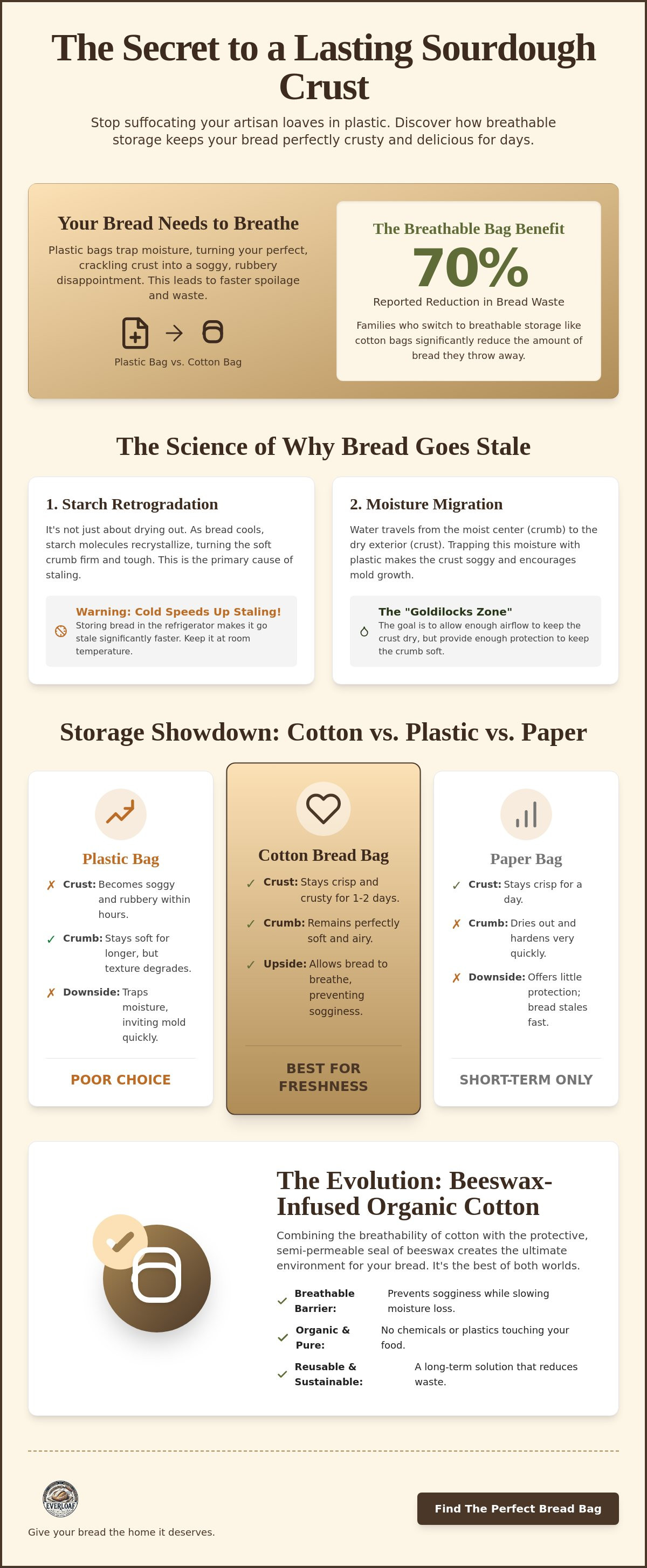
Starch molecules are like tiny springs. During the baking process, they absorb water and soften. As soon as the loaf leaves the oven, those molecules start to realign and crystallize. This process is called starch retrogradation. It is the primary cause of crumb firmness. Retrogradation is the fundamental reason your bread loses its pillowy texture and becomes tough. Many people think the fridge helps. They are wrong. Cold temperatures actually speed up this crystallization. Your bread will go stale significantly faster in the refrigerator than on the counter. Keep it at room temperature to protect the crumb from this rapid decline.
The Role of Moisture Migration
Water is always on the move. It travels from the soft, moist center of the loaf to the dry, crunchy crust. This is moisture migration. If you use a plastic bag, you create a swamp. The moisture hits the plastic and stays there. It turns your beautiful crust into a soggy, rubbery mess. Eventually, that trapped water invites mold to the party. Plastic is the enemy of the artisan loaf. You need a storage solution that manages this migration without killing the crunch. Ambient room temperature also plays a role. In a humid kitchen, moisture migration happens differently than in a dry one. You need a container that adapts to these shifts.
Many home bakers ask, do cotton bread bags keep bread fresh by stopping this moisture movement? The answer lies in finding the Goldilocks zone. You need enough airflow to keep the crust dry, but enough protection to keep the center soft. Airtight storage is a trap. It suffocates the bread and ruins the texture. A specialized beeswax cotton bread bag acts as a second skin. It provides a semi-permeable barrier that respects the bread's need to breathe. It slows down retrogradation while allowing the crust to remain a crust. Your bread worked hard to get that crunch. Don't let a bad bag take it away.
Do Cotton Bread Bags Actually Work? The Breathability Factor
Your sourdough is a masterpiece. It took days of feeding, proofing, and baking to achieve that perfect crumb. Don't throw all that effort away by tossing it into a plastic bag. Plastic is a moisture trap. It forces your bread to sit in its own evaporated water. This creates "sweating," which is a fast track to a soggy crust and a moldy interior. Your bread needs a partner, not a prison.
So, do cotton bread bags keep bread fresh? Yes. They work because they allow the bread to breathe naturally. Unlike synthetic materials or plastic films, cotton has a porous structure that facilitates consistent airflow. This airflow is the primary defense against mold. By letting excess moisture escape, you prevent the damp environment that spores love. However, plain cotton has its limits. While it is the superior choice for same-day or next-day consumption, it doesn't provide a total seal. It is a tool for the fresh-bread enthusiast who values texture over indefinite shelf life.
Airflow vs. Evaporation
Plastic bags are non-porous. They stop all evaporation; this sounds good in theory but fails in practice. When bread sits, it releases moisture. In plastic, this moisture has nowhere to go. It pools on the surface. Cotton weaves are different. They offer microscopic gaps that allow just enough vapor to pass through. This keeps the "Goldilocks" level of humidity. You maintain a crispy crust because the surface isn't being constantly re-hydrated by trapped steam. Synthetic fabrics often have tighter, less predictable pore sizes. Pure cotton provides a consistent, natural rhythm for your loaf.
Why Organic Cotton Matters
Your artisan sourdough is made of flour, water, and salt. It is pure. Your storage should be too. Organic cotton is free from the pesticides and harsh bleaches found in cheaper textiles. This is critical when the fabric is in direct contact with your food. High-quality cotton is also incredibly durable. You can wash it and reuse it for years. This makes it a sustainable alternative to the endless cycle of single-use plastic wraps. It is better for the planet and better for your kitchen. Families using these natural solutions have reported a 70% reduction in bread waste.
If you want to take your storage to the professional level, consider how a beeswax-infused cotton bag combines this breathability with a protective seal. It is the natural evolution of the traditional bread bag. Give your bread the respect it deserves. It is time to stop settling for rubbery crusts and start enjoying your bake exactly as it was intended.
Cotton vs. Plastic vs. Paper: The Storage Showdown
Your choice of storage is the final act of care for your loaf. Most bakers reach for whatever is in the kitchen drawer. This is a mistake. You are choosing the fate of your crust and crumb. To answer the question, do cotton bread bags keep bread fresh, we must look at how they stack up against the traditional enemies of quality: plastic and paper.
- Plastic: Keeps the crumb soft but destroys the crust. High risk of mold.
- Paper: Maintains some crust but wicks away moisture. Turns bread into a rock.
- Cotton: Preserves the crust integrity while slowing down the staling process.
The Plastic Trap
Plastic is a humidity chamber. It creates a micro-climate where moisture is trapped against the bread's surface. This is why your crust becomes rubbery and soft within hours. Worse, this stagnant, damp environment is a paradise for mold. You are essentially suffocating your bake. Many home enthusiasts ask, do cotton bread bags keep bread fresh better than these airtight options? The results are clear. Breathability wins over a sealed plastic trap every time. If you want to see the top-rated alternatives, explore our guide on The Best Bread Bags of 2026. We've tested the options so you don't have to settle for a soggy loaf.
The Paper Problem
Paper is a thief. It acts as a wick, pulling essential moisture out of the open-crumb structure of your sourdough. This is perfect for the short walk home from the local bakery. It is a disaster for long-term storage. By the next morning, your beautiful loaf will be dry and brittle. Paper offers zero protection against the air that accelerates staling. It is a temporary fix, not a storage solution. It treats your bread as a commodity rather than a craft.
The real winner of this showdown is a hybrid approach. Pure cotton is excellent for breathability, but it can let too much moisture escape over several days. This is why the evolution of bread storage has led us to beeswax-infused materials. A beeswax cotton bread bag provides the perfect balance. It seals in enough moisture to keep the crumb pillowy while allowing the crust to stay crisp. It is the sophisticated choice for the serious baker who demands excellence.
Professional Tips for Maximizing Freshness in Fabric Bags
Owning the right gear is only half the battle. You treat your starter with respect. You should treat your storage with the same level of care. Many bakers ask, do cotton bread bags keep bread fresh indefinitely? No. But when used correctly, they extend that "just-baked" window significantly. It's about technique. It's about respecting the loaf's inherent needs. If you follow a few simple rules, you can enjoy a perfect crust for days.
- Cool your bread completely on a wire rack before bagging.
- Store the bag in a cool, dry place away from direct sunlight.
- Use the "cut-side down" method to protect the exposed crumb.
- Keep the bag clean and dry between uses to prevent mold spores.
The Cooling Rule
Patience is a baker's greatest tool. Bagging warm bread is the fastest way to ruin your hard work. Internal steam must escape before storage. If you trap that heat, you create instant condensation inside the bag. This moisture settles on the crust and invites mold to grow. For a standard 500g boule, wait at least two to three hours. Larger artisanal loaves may need up to four hours to reach room temperature. If the bottom of the loaf feels even slightly warm, it isn't ready. Let it breathe on a rack until it's truly cold to the touch.
Slicing and Placement
How you cut your bread matters. Most people slice from one end. This leaves a massive surface area of the crumb exposed to the air. Instead, try slicing your loaf from the middle. When you're finished, press the two cut halves back together before sliding them into the bag. This creates a natural seal that keeps the interior soft. If you only have one half left, use the "cut-side down" method. Place the exposed crumb face-down on a wooden cutting board or a flat surface inside the bag. This physical barrier stops air from drying out the center while the cotton protects the crust. For more advanced techniques, read our guide on How to Store Homemade Bread to Maintain a Crispy Crust.
Location is everything. Don't leave your bag next to the dishwasher or on top of the refrigerator. These spots are too warm and humid. Heat accelerates the chemical staling process. Find a dark corner of your counter or a dedicated bread box. A stable, cool environment helps the fabric do its job. Your bread deserves a sanctuary. If you are ready to upgrade your kitchen setup, invest in a high-quality beeswax cotton bread bag today. It is the professional solution your sourdough has been waiting for.
Beyond Plain Cotton: Why Beeswax-Infused Organic Cotton Wins
Plain cotton is a massive upgrade from the plastic trap. We have established that breathability is the lifeblood of a good crust. However, for the serious home baker, plain fabric is only the first step. You likely still wonder, do cotton bread bags keep bread fresh long enough for a large, artisanal boule? If you want to push your freshness window from two days to over a week, you need a material that works harder. You need the evolution of the traditional bag.
Beeswax-infused organic cotton is the professional standard for a reason. It doesn't just hold the bread; it protects it. By combining the natural pore structure of cotton with the sealing power of wax, you create a semi-permeable barrier. This is the "Goldilocks" solution. It is the ultimate way to Keep Sourdough Fresh for 10 Days without sacrificing the integrity of your bake. Your bread deserves a storage solution that is as crafted as the loaf itself.
The Beeswax Advantage
Think of beeswax as a second skin. In nature, fruit has a peel to regulate moisture and prevent decay. Beeswax mimics this protective layer perfectly. It allows the bread to breathe, which prevents the "sweating" and mold we see in plastic. Yet, it also provides a gentle seal that plain cotton lacks. This seal slows down the evaporation of water from the crumb significantly. Pure beeswax also possesses natural antibacterial and antifungal properties. It creates a clean, protective environment that respects the biology of your sourdough. You get the crunch of a fresh loaf with the longevity of a preserved one. It stops the drying process without turning the crust into a rubbery mess.
The Everloaf Difference
We believe in quality without compromise. The beeswax Bread Bag is the result of deep respect for the baker's craft. We use 100% organic cotton as our foundation. This ensures your bread never touches harsh chemicals or synthetic residues. Each bag is infused with a specialized wax blend that remains flexible and durable for repeated use. Cleaning is simple. You just wipe it down or rinse it with cool water. It is a long-term, sustainable investment for your kitchen.
Our community of enthusiasts has moved beyond the guilt of single-use wraps. They have found a solution that actually works. When you ask, do cotton bread bags keep bread fresh, the answer becomes a resounding yes when beeswax enters the equation. It is time to treat your loaves with the reverence they deserve. Stop settling for "good enough" storage. Experience the professional standard and enjoy the perfect slice, even ten days after the bake. Your sourdough will thank you.
Give Your Sourdough the Home It Deserves
You've spent hours perfecting your craft. Don't let a plastic bag undo your hard work. We've seen how starch retrogradation and moisture migration work against your bake. You now know the answer to do cotton bread bags keep bread fresh is found in the balance of breathability and protection. While plain cotton is a great start, your artisan loaves need more. They need a semi-permeable seal that respects the science of staling.
It's time to stop settling for rubbery crusts. Upgrade your kitchen with the Beeswax Organic Cotton Bread Bag. Every bag is crafted from 100% organic cotton and infused with pure beeswax to deliver 10-day freshness. These tools were designed by culinary professionals from Lyon, France, to honor the tradition of great baking. Join a community that values quality and sustainability. Your next loaf is waiting for its perfect partner. Keep baking with confidence.
Frequently Asked Questions
Do cotton bread bags actually prevent mold?
Cotton bags are your best defense against mold because they prioritize airflow. Plastic traps moisture and creates a swampy environment where spores thrive. By letting your loaf breathe, you keep the surface dry and healthy. It's a simple change that makes a massive difference for the life of your sourdough.
How long does bread stay fresh in a cotton bag?
Artisan loaves stay at peak quality for two to three days in plain fabric. If you're asking do cotton bread bags keep bread fresh for longer, the answer lies in beeswax. Our specialized infused bags extend that window to ten days. This gives you plenty of time to enjoy every slice of your hard work without the rush.
Should I wash my cotton bread bag before using it?
You should always wash a new cotton bag before its first use. This removes any dust or residues from the manufacturing process. Use a fragrance-free detergent to ensure your bread doesn't absorb artificial scents. It is a vital step to protect the purity and flavor of your bake.
Can I use a cotton bag for store-bought sliced bread?
Cotton bags are not recommended for commercially produced, pre-sliced bread. These loaves are formulated with preservatives to stay soft specifically in plastic environments. Sliced bread has a massive surface area that dries out rapidly in breathable fabric. Stick to artisan boules and homemade sourdough for the best results in fabric storage.
Do linen bread bags work better than cotton ones?
Linen offers superior air circulation for baguettes, but cotton is the better choice for sourdough. Cotton has a denser weave that provides slightly better moisture retention for the crumb. This helps keep the interior pillowy while the crust stays crisp. It is the versatile workhorse most home bakers prefer for their daily loaves.
How do I clean a beeswax-infused cotton bread bag?
Clean your beeswax-infused bag with cool water and a drop of mild soap. Never use hot water because it will melt the protective wax seal. Wipe it down or rinse it gently, then let it air dry completely. It is a durable solution that stays fresh with very little effort from you.
Can I freeze bread inside a cotton bread bag?
You should not use a cotton bag for long-term freezing. Freezer burn occurs when air reaches the bread's surface and dries it out. For the freezer, you need an airtight seal to lock in every bit of moisture. Use your cotton bag for counter storage and a dedicated wrap for the freezer.
Why did my bread go hard even though it was in a fabric bag?
Bread often goes hard if you bag it while it is still warm. Internal steam must escape completely before storage or it will ruin the texture. Additionally, if your kitchen is very dry, plain cotton may allow too much evaporation. Do cotton bread bags keep bread fresh in dry climates? They work best when infused with beeswax to provide a more effective moisture barrier.


